walking upstream…
The Ink Spots

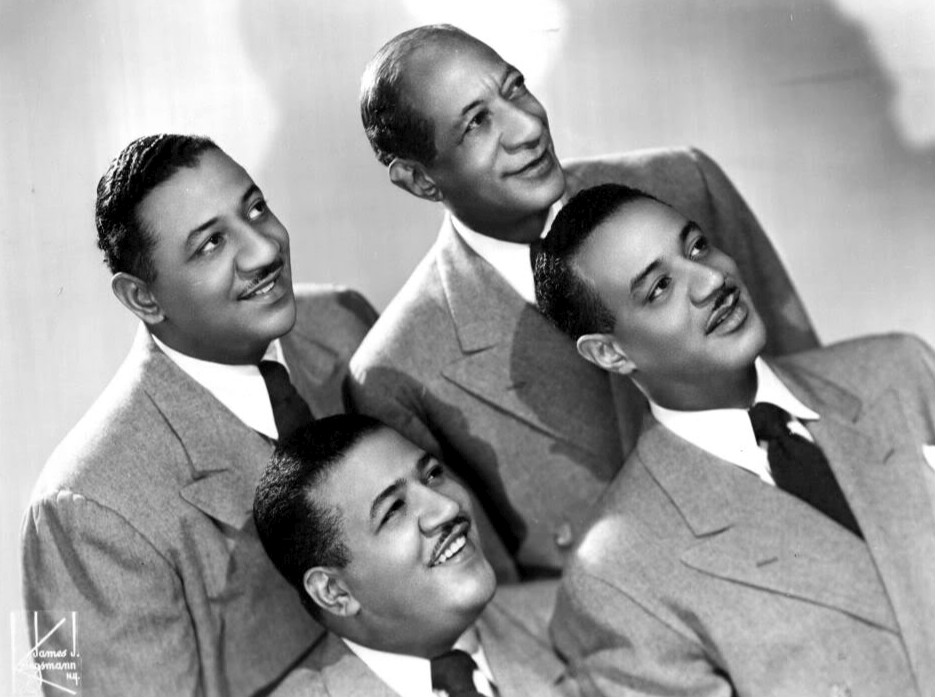
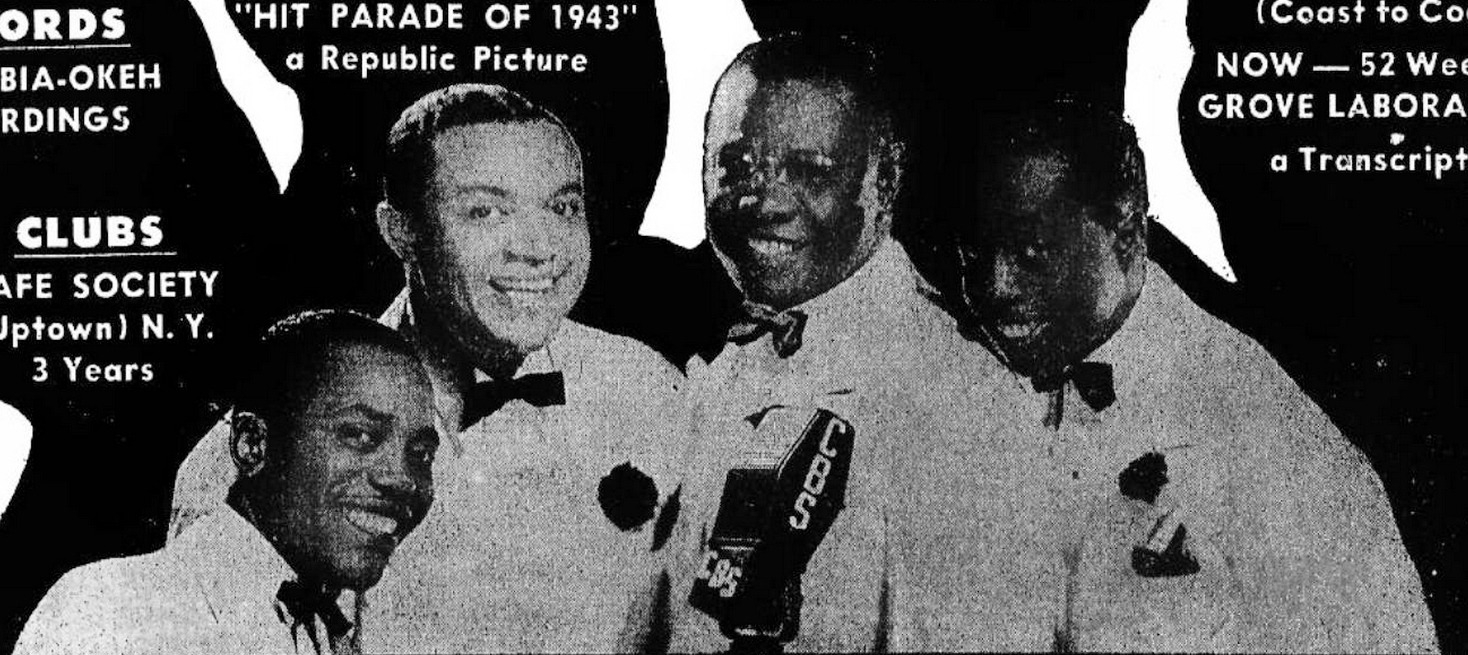
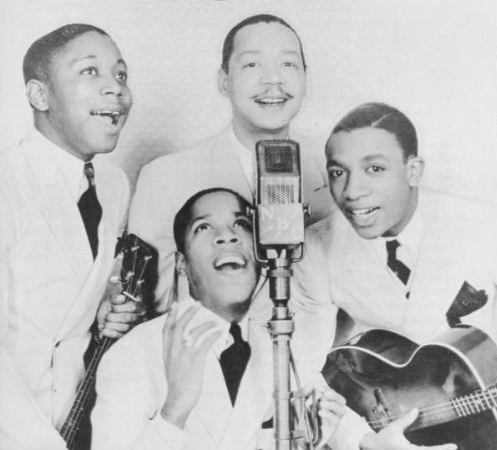 photo: unknown author · public domain ↗
The Ink Spots
sourcesThe Vocal Group Hall of Fame — The Ink Spots (formation; 'Top & Bottom' format; talking bass) · DORTI — The timeless legacy of the Ink Spots ('If I Didn't Care' breakthrough and sales) · The Ink Spots Errata — Four Riff Brothers on WLW Cincinnati (the Mills Brothers' vacated radio slot) · Remembering the Mills Brothers — 'people had sort of forgotten us' (the Ink Spots as Mills Brothers' successor) · The Vocal Group Hall of Fame — The Golden Gate Quartet ('a template that would later influence groups like the Ink Spots') · Carnegie Hall — Gospel quartet timeline (Cliff Givens' move from the Golden Gate Quartet to the Ink Spots)
In July 1934, four Cincinnati radio veterans calling themselves King, Jack and Jester walked into Harlem's Apollo Theater as the 4 Ink Spots, chasing a one-off booking. The name stuck; the sound took five more years to arrive. In 1939, Decca paired lead singer Bill Kenny's soaring, four-octave tenor against bass singer Hoppy Jones's spoken-word interludes on a leftover ballad called 'If I Didn't Care' — a format Kenny called 'Top and Bottom,' his voice pleading up top, Jones murmuring the same lines back down low. The single sold past nineteen million copies and became the template rhythm and blues, then doo-wop, would spend two decades filling in. Kenny had 'never had a voice lesson' in his life, he said — he built that tenor entirely by ear, off the radio.
the sound in question
1939
If I Didn't CareThe Ink Spots
walk the tributaries ↓
Morton Downey1920s–30s · Popular song / Irish tenor / Vaudeville
Bill Kenny's kin drew the line first: his twin brother Herb recalled that Morton Downey, the Irish-American radio tenor known as 'The Irish Nightingale,' was the singer young Bill 'listened to religiously on the radio.' Downey's trademark was a bright, creamy high tenor delivered with almost falsetto sweetness — the same bell-like clarity and diction Kenny brought to the Ink Spots' earliest sides, before the group settled on the format that made them famous. Music historians would later credit Kenny as rhythm and blues' 'godfather' of tenor singing; by his brother's account, the lesson started on the family radio, before there was an Ink Spots to sing for.
listen: upstream & heresource: Amsterdam News — Bill Kenny, 'Mr. Ink Spot,' a tenor like no other (Morton Downey influence; Kenny's own quotes) ↗
1931
Wabash MoonMorton Downey
1939
If I Didn't CareThe Ink Spots
listen forDowney's 'Wabash Moon' floats his tenor high and unhurried over a spare dance-band bed, every note landing soft-edged, almost sighed rather than sung — the vocal equivalent of a held breath. Cue up 'If I Didn't Care' and that same weightless high register is instantly recognizable in Kenny's opening lines, before Hoppy Jones's bass drops in underneath to speak the second verse. The debt isn't in the words; it's in how little effort either tenor seems to spend reaching a note most singers would strain for.
The Mills Brothers1930s–40s · Vocal jazz / Traditional pop / Barbershop
Before there were Ink Spots, there were the Four Riff Brothers — the Cincinnati quartet built around Hoppy Jones and Deek Watson — broadcasting on WLW radio in the very slot the Mills Brothers had just vacated. The Mills Brothers had already proven a black vocal harmony act could sell nationally and cross racial lines doing it; the Ink Spots inherited both the slot and the ambition. When the Ink Spots broke through in 1939, the Mills Brothers noticed exactly who'd taken their place: 'the Ink Spots were coming up, and people had sort of forgotten us,' they said of returning from a tour abroad to a changed landscape.
listen: upstream & heresource: Dan Gross — The Mills Brothers ↗
1931
Tiger RagThe Mills Brothers
1940
Java JiveThe Ink Spots
listen forThe Mills Brothers built 'Tiger Rag' entirely from voices doing an orchestra's job — trumpet, trombone, and rhythm section all faked with mouths and breath, at a tempo built for showing off. 'Java Jive' borrows that same appetite for a novelty tempo and vocal trickery, but swaps the instrument-mimicry for the Ink Spots' own device: Hoppy Jones's spoken-bass aside, dropped into the coffee-and-tea patter like a punchline. Both records treat the vocal group as a small orchestra; only the gimmick each uses to prove it has changed.
Golden Gate Quartet1930s–40s · Gospel / Jubilee quartet / A cappella
The clearest thread from gospel to the Ink Spots' sound has a name: Cliff Givens, who sang for the Golden Gate Quartet through World War II before leaving to join the Ink Spots outright. Music scholarship describes the Golden Gate Quartet's own achievement — welding barbershop's close harmony to jazz phrasing and blues rhythm into 'a template that would later influence groups like the Ink Spots' — as one of the clearest lines from the black gospel quartet tradition into secular pop. Givens didn't just carry a résumé across that line; he carried the arrangement instincts gospel had spent a decade refining.
listen: upstream & heresource: Music Rising (Tulane) — Black gospel (Golden Gate Quartet's gospel-quartet template for the Ink Spots) ↗
1937
Golden Gate Gospel TrainGolden Gate Quartet
1939
Address UnknownThe Ink Spots
listen for'Golden Gate Gospel Train' rides on the call and response between a lead voice pushing the story forward and the rest of the quartet chanting the answer underneath, the rhythm built entirely out of where each voice sits in the stack — high pushing, low grounding. 'Address Unknown' works a quieter version of the same idea: Kenny's tenor carries the verse, and Jones's bass doesn't harmonize so much as answer him, murmuring the next line back in a register the Golden Gate Quartet had already proven could carry as much feeling as the lead.