walking upstream…
Frankie Lymon and the Teenagers
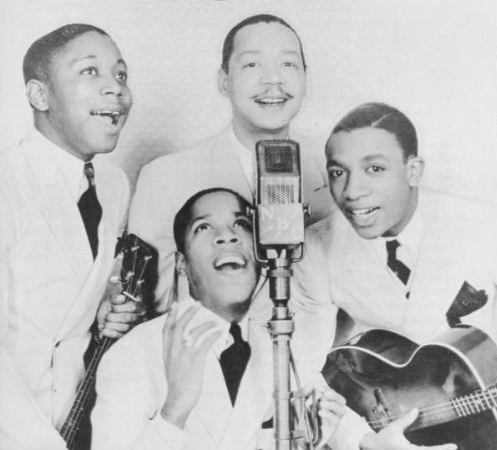


 photo: gee records · public domain ↗
Frankie Lymon and the Teenagers
sourcesVocal Group Hall of Fame — Frankie Lymon and the Teenagers (gospel roots via the Harlemaires; the group's formation) · Britannica — Frankie Lymon and the Teenagers ('Why Do Fools Fall in Love' chart run) · AllMusic — Bill Kenny and the Ink Spots (Kenny's tenor lineage to Frankie Lymon, and to Clyde McPhatter of the Dominoes) · SHSU — Doo-Wop · Wikipedia — Sixty Minute Man (Bill Brown's bass lead, not McPhatter's tenor, on the Dominoes' crossover hit)
Frankie Lymon was thirteen when a neighbor's cast-off love letters became a hit record. His group, then rehearsing under a streetlight at 165th and Amsterdam, took one of the letters and reworked it into "Why Do Fools Fall in Love" — five weeks atop the Billboard R&B chart in 1956, sung in a soprano that hadn't broken yet. He'd grown up singing gospel with his father's group, the Harlemaires, discipline he carried into doo-wop harmony almost as soon as he could read a lyric sheet. Motown's Berry Gordy later built much of the Jackson 5's sound on those Teenagers records, using the group as his working model for a kid-fronted vocal act. Lymon was gone from the charts within two years, but the format he pioneered — an unbroken voice fronting a harmony group — outlived him by decades.
the sound in question
1956
Why Do Fools Fall in LoveFrankie Lymon and the Teenagers
walk the tributaries ↓
The Ink Spots1930s–40s · Vocal harmony / Traditional pop
By the time Lymon was born, Bill Kenny had already spent a decade turning the Ink Spots' "top and bottom" formula — his own high tenor carrying the melody over a spoken bass verse — into the sound a whole generation of vocal groups would copy. AllMusic's account of that lineage is blunt about where it led: Kenny's tenor "paved the way for Sonny Til, Maithe Marshall, Frankie Lymon... and many others to follow." Lymon didn't just borrow that lead-voice arrangement; he pushed it further than Kenny's own range could reach, singing lead in a boy soprano the Ink Spots had only gestured toward.
listen: upstream & heresource: Smithsonian Magazine — Teen idol Frankie Lymon's tragic rise and fall (streetlight-corner discovery; Berry Gordy's Jackson 5 model; the Ink Spots-to-Lymon vocal lineage) ↗
1939
If I Didn't CareThe Ink Spots
1956
Why Do Fools Fall in LoveFrankie Lymon and the Teenagers
listen forOn "If I Didn't Care," Kenny's tenor floats alone over the group's hummed chords before the bass singer breaks in with a spoken aside — the architecture doo-wop would borrow for the next two decades. "Why Do Fools Fall in Love" keeps that same shape — tenor lead, murmured harmony underneath — but raises the stakes: Lymon's voice sits almost an octave above Kenny's, unbroken and bright where Kenny's was smooth and grown. Listen for the backing group dropping to a near-whisper each time Lymon's voice climbs, the same trick Kenny used to make his tenor sound like it was floating free of the band.
The Orioles1940s–50s · Doo-wop / R&B
Eight years before the Teenagers cut a note, the Orioles had already written the rulebook the group would follow: one academic account of the genre traces doo-wop itself to their 1948 single "It's Too Soon to Know," the record that taught "young doo-wop groups" to replicate "the formula employed a generation earlier" — wordless harmonizing stacked over bare guitar. The Teenagers grew up performing songs by groups the Orioles had directly shaped, absorbing that stripped-down blueprint before they ever wrote an original of their own.
listen: upstream & heresource: Wikipedia — It's Too Soon to Know (the Orioles' wordless harmony and bare-guitar template) ↗
1948
It's Too Soon to KnowThe Orioles
1956
I Want You to Be My GirlFrankie Lymon and the Teenagers
listen for"It's Too Soon to Know" strips everything back to Sonny Til's lead floating over hummed chords and a single acoustic guitar, no drums pushing the tempo — a group trusting harmony alone to carry a ballad. "I Want You to Be My Girl" keeps that same bare arrangement, a lead tenor riding over softly murmured backing vowels, but Lymon's group speeds the tempo and brightens the harmony until the same skeletal structure sounds like a playground chant instead of a slow dance.
Billy Ward and the Dominoes1950s · R&B / Doo-wop
Billy Ward built the Dominoes around Clyde McPhatter's gospel-trained tenor — a voice, as one account puts it, "steeped in gospel music" — and it was McPhatter who was largely responsible for the group's early success, before their 1951 single "Sixty Minute Man" crossed over completely: fourteen weeks at number one on the R&B chart, a million copies sold, lyrics blunter than gospel-rooted vocal groups had dared. The Teenagers were still schoolboys studying that record's proof that church-trained harmony and unapologetic R&B swagger weren't opposites, a lesson audible years later in how directly Lymon's own group would address the listener.
listen: upstream & here
1951
Sixty Minute ManBilly Ward and the Dominoes
1956
I'm Not a Juvenile DelinquentFrankie Lymon and the Teenagers
listen for"Sixty Minute Man" is built on direct address — Bill Brown's bass, not McPhatter's tenor, states its case in blunt, boastful lines while the group's close harmony answers behind him, gospel's call-and-response repurposed for a song that talks straight at the listener instead of narrating a scene. "I'm Not a Juvenile Delinquent" uses that same direct-address shape — Lymon's bright tenor pleads his case line by line while the Teenagers answer back — but flips the content from boast to defense, a teenager protesting his innocence in the same declarative voice a grown man once used to brag.