walking upstream…
Golden Gate Quartet
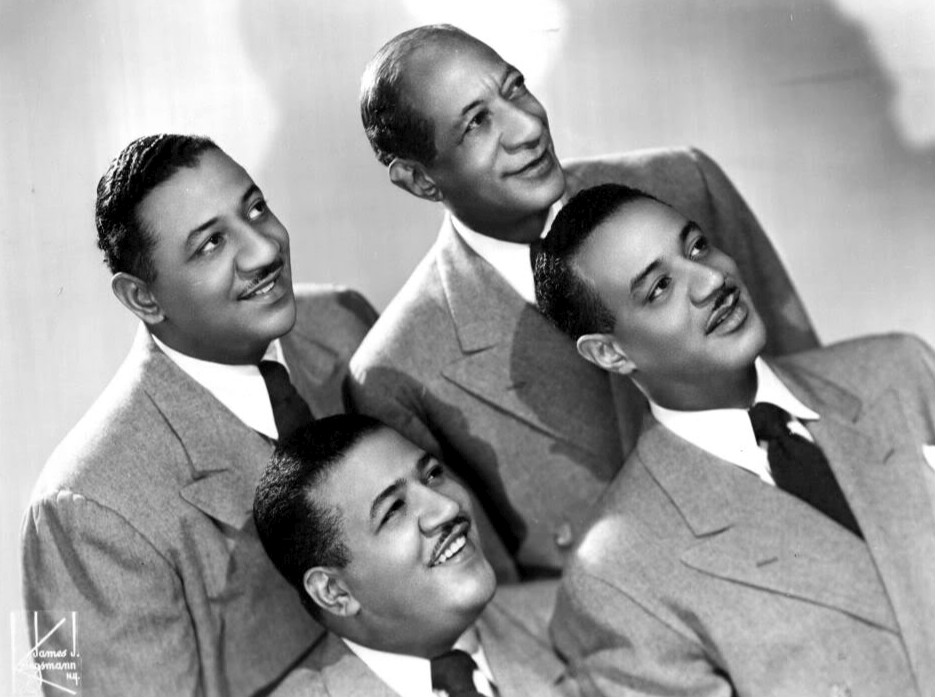
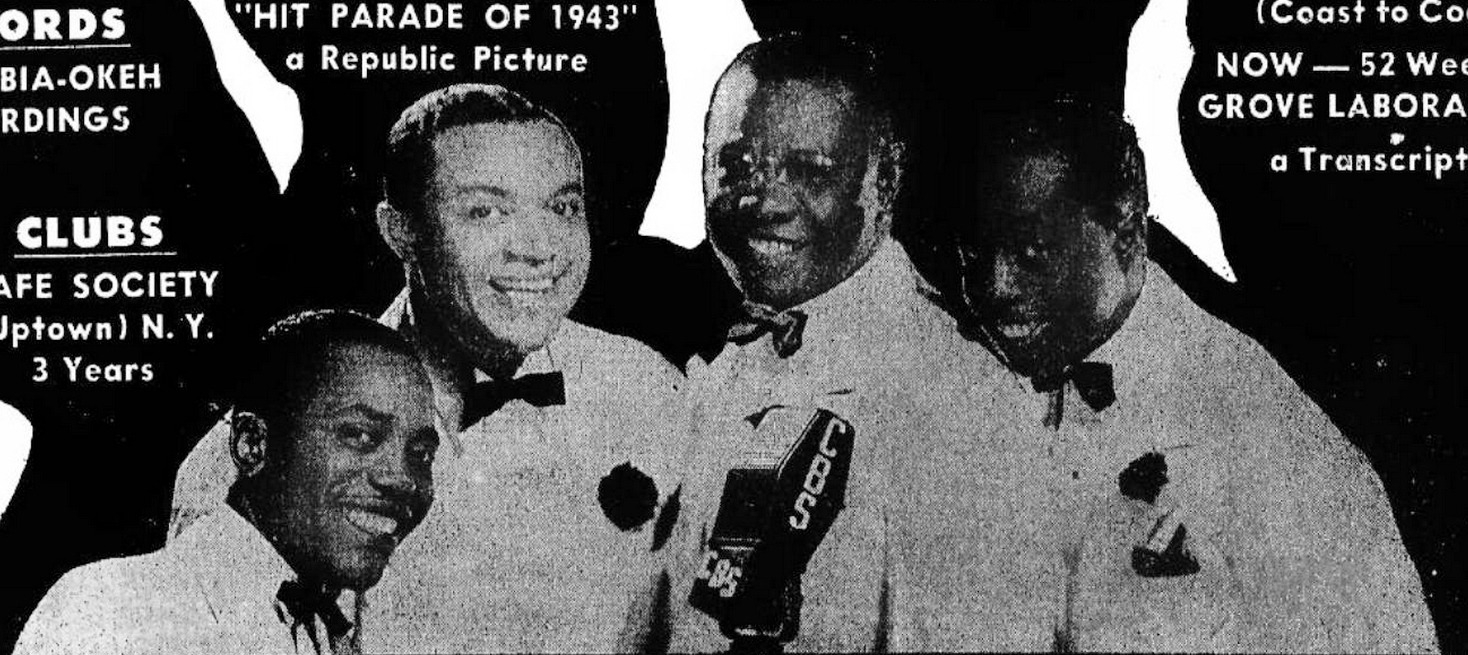 photo: unknown author · public domain ↗
Golden Gate Quartet
sourcesWikipedia — Golden Gate Quartet (group history, member timeline) · AllMusic — Norfolk Jazz & Jubilee Quartet biography by arwulf arwulf (naming the Gates as the group's followers) · clydewright.com — Golden Gate Quartet group history (A. C. Griffin's barbershop origin and retirement) · Vocal Group Hall of Fame — induction essay by Jay Warner (Mills Brothers influence on vocal-instrument imitation)
In 1931, in a barbershop in the Norfolk, Virginia suburb of Berkeley, two Booker T. Washington High School students practiced spirituals every day, drilled by the shop's owner, tenor A. C. Griffin, in how to arrange old hymns into structured, rhythmic songs. By August 1937, that training had sharpened into scat-driven, train-whistling close harmony: fourteen sides cut in two hours at a Charlotte hotel session, led by the single "Golden Gate Gospel Train," made the Golden Gate Quartet gospel's first crossover stars, playing Carnegie Hall and Franklin Roosevelt's inaugural gala within four years. Willie Johnson's narrated biblical ballads, Henry Owens' harmonic invention, and Orlandus Wilson's rhythm-driving bass turned a Sunday tradition into music sharp enough for a Manhattan nightclub stage — gospel that could swing without losing its testimony.
the sound in question
1937
Golden Gate Gospel TrainGolden Gate Quartet
walk the tributaries ↓
The Mills Brothers1930s–40s · Vocal jazz / Traditional pop / Barbershop
Orlandus Wilson said as much decades later, naming his source outright: "there is a group which I have always admired, which was the Mills Brothers... And the bass was doing what you called a pump bass during that period." He didn't borrow the material, he borrowed the mechanism — that syncopated, rhythm-carrying bass, a jazz-record trick from the late 1920s, applied to spirituals. "The bass singer was more or less like... the drummer who keeps the tempo for the group," Wilson explained, describing his own role in the Gates as a direct transplant from what he'd heard.
listen: upstream & heresource: NPR/Smithsonian — Wade In The Water Ep. 10 transcript (Orlandus Wilson on the Mills Brothers and the pump bass; Bernice Johnson Reagon narration on the Tidewater tradition) ↗
1932
Nobody's SweetheartThe Mills Brothers
1946
ShadrackGolden Gate Quartet
listen forCue up the Mills Brothers' "Nobody's Sweetheart" first: under the close harmony, one voice pumps out a bouncing, syncopated bass line instead of a straight root note, standing in for a stand-up bass. Then play the Gates' "Shadrack" — Wilson's bass does the identical job, walking under the other three voices' call-and-response and pushing the beat forward rather than just anchoring it. It's the same transplant he named for himself: a jazz record's rhythm section, sung.
Norfolk Jubilee Quartet1920s · Gospel / Jubilee quartet
The Gates didn't invent Tidewater's jubilee-quartet sound; they inherited it. A decade before two Norfolk teenagers found A. C. Griffin's barbershop, the Norfolk Jubilee Quartet was already touring the region behind bass singer Len Williams, who, per critic arwulf arwulf, "anchored each song with scat-like rhythmic patterns in the bass clef." AllMusic calls the group simply "the best known and most influential... prior to the appearance of their best-known followers the Golden Gate Quartet." Radio historian Bernice Johnson Reagon's own documentary narration is blunter still about the lineage: the Norfolk group's "sound actually predates the Gates."
listen: upstream & here
This Old World Is In Bad ConditionNorfolk Jubilee Quartet
1939
This World Is in a Bad ConditionGolden Gate Quartet
listen forBoth groups recorded a version of the same spiritual theme a decade apart. The Norfolk Jubilee Quartet's "This Old World Is In Bad Condition" moves in straighter, more measured close harmony, the bass filling space rather than driving it. On the Gates' 1939 recording of the same idea, "This World Is in a Bad Condition," that harmony gets sharpened into crisper, more syncopated timing — the same Tidewater bones, dressed in a faster, more percussive arrangement.
A. C. Griffin1930s · Gospel / Barbershop
Griffin never made a record — he cut hair. But before Willie Johnson narrated a single "preaching ballad," Griffin taught him and Henry Owens the mechanics behind it. Gospel historian Kathryn Kemp writes that the Norfolk barbershop owner "taught them how to arrange old spirituals into songs with chords and tempo," drilling the two teenage protégés daily alongside older singer Robert "Peg" Ford. By 1935, more certain of his haircutting business than a singing career, Griffin retired from the quartet he had personally built and trained.
listen: upstream & heresource: Library of Congress, National Recording Preservation Board — Kathryn Kemp essay on "John the Revelator" (A. C. Griffin's barbershop tutelage; Mills Brothers comparison) ↗
No known recordingA. C. Griffin
1938
John the RevelatorGolden Gate Quartet
listen forThere's no recording to hold up against this one — Griffin left the group three years before its first session. Listen instead for the craft he installed. On "John the Revelator," Willie Johnson narrates the biblical verse in loose, just-off-the-beat phrasing while the other three voices lock into a fixed, cycling harmony underneath him, built on a steady chord progression and a set tempo — the two building blocks a barbershop tenor drilled into a teenage Johnson years before this recording existed.