walking upstream…
Swan Silvertones
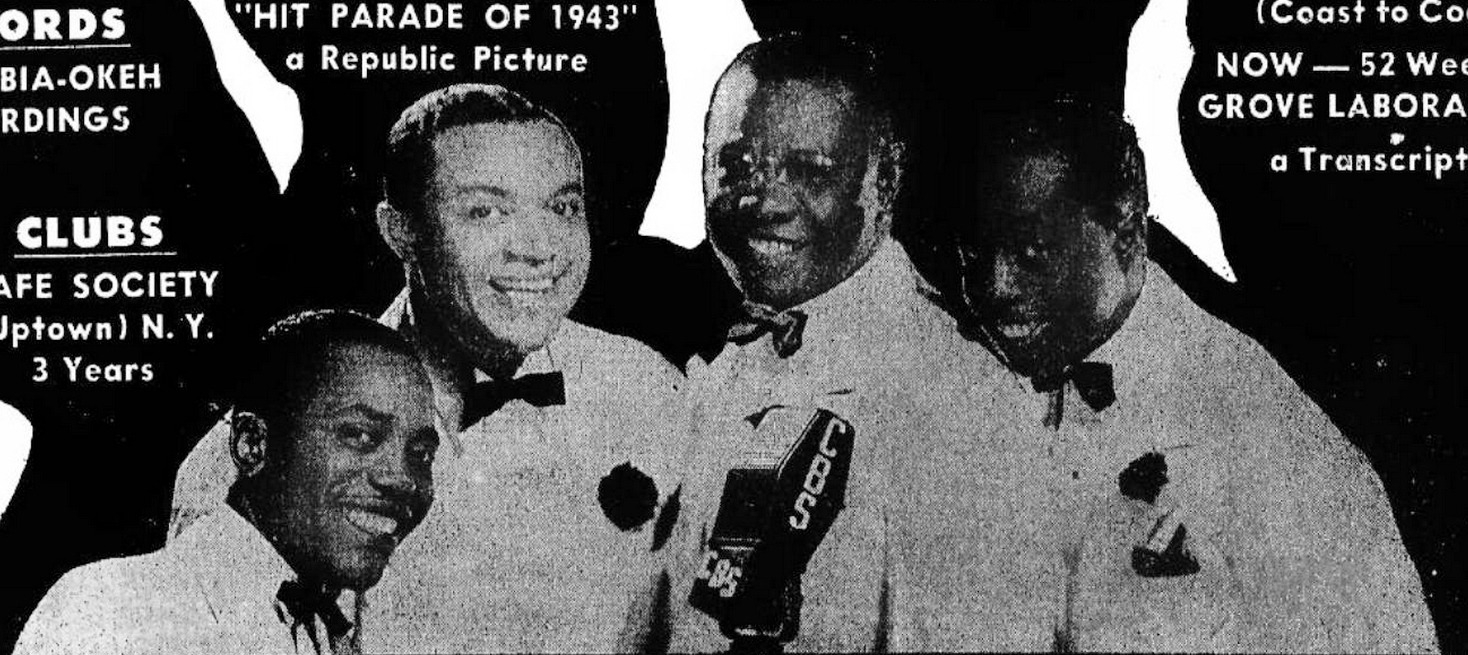
Swan Silvertones
Formed in 1938 by West Virginia coal miner Claude Jeter as the Four Harmony Kings, the Swan Silvertones became one of postwar gospel's defining quartets on the strength of Jeter's soaring, seemingly effortless falsetto lead weaving improvised runs over the group's close, driving harmony. Their 1959 recording of 'Mary Don't You Weep' — capped by Jeter's ad-libbed 'bridge over deep water' line — became one of gospel's most quietly influential singles, reaching directly into the pop mainstream a decade later through Paul Simon.
the sound in question
1959
Mary Don't You WeepSwan Silvertones
walk the tributaries ↓
Golden Gate Quartet1930s–40s · Gospel / Jubilee quartet / A cappella
The same West Virginia Encyclopedia account names the Golden Gate Quartet — the era's biggest jubilee act, already a national radio draw by the late 1930s — as a direct inspiration for Jeter, whose young Swan Silvertones measured their own showmanship and harmony against the older group's standard.
listen: upstream & heresource: e-WV ↗
1937
Golden Gate Gospel TrainGolden Gate Quartet
1953
I'm Coming HomeSwan Silvertones
listen forThe Golden Gate Quartet locks four voices into a rapid-fire, syncopated jubilee shuffle, imitating a train whistle with nothing but their own voices; the Swan Silvertones borrow that same tight, driving blend and vocal-percussion energy on their own up-tempo material before Jeter's falsetto lead pulls the sound in a more soaring, solo-focused direction.
Norfolk Jubilee Quartet1920s · Gospel / Jubilee quartet
A West Virginia Encyclopedia account of Jeter's formative influences names the Norfolk Jubilees directly among the acts he drew from; the rhythmic, syncopated bass-driven quartet blueprint the Tidewater, Virginia group helped establish (and passed on to the Golden Gate Quartet) is the foundation the Swan Silvertones built their own sound on top of.
listen: upstream & here
1925
Get On Board, Little ChildrenNorfolk Jubilee Quartet
1953
Trouble In My WaySwan Silvertones
listen forListen for the Norfolk group's rapid, percussive bass-and-rhythm vocal interplay churning under the lead — a jazz-inflected propulsion the Swan Silvertones inherit wholesale on their own up-tempo numbers, even as Jeter's floating falsetto pulls the lead voice somewhere the earlier group never went.
The Charioteers1940s · Gospel / Pop / Vocal harmony
The same account of Jeter's early influences names Billy Williams, the honeyed tenor lead of the Charioteers, alongside the Golden Gate Quartet and the Norfolk Jubilees; Williams' smooth, pop-crossover lead singing over close harmony offered Jeter a model for carrying a gospel quartet's sound toward a wider mainstream audience — the same crossover the Swan Silvertones would later make, with Paul Simon's help.
listen: upstream & heresource: e-WV ↗
1939
Swing Low, Sweet ChariotThe Charioteers
1962
Saviour Pass Me NotSwan Silvertones
listen forWilliams floats a warm, unhurried tenor lead over the Charioteers' soft close harmony on their namesake spiritual; Jeter's own lead on the Swan Silvertones' calmer material carries that same relaxed, pop-adjacent smoothness before he opens up into the wilder falsetto runs that were entirely his own.