walking upstream…
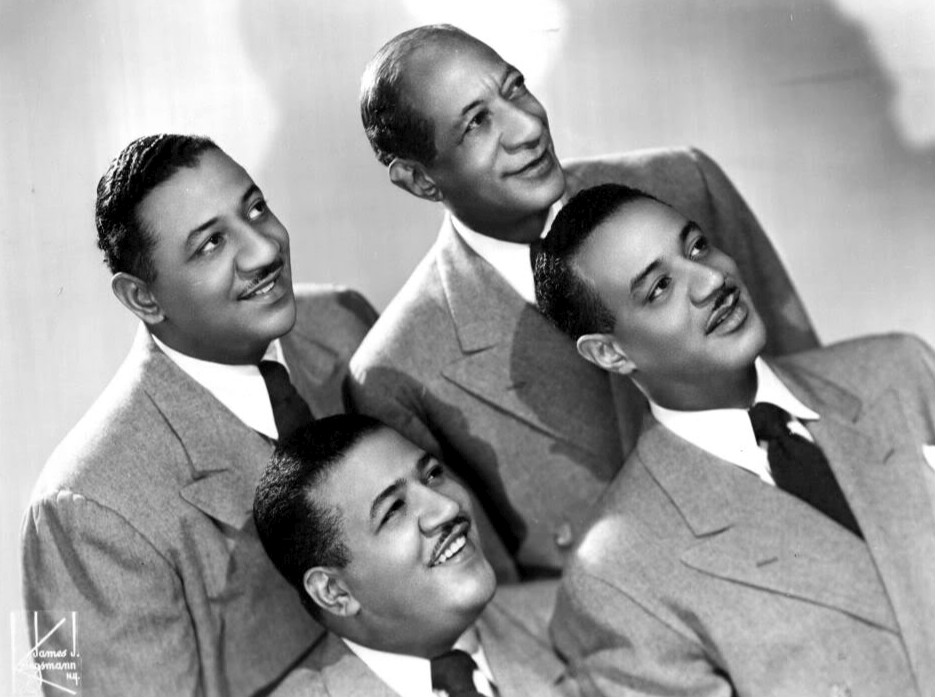
The Mills Brothers


sourcesDayton Daily News — 'The most famous recording stars of their time' · AllMusic — Artist Biography by John Bush (Ellington/Bubber Miley parallel, Dixieland framing) · The Vocal Group Hall of Fame — The Mills Brothers (Caravan session, Armstrong collaboration) · 2 or 3 lines blog — Mills Brothers 'Caravan' (1938) (guitar-only instrumentation detail) · Eco-Jazz — The Mills Brothers · BlackPast — The Mills Brothers (1925-1982) (early street-corner and church performances)
In Piqua, Ohio, sometime around 1928, Harry Mills stepped onto the stage of an amateur contest and realized he'd lost his kazoo. He cupped a hand over his mouth and faked a trumpet instead — and his brothers, sons of a barber who led his own barbershop quartet, built an act around the trick: John on imitation tuba, Herbert on second trumpet, Donald on trombone. Word of the four-voice "band" reached Duke Ellington's touring orchestra in Cincinnati, and within years the brothers were a Brunswick and Decca sensation, the first Black act with a national network radio show, four voices and one real guitar convincing millions they were hearing horns. "Paper Doll" made them the biggest-selling vocal group in the country in 1943. Their achievement was less a sound than a persuasion: making an audience believe.
the sound in question
1943
Paper DollThe Mills Brothers
walk the tributaries ↓
Louis Armstrong1920s–30s · Jazz
By the time Armstrong and the brothers cut their first Decca session together in April 1937, the group's hornlike voices already had a model to draw on in Armstrong's own big-band records. Ricky Riccardi, the Louis Armstrong House Museum's research director, laid out the debt precisely: behind Armstrong's vocal on "Darling Nelly Gray," "the Mills hum on the first and third beats of every measure, a technique often employed by the horns on some of Armstrong's earlier big band recordings — think 'Stardust' behind his trumpet." The Vocal Group Hall of Fame called what came next — imitating trumpet directly behind Armstrong's own live horn — "a gutsy move."
listen: upstream & heresource: Ricky Riccardi / Louis Armstrong House Museum — 75 Years of Louis Armstrong and the Mills Brothers's First Session ↗
1931
StardustLouis Armstrong
1937
Darling Nelly GrayThe Mills Brothers
listen forOn "Stardust" (1931), the horns behind Armstrong's trumpet punctuate softly on the off-beats, staying out of his way while framing the line. Listen to "Darling Nelly Gray" (1937) for the same restraint transferred to voices: the Mills brothers hum in short, breathy stabs under Armstrong's vocal, echoing that horn-section punctuation almost note for note before their own hornlike break answers his trumpet.
Duke Ellington1930s–40s · Jazz / Big band
The brothers were still a Cincinnati radio act when Ellington's touring orchestra happened to be playing the same city and caught their broadcast; he and his manager, a hometown newspaper later recounted, "moved to make some calls and sign them to a contract" — the push that took four boys from a barbershop in Piqua to a New York record deal. Years later they returned the favor directly: a full vocal-and-guitar recreation of "Caravan," one of Ellington's signature pieces, sung by nobody. A blogger who tracked down the session put it plainly: "the only musical instrument on the recording is a guitar."
listen: upstream & here
1937
CaravanDuke Ellington
1938
CaravanThe Mills Brothers
listen forEllington's 1937 big-band "Caravan" builds its exoticism from real horns circling a hypnotic minor vamp, Juan Tizol's valve trombone snaking through muted brass. The Mills Brothers' 1938 version keeps that vamp and that mood but replaces every horn with a throat — no lyric, just four men breathing trumpet and trombone lines in close harmony over a single guitar. Nothing plays but voices; everything else about the arrangement, down to the vamp's slink, survives intact.
Original Dixieland Jass Band1910s · Dixieland / Jazz
The Mills Brothers' first Brunswick record and breakout hit, cut in late 1931, was a cover: "Tiger Rag," the tune the Original Dixieland Jass Band had ridden to jazz's first mainstream hit in 1917. A student research blog on the group's early career called it exactly that — "a cover of the Original Dixieland Jass Band 'Tiger Rag'" that "became a best-seller and a no. 1 hit on the charts nationwide." AllMusic's biographer went further, writing that on records like this one the brothers "sounded closer to a hot Dixieland combo than a vocal group" — the imitation project measured against the band that defined the sound.
listen: upstream & here
1918
Tiger RagOriginal Dixieland Jass Band
1931
Tiger RagThe Mills Brothers
listen forThe Original Dixieland Jass Band's 1918 "Tiger Rag" is a five-piece ensemble racing through the tune's famous "hold that tiger" strain, clarinet, cornet, and trombone trading the collective, tumbling energy that defined early jazz. The Mills Brothers' 1931 cover chases that same speed and density with four voices and one guitar, each brother taking a horn's part in the ensemble — the tune, the tempo, and the crowded, overlapping texture all carried over; only the instruments have changed.