walking upstream…
Lefty Frizzell


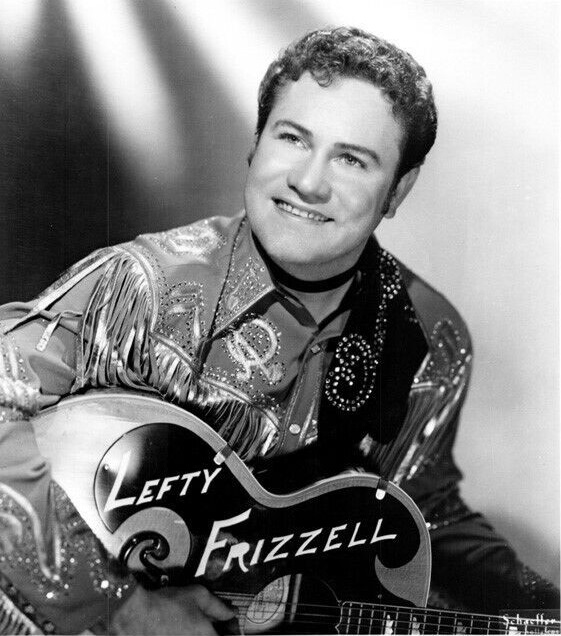 photo: columbia records · public domain ↗
Lefty Frizzell
William Orville Frizzell was born March 31, 1928, in Corsicana, Texas, trailing his oil-driller father through Texas, Oklahoma, and Arkansas boomtowns. At six, in El Dorado, Arkansas, he pressed his ear to the victrola's speaker gates and wore out his father's Jimmie Rodgers 78s. He earned the nickname 'Lefty' from a schoolyard fight, not a boxing ring, and was singing on the radio by twelve. Working Texas honky-tonks through the late 1940s, he absorbed Rodgers, Ernest Tubb, and Ted Daffan and fused them into something new: long, bent syllables where the older singers cut clean. 'If You've Got the Money, I've Got the Time' made him a star in 1950; four Top 10 hits followed within a year. Rock and roll stalled his chart run after 1952, but the phrasing he invented outlived it, resurfacing in nearly every honky-tonk singer who followed.
the sound in question
1959
Long Black VeilLefty Frizzell
walk the tributaries ↓
Jimmie Rodgers1920s–30s · Country / Old-time / Blues
Frizzell's father traded a milk cow for an old victrola when the boy was about six, and out of it came Jimmie Rodgers' 78s. "We had an old victrola that my Dad had traded for a milk cow when I was about six," he remembered, "and I remember some old thick records of Jimmie Rodgers. It was an inspiration." Rodgers had already died by then — the singer who taught Frizzell to sing was a voice on shellac, pressed close against his ear in El Dorado, Arkansas. Frizzell later built an entire tribute album around the record he'd worn thin as a boy.
listen: upstream & heresource: Encyclopedia.com — Frizzell, Lefty (childhood victrola/Jimmie Rodgers quote; Daffan and Tubb named as stylistic influences) ↗
1927
Blue Yodel No. 1 (T for Texas)Jimmie Rodgers
1950
If You've Got the Money, I've Got the TimeLefty Frizzell
listen forRodgers built "T for Texas" around a blue yodel — a plain, storytelling verse that breaks open into a high, swooping falsetto at the end of each line, the vocal equivalent of a shrug. Frizzell keeps that same blues-based phrasing but trades the yodel break for something subtler: on "If You've Got the Money," he holds and bends single syllables — "time," "mine" — sliding through two or three notes where Rodgers would land on one, stretching the line until it sounds like the words themselves are reluctant to end.
Ernest Tubb1940s · Honky-tonk / Country
By 1949, Ernest Tubb had spent most of a decade as one of country music's most popular singers, ever since "Walking the Floor Over You" helped invent the honky-tonk sound in 1941. Then word started moving through Dallas about a kid working a club called the Ace — critic Michael Corcoran writes that "there was a new singer at the Ace who could sing all over that Ernest Tubb stuff," the compliment carrying its own edge: Frizzell hadn't copied Tubb's plain, straight-ahead delivery so much as taken it somewhere Tubb's flatter voice never could.
listen: upstream & heresource: Michael Corcoran — Lefty Frizzell ↗
1941
Walking the Floor Over YouErnest Tubb
1951
I Want to Be with You AlwaysLefty Frizzell
listen forTubb sings "Walking the Floor Over You" almost conversationally — plain, level, unadorned, the famous electric-guitar lick doing more emotional work than his voice does. "I Want to Be with You Always" keeps Tubb's same steady, story-first delivery and honky-tonk backing, but Frizzell can't leave a vowel alone: he curls and stretches "always" across several notes where Tubb would sing it flat and move on, turning the older singer's plainspoken devotion into something that sounds like it's still deciding how to end.
Ted Daffan1940s · Honky-tonk / Country
By the time Frizzell was working the honky-tonk circuit through Texas, New Mexico, and Arkansas in the late 1940s, Ted Daffan was already one of its biggest songwriters — the man behind "Born to Lose," a million-selling hit for his band, the Texans, that turned barroom heartbreak into a polished, string-band standard. Biographers name Daffan, alongside Ernest Tubb, as one of the two artists (besides Rodgers) who shaped Frizzell's developing honky-tonk sound — the craft of building a hit around one plainly stated ache, dressed in a Western swing arrangement Frizzell would then bend to his own vocal style.
listen: upstream & heresource: Wikipedia — Ted Daffan ('Born to Lose' composition, sales, and gold disc) ↗
1943
Born to LoseTed Daffan
1951
Always Late (With Your Kisses)Lefty Frizzell
listen forDaffan's "Born to Lose" sets its ache at a formal distance — steel guitar sighing behind a vocal that stays level and unhurried, the singer narrating heartbreak more than feeling it aloud. "Always Late (With Your Kisses)" borrows that same unhurried, string-band shuffle but pulls the vocal in close: Frizzell leans into vowels — "late," "kisses" — sliding and doubling back on a single syllable the way Daffan's phrasing never does, turning Daffan's polite lament into something rawer and more physically felt.