walking upstream…
Nusrat Fateh Ali Khan
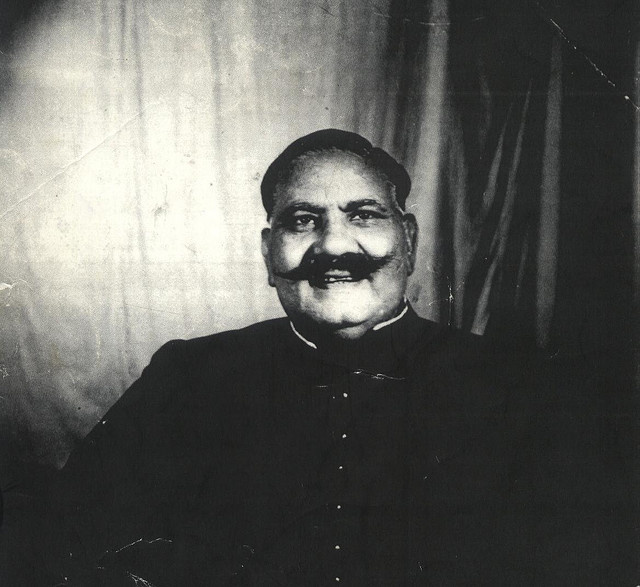
 photo: thomas rome · cc by 2.0 ↗
Nusrat Fateh Ali Khan
sourcesThe New York Review of Books — Our Nusrat (family background, training timeline, classical-qawwali synthesis) · Youlin Magazine — Nusrat Fateh Ali Khan · Wikipedia — Nusrat Fateh Ali Khan (biography, family, gharana lineage) · Wikipedia — Fateh Ali Khan (Qawwali singer) (father's biography, Iqbal tribute, Na To Butkade Ki Talab Mujhe)
In 1964, a sixteen-year-old schoolboy sang in public for the first time — at his own father's chehlum, the Muslim mourning gathering held forty days after a death. His father, Fateh Ali Khan, had spent years pushing Nusrat toward medicine or engineering; qawwali carried too little social status in Lyallpur (now Faisalabad), Pakistan, and he relented only when the boy's aptitude for tabla and voice became undeniable. That premature debut made Nusrat the presumptive heir to a Sufi devotional lineage that traced, in family telling, six centuries back to the poet Amir Khusrau. His uncles, Mubarak Ali Khan and then Salamat Ali Khan, finished the education his father had begun. By the 1990s he had turned that inherited discipline into a marathon-length, classically muscled style loud enough to reach Peter Gabriel's Real World label — qawwali exported without losing its devotional center.
the sound in question
1992
Dam Mast QalandarNusrat Fateh Ali Khan
walk the tributaries ↓
Fateh Ali Khan1940s–1960s · Qawwali / Sufi / Hindustani classical
The poet Muhammad Iqbal once told Nusrat's father directly, "I was restricted to schools and colleges only. You, Ustad Fateh Ali Khan, have spread my poetry through India" — proof of a reputation Nusrat inherited before he'd sung a note. Fateh Ali Khan wanted a doctor or an engineer instead; qawwali carried too little status in 1950s Lyallpur, and he relented only when his son's aptitude for tabla and voice became undeniable. What survived him was doctrine: "we place great value on classical learning in the beginning," Nusrat said years later, describing a gharana that never let qawwals merely "memorize the texts."
listen: upstream & heresource: Outlook India — 1988 interview with Nusrat Fateh Ali Khan (artist's own testimony on gharana, training, and the 1965 Jashn-e-Baharan festival) ↗
1958
Na To Butkade Ki Talab MujheFateh Ali Khan
Na To Butkade Ki TalabNusrat Fateh Ali Khan
listen forFateh Ali Khan and his brother Mubarak recorded "Na To Butkade Ki Talab Mujhe" live in 1958, its opening lines moving in long, unhurried phrases before the harmonium ever pushes the tempo — the classical patience Iqbal praised, audible before the qawwali proper begins. Nusrat's own recording of the same song keeps that opening intact, then breaks it open: the identical phrase now stretches across minutes of rapid sargam runs, tabla driving harder underneath him, before the responding chorus even enters. The discipline is his father's; the scale it's pushed to is entirely his own.
Mubarak Ali Khan1950s–60s · Qawwali / Sufi devotional music
When Fateh Ali Khan died, it was his brother who completed the job. "My father's brother took me into the qawwali ensemble," Nusrat said of 1964, "and started giving me formal education in qawwali." For seven years, until Mubarak Ali Khan's own death in 1971, Nusrat sang lead in a party still billed under his uncle's name, drilled to the same standard — sessions Nusrat remembered running "10 hours every day" in the family's telling. Only after 1971 did the group become simply Nusrat Fateh Ali Khan & Party, the apprenticeship finally over.
listen: upstream & heresource: Wikipedia — Nusrat Fateh Ali Khan & Party (Mubarak Ali Khan's co-leadership, 1964–1971) ↗
1958
Na To Butkade Ki Talab MujheMubarak Ali Khan
1990
Tum Ek Gorakh Dhanda HoNusrat Fateh Ali Khan
listen forThat 1958 recording of "Na To Butkade Ki Talab Mujhe" is Mubarak Ali Khan's voice as much as his brother's — listen for how the two trade the same line back and forth, one completing the other's phrase without a break in tempo. Nusrat's 1990 recording of "Tum Ek Gorakh Dhanda Ho" keeps that call-and-response instinct but folds it into a single voice: he answers his own plain opening line with a burst of ornamented sargam, then drops back to plain delivery again, the two-way conversation Mubarak once shared with his brother now running inside one performer.
Bade Ghulam Ali Khan1940s–1950s · Hindustani classical / Khayal / Thumri
Nusrat's own introduction to classical music came through Bade Ghulam Ali Khan's son: as a boy he played tabla for Munawar Ali Khan when the singer visited Pakistan from India, an apprenticeship the Youlin Magazine profile credits with giving him "incredible command over the subcontinental tradition of composition based on an intricate arithmetical system of Taal." The connection paid off publicly in 1965, when Nusrat made his debut at Radio Pakistan's Jashn-e-Baharan festival: among the masters he later said "gave me encouragement" that day was Ustad Bare Ghulam Ali Khan himself. Nusrat spent the rest of his career absorbing that world's sargam runs and tarana forms into qawwali.
listen: upstream & heresource: Wikipedia — Bade Ghulam Ali Khan (biography, Kasur Patiala Gharana, classical style) ↗
Classical vocal recital (raag Malkauns / thumri)Bade Ghulam Ali Khan
1990
Mustt MusttNusrat Fateh Ali Khan
listen forBade Ghulam Ali Khan's classical vocal recordings move in unhurried arcs, each phrase of a raga worked and reworked before he lets it resolve — technical control kept just inside the bounds of a listener's patience. Nusrat and Michael Brook's 1990 "Mustt Mustt" takes that same slow-build control and drops it into a rock rhythm section: Nusrat's opening vocal line still unfolds in that patient, classical arc, but the tabla-and-loop groove underneath pushes toward a hook a khayal singer would never have needed.