walking upstream…
A.R. Rahman


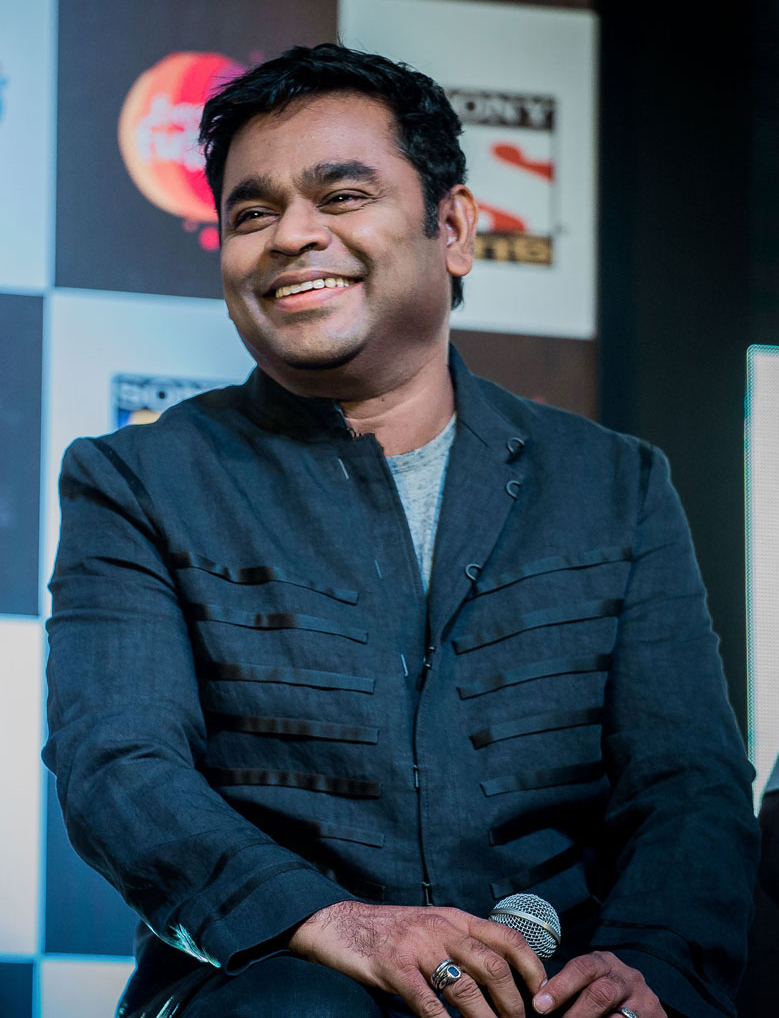 photo: sriram narasimhan · cc by-sa 4.0 ↗
A.R. Rahman
Born A.S. Dileep Kumar in Madras in 1967, A.R. Rahman was the son of film composer and conductor R.K. Shekhar, and after his father's early death he supported his family as a session keyboard player, spending years in Ilaiyaraaja's film orchestra. Trained in Carnatic, Hindustani and Western classical music and drawn to Sufi devotion after his family's conversion to Islam, he fused those traditions with synthesizers and electronic production when his 1992 debut score for Roja transformed Indian film music. His work on Slumdog Millionaire (2008) brought him two Academy Awards and made him the most globally recognized figure in Indian music.
the sound in question
2008
Jai HoA.R. Rahman
walk the tributaries ↓
Ilaiyaraaja1980s–1990s · Indian film music / Carnatic fusion / Symphonic
Before he was a composer, Rahman spent years as a keyboard player in Ilaiyaraaja's film orchestra, absorbing the older man's method of pouring lush string writing and countermelody into popular film song; that architectural, orchestral approach to arrangement runs straight through Rahman's own scores.
listen: upstream & here
1991
Rakkamma Kaiya ThattuIlaiyaraaja
1995
Bombay ThemeA.R. Rahman
listen forPut on Ilaiyaraaja's sweeping 'Rakkamma Kaiya Thattu' and then Rahman's 'Bombay Theme' — hear how both let a simple folk-tinged melody bloom into wide, cinematic orchestration where the strings carry as much feeling as the tune.
Nusrat Fateh Ali Khan1980s–90s · Qawwali / Sufi devotional music / World music
Rahman has been described as steeped in the qawwali style of Nusrat Fateh Ali Khan, and his Sufi-flavoured songs borrow the qawwali's devotional build — a slow invocation, hand-clap propulsion and rising, ecstatic repetition — for the screen.
listen: upstream & here
Allah HooNusrat Fateh Ali Khan
2008
Khwaja Mere KhwajaA.R. Rahman
listen forPlay Nusrat's 'Allah Hoo' and then Rahman's 'Khwaja Mere Khwaja': listen for the same unhurried Sufi ascent, the group refrain and the way a single sacred phrase is turned over and over until it lifts.
R.D. Burman1970s · Hindi film music / Filmi / Rock
Rahman grew up on the film music of the composers before him, R.D. Burman among the most adventurous, and he shares Burman's appetite for splicing Western pop, funk and rhythmic novelty into Indian film song rather than treating them as separate worlds.
listen: upstream & here
1971
Dum Maro DumR.D. Burman
1995
Humma HummaA.R. Rahman
listen forFollow Burman's brassy, groove-driven 'Dum Maro Dum' with Rahman's 'Humma Humma' — both ride a swaggering imported-pop rhythm section and a chant-like hook, Indian film song wearing Western dance clothes.