walking upstream…
Ilaiyaraaja
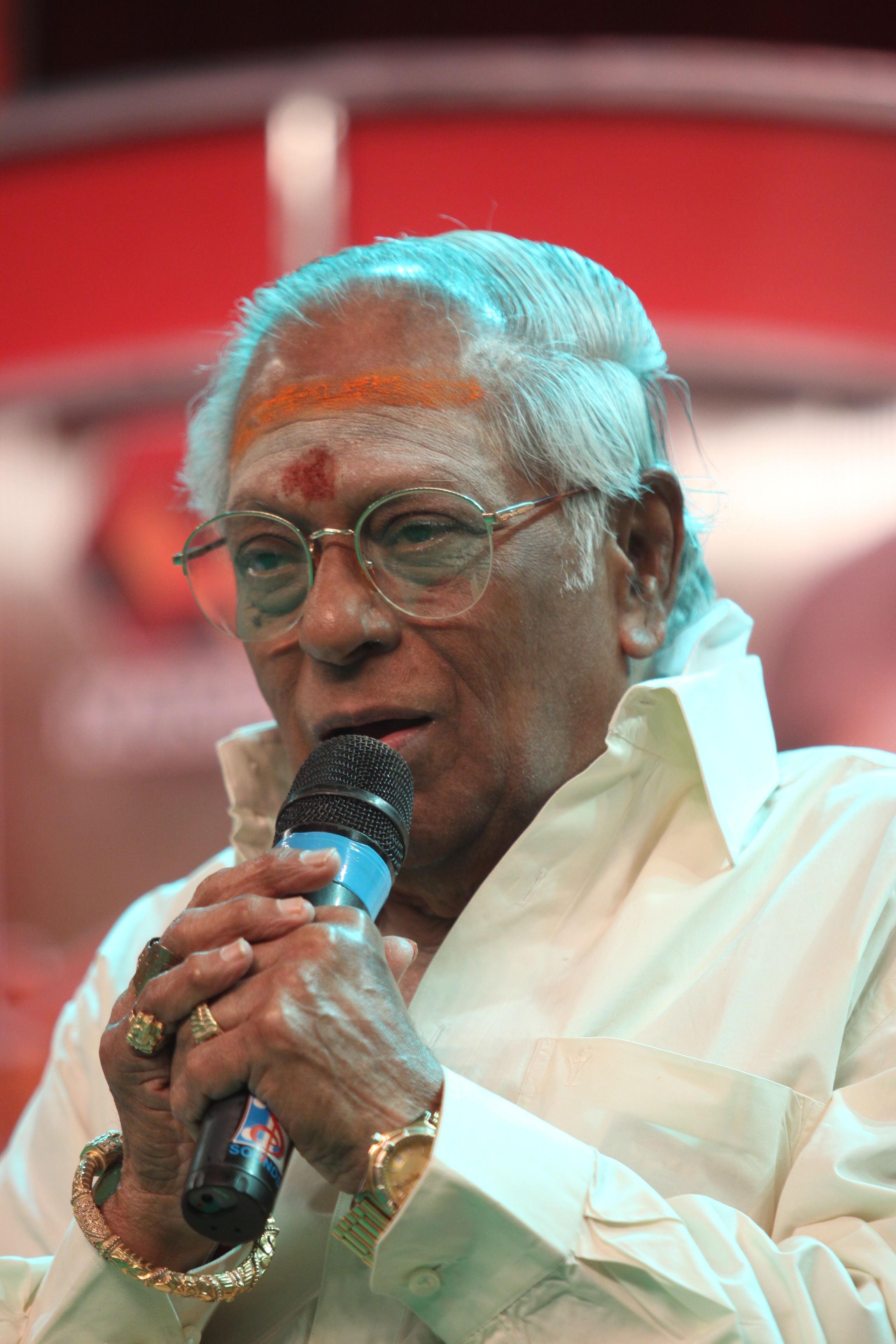

In 1968, a schoolboy who had already left the classroom at 14 walked from Tamil Nadu's Theni district to Madras with his brothers, saving bus fare on foot and going to bed hungry more nights than not. Within a year he was apprenticing under the Kannada film composer G.K. Venkatesh, learning orchestration on dawn-to-midnight days. Ilaiyaraaja, born R. Gnanathesikan in 1943, broke through as his own composer with 1976's Annakili and went on to score more than a thousand films across nine languages, a scale unmatched in Indian cinema. Trained in Western classical technique alongside Carnatic tradition, he built symphonic textures under Tamil melody, insisting the two were never really separate: "I am proving that all these forms of music are one."
the sound in question
1991
Rakkamma Kaiya ThattuIlaiyaraaja
walk the tributaries ↓
M.S. Viswanathan1960s–1970s · Tamil film music / Light music / Carnatic
Years before he wrote a note of his own, Ilaiyaraaja sat in as an organist on M.S. Viswanathan's "Malar Ethu Kankal Than," from the 1971 film Avalukkendru Oru Manam — an anonymous session hand watching a master at work. He never let the debt go quiet afterward. "I could be a music director only by closely watching and listening to the great techniques introduced by M.S. Viswanthan in film music," he told the Hindu in 2015, still naming Viswanathan first among the handful of composers he calls his teachers.
listen: upstream & heresource: The Hindu — I owe it to MSV, says Ilayaraja (M.S. Viswanathan influence quote and organ session) ↗
1966
Nilave Ennidam NerungadheM.S. Viswanathan
1982
Ilaya NilaIlaiyaraaja
listen forNeither song is a credited descendant of the other, but set 1966's "Nilave Ennidam Nerungadhe" beside 1982's "Ilaya Nila" and the kinship is audible: a single vocal line drifting over a raga-tinted sway, patient, more interested in melody than momentum. Both titles even circle moonlight — nilavu in one, nila in the other — a coincidence of language that only sharpens how alike the mood sits between a song Viswanathan wrote and one Ilaiyaraaja wrote eleven years into his own career.
G.K. Venkatesh1960s–1970s · Kannada film music / Film score
In 1969, Ilaiyaraaja began assisting the established Kannada film composer G.K. Venkatesh — dawn music lessons, a full day of recording sessions, home near midnight, across some two hundred films. "GK Venkatesh was my teacher, guru and encouraged me to write orchestra scores," he recalled. Between sessions he'd talk Venkatesh's own musicians into running through his fledgling compositions on their breaks — an apprenticeship where the future composer of a thousand films first learned to hear a film orchestra as an instrument of his own.
listen: upstream & heresource: The Hindu — There's India in Ilaiyaraja's music (G.K. Venkatesh guru quote; 'great masters') ↗
1972
Nagu Nagutha NaliG.K. Venkatesh
En Iniya Pon NilaveIlaiyaraaja
listen forNo source credits Ilaiyaraaja by name on a specific Venkatesh soundtrack — this is the sound of the workshop, not a named lesson. 1972's "Nagu Nagutha Nali" shows the house style he was absorbing: an unhurried melody, strings banked thick beneath the singer, nothing rushing toward a chorus. Set beside "En Iniya Pon Nilave," the family resemblance is in that same patient lushness — Ilaiyaraaja keeps the calm, then adds a harmonic reach Venkatesh's arrangements never quite attempted.
Franz Schubert1810s–1820s · Classical / Romantic / Lieder
At a performance of his own Valiant symphony in Chennai, Ilaiyaraaja paused to explain something buried in a much older song: 1979's "Idhayam Pogudhey," from the film Puthiya Vaarpukkal, secretly carries material from Schubert's Unfinished Symphony, absorbed years earlier when a Madras teacher named Dhanraj Master set him loose on records of Bach, Beethoven, Mozart and Schubert. "They were from two different cultures," he said. "But I wanted to prove that they were not different; it's the same thing."
listen: upstream & here
1822
Symphony No. 8 in B minor, "Unfinished"Franz Schubert
1979
Idhayam PogudheyIlaiyaraaja
listen forListen for the string writing: Schubert's symphony opens on murmuring low strings beneath a plaintive melody that keeps withholding resolution, never settling into the movement you expect. "Idhayam Pogudhey" borrows exactly that hesitation — a minor-key vocal line suspended over hushed strings, always seeming to withhold rather than arrive. It's less a note-for-note quotation than a mood transplanted whole, the concert hall's melancholy set down inside a Tamil heartbreak song.