walking upstream…
Johann Sebastian Bach

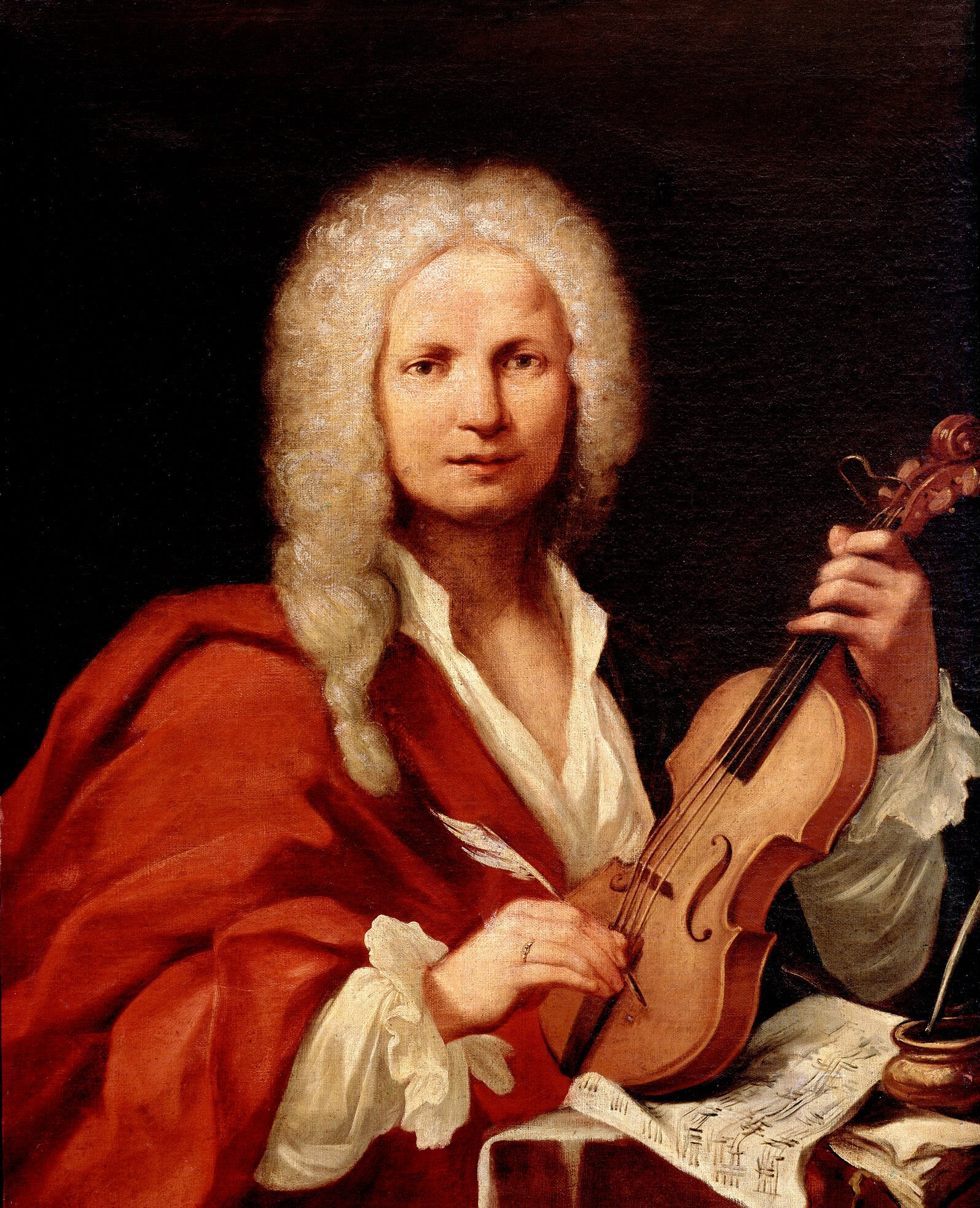
 photo: elias gottlob haussmann · public domain ↗
Johann Sebastian Bach
Johann Sebastian Bach was born in Eisenach in 1685; his father died when he was nine, and he was apprenticed to his oldest brother, Johann Christoph, a former pupil of Pachelbel who kept a library of scores. In autumn 1705, twenty years old and working as a church musician in Arnstadt, Bach walked roughly 260 miles to Lubeck on a month's leave, and stayed nearly four, absorbing the organist Dieterich Buxtehude's playing at Lubeck's main church. At Weimar a few years later he ran the same instinct on paper, transcribing Antonio Vivaldi's Italian concertos for keyboard to learn their machinery firsthand. He spent his career as a provincial church Cantor, largely unrecognized as more than a formidable organist; the walking and the copying tell the same story, a composer who built his own voice by taking other men's apart.
the sound in question
1721
Brandenburg Concerto No. 3 in G major, BWV 1048Johann Sebastian Bach
walk the tributaries ↓
Dieterich Buxtehude1680s · Baroque / Organ music
In autumn 1705, the twenty-year-old Bach requested four weeks' leave from his church post in Arnstadt to hear Dieterich Buxtehude, the organist he considered "the greatest organist composer in the world at that time," play at Lubeck's main church, the Marienkirche. He stayed nearly four months, attending the Abendmusiken, an evening concert series Buxtehude ran there, rather than taking formal lessons, and came home to a consistory court demanding to know why. The walk was roughly 260 miles each way; the debt he brought back outlasted the reprimand.
listen: upstream & here
1680
Praeludium in G minor, BuxWV 163Dieterich Buxtehude
1706
Toccata and Fugue in D minor, BWV 565Johann Sebastian Bach
listen forBuxtehude's Praeludium in G minor swings between free, rhapsodic flourishes and strict fugal writing, the stylus phantasticus, a deliberately improvisatory keyboard style, worked in short interlocking bursts. Bach's Toccata and Fugue in D minor opens with the same unaccompanied cascade before the fugue locks into place, then keeps trading the two modes across a much longer span. A scholar of the Lubeck visit has described Bach's particular gift as making "an enormous span of music hold together" — audible in how long Bach sustains an alternation Buxtehude worked in short bursts.
Antonio Vivaldi1710s · Baroque / Italian concerto
At Weimar around 1713, Prince Johann Ernst, the teenage co-ruler of the duchy, returned from two years in Amsterdam with a stack of Italian scores, including Vivaldi's newly published concerto collection L'estro armonico. Bach didn't just read them — he sat down and transcribed several for keyboard and organ, reworking string parts note by note and inventing manual markings to fake an orchestra's give-and-take on a single instrument. One scholar's verdict on what the exercise left him with: Bach learned "the essential tools that he would use for the expansion and transformation of seventeenth-century genres into large-scale forms."
listen: upstream & heresource: The Diapason — The influence of Antonio Vivaldi on J.S. Bach's organ concerto transcriptions (Weimar transcription practice) ↗
1711
Violin Concerto in D major, RV 230 (L'estro armonico, No. 9)Antonio Vivaldi
1714
Harpsichord Concerto in D major, BWV 972Johann Sebastian Bach
listen forVivaldi's Violin Concerto in D major trades a soloist against the full string band in clean, repeating blocks, a ritornello theme returning like a chorus between each solo turn. Bach's Harpsichord Concerto in D major, BWV 972, is that same piece reduced to two hands: the left keeps the orchestra's pulse going while the right plays the solo line, and the block structure Vivaldi built for an ensemble survives note for note on a single keyboard. Listen for the same call-and-answer shape, just compressed onto one instrument instead of several.