walking upstream…
Frédéric Chopin


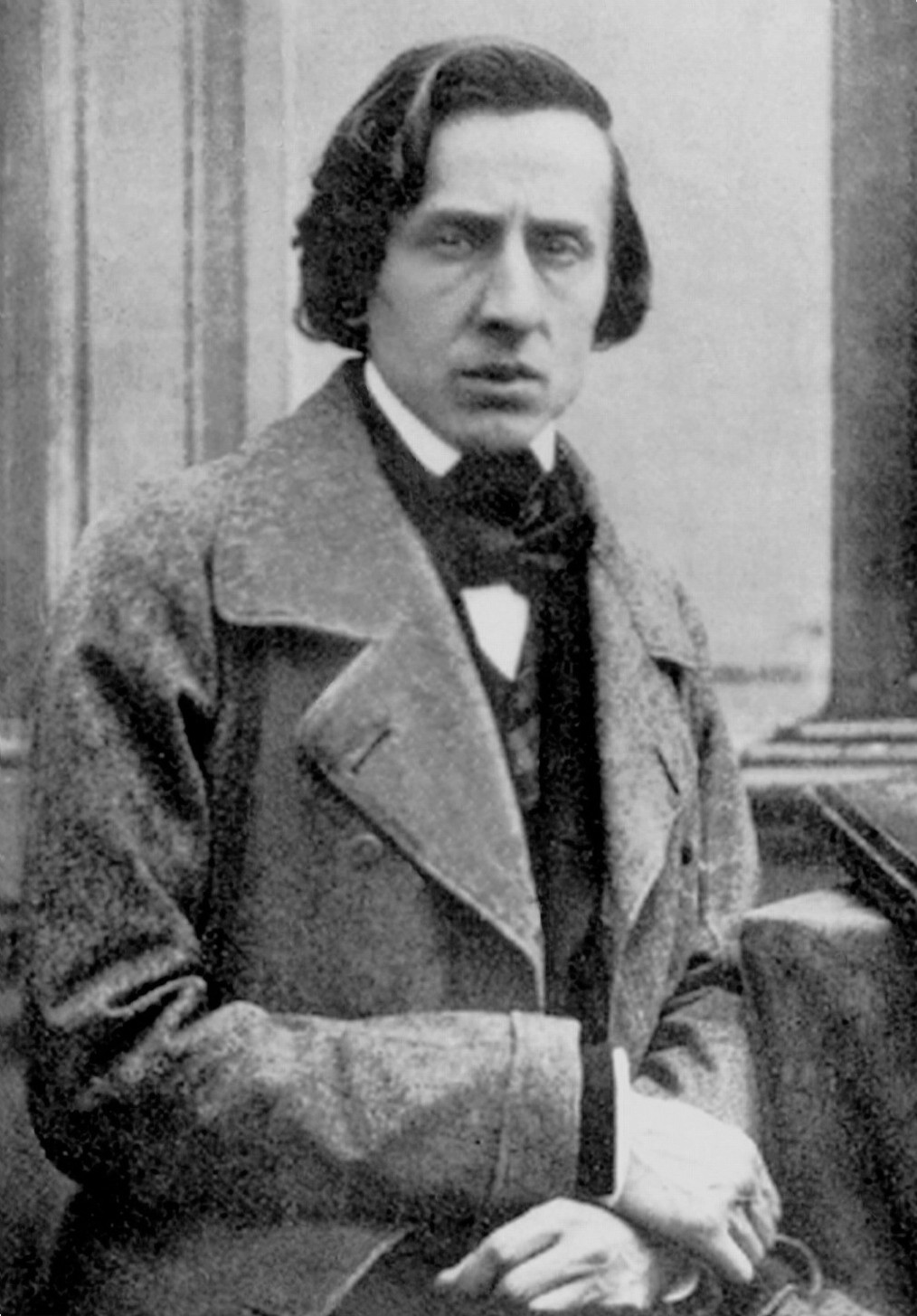 photo: louis-auguste bisson · public domain ↗
Frédéric Chopin
sourcesProject Gutenberg — Karasowski, Frederic Chopin · David Korevaar — Chopin · Vermont Public — Alchemy of Genius · Fryderyk Chopin Institute / Chopin Competition — Requiem for piano solo on the anniversary of Fryderyk Chopin's death (backs the Mozart Requiem funeral request, quoting Berlioz's obituary) · Hyperion Records — liner notes for Op. 2 "Là ci darem la mano" Variations, by Ateş Orga, 1991 (backs the Mozart source melody and Schumann's review)
In 1830, twenty-year-old Chopin left Warsaw for Paris carrying a silver cup filled with Polish soil; the November Uprising against Russian rule closed the border behind him days later, and he never returned home. He built his career around the private discipline of the practice room rather than the public stage — he gave only around thirty concerts in his lifetime, supporting himself instead through composition sales and piano lessons to Paris's salons, and wrote almost exclusively for solo piano while contemporaries like Liszt filled concert halls. Tuberculosis killed him in Paris in 1849, at thirty-nine; per his own wish, his sister carried his heart back to Warsaw sealed in a jar of alcohol. What he left behind was a modern piano vocabulary built from study, not spectacle — nocturne, ballade, mazurka, each refined alone until it could stand as a concert work.
the sound in question
1835
Ballade No. 1 in G minor, Op. 23Frédéric Chopin
walk the tributaries ↓
Johann Sebastian Bach1720s · Baroque / Classical
Before public appearances, Chopin retreated for two weeks at a time and touched nothing but Bach's Well-Tempered Clavier — the pianist Wilhelm von Lenz recorded him explaining, "I shut myself up for a fortnight and play Bach. That is my preparation. I do not practise my own compositions." Seven years later, sailing to Majorca with the writer George Sand in the winter of 1838, he reportedly packed only that same score. He came home with the 24 Preludes, Op. 28 — one prelude in every major and minor key, the same complete-key scheme Bach had set as a teaching exercise a century earlier.
listen: upstream & here
1722
The Well-Tempered Clavier, Book I: Prelude No. 1 in C major, BWV 846Johann Sebastian Bach
1839
Prelude in C major, Op. 28 No. 1Frédéric Chopin
listen forBach's C major Prelude that opens the Well-Tempered Clavier is a single arpeggiated figure, unbroken chord after unbroken chord, built to show that a whole harmonic system could live inside one repeating shape. Chopin's Op. 28 No. 1, the piece that opens his own 24-key cycle, borrows the idea and speeds it up — a restless, agitato arpeggio racing under a melody that keeps trying to break free of it. Listen for how briefly each stays: Bach's unfolds patiently for two minutes, Chopin's barely thirty seconds, the same architecture compressed into a nervous sprint.
Wolfgang Amadeus Mozart1780s · Classical / Opera
Chopin named only two composers as decisive to his own musical outlook, and Mozart was one; his teenage breakout, a set of variations built on the "Là ci darem la mano" duet from Don Giovanni, quotes Mozart's own melody outright. That debt held to his last hours: dying of tuberculosis in Paris, he asked that his own music stay silent at his funeral and that only Mozart's Requiem be sung. The French composer Hector Berlioz, writing his obituary, recorded that Chopin's pupil Adolphe Gutmann "took over this wish with his master's last breath."
listen: upstream & here
1787
Don Giovanni: "Là ci darem la mano"Wolfgang Amadeus Mozart
1827
Variations on "Là ci darem la mano", Op. 2Frédéric Chopin
listen forMozart's duet is Zerlina and the Don trading a simple, seductive four-bar tune back and forth, gentle and symmetrical. Chopin, not yet eighteen, takes that same tune whole and runs it through five variations of increasing bravura — trills, runs, leaping octaves — before the melody resurfaces bare at the close. The composer-critic Robert Schumann heard the published score in 1831 and announced in print, "Off with your hats, gentlemen — a genius!" Listen for the moment near the end when the ornament falls away and Mozart's original phrase returns, unmistakable under all that new technique.
John Field1810s · Classical / Romantic
John Field, an Irish pianist-composer active in Russia, invented the nocturne a generation before Chopin was born — a singing right-hand melody floated over a slow, pedaled left-hand murmur. Newly arrived in Paris in December 1831, twenty-one-year-old Chopin auditioned for the pianist Friedrich Kalkbrenner, playing his own E minor Concerto. "Kalkbrenner was astonished," Chopin wrote home, "and asked if I were a pupil of Field. He remarked that I had Cramer's style, but Field's touch." Chopin's own teaching later confirmed the debt formally: he assigned Field's works to new pupils alongside Bach, and one student recalled that only Field's tone could be compared to his teacher's.
1815
Nocturne No. 5 in B-flat major, H 37John Field
1832
Nocturne in B-flat minor, Op. 9 No. 1Frédéric Chopin
listen forField's Nocturne No. 5 lays the template bare: a plain, singing melody in the right hand drifts over a left hand spread wide across the keyboard, blurred by the sustain pedal into one continuous wash of sound. Chopin's Nocturne in B-flat minor, Op. 9 No. 1 — his first published nocturne, written within a few years of Field's death — takes that exact texture and stretches it, adding chromatic turns and a middle section that pushes the form toward opera. Listen for how both let the melody float free of a strict beat while the left hand keeps time underneath.