walking upstream…
Pritam


sourcesRolling Stone India — Pritam · Rolling Stone India — Pritam and the Politics of Bollywood Music ("three of us" quote, positioning vs. Rahman-era peers) · Outlook India — Music Composer Pritam Doesn't Believe In Keeping A Song Bank (script-first creative process quote) · AllMusic — Pritam (genre versatility across films; teenage Burman influence claim, unverified by direct fetch) · Wikipedia — Pritam (birth, education, geology degree, FTII, Chandrabindoo) · Wikipedia — Chura Liya Hai Tumne Jo Dil Ko (song background, year, Bhupinder Singh's guitar)
Pritam Chakraborty studied geology at Calcutta's Presidency College before switching, in 1994, to sound engineering at the Film and Television Institute of India — a path that ran through his father's home music school, where Baul singers and Rabindra Sangeet mixed with the rock and roll Pritam played on bass for the Bengali band Chandrabindoo. He composed ad jingles in Mumbai for years before the title track of 2004's Dhoom made him a hit-maker; years of plagiarism controversy followed, then a slower, script-driven method he now credits with his longevity. "The current commercial sound of Bollywood was shaped by three of us: Vishal-Shekhar, Shankar-Ehsaan-Loy and me," he told Rolling Stone India. "Till today, everybody is following the same template." His catalog refuses a signature sound on principle — rock, Sufi, ghazal, folk-pop, whatever a film demands.
the sound in question
2007
Tum Se HiPritam
walk the tributaries ↓
Bengali Folk Music TraditionFolk / Bhatiali / Bhawaiya
Before Pritam ever wrote a film score, he was a boy singing Bhatiali and Bhawaiya — Bengal's boatmen's and herders' folk songs — in his father's front room, where musician friends dropped by to play alongside the family's Baul records and Rabindra Sangeet. "One of my strongest influences is folk because I used to sing Bhatiali and Bhawaiya folk songs as a kid," he told Rolling Stone India, adding that he layers "an element of soft ballad rock" over that foundation in nearly everything he writes. Both folk forms are built for solitude and longing, sung in long, aching phrases that outlasted the childhood that taught them to him.
listen: upstream & here
Bhatiyali (traditional Bengali boat song)Bengali Folk Music Tradition
2019
KhairiyatPritam
listen forThe traditional Bhatiyali recording strips almost everything away — a single voice, barely any accompaniment, each line stretched and bent the way a boatman's cry would carry over water. "Khairiyat" keeps that same discipline inside a film-song budget: Arijit Singh's vocal enters over little more than a guitar figure, the strings held back until the final chorus, every phrase given room to hang before the next one starts. It's the folk form's patience, not its melody, that survives the transplant — restraint used as the main expressive device, the arrangement staying out of the voice's way.
R.D. Burman1970s · Hindi film music / Filmi / Rock
Growing up in Calcutta, Pritam absorbed R.D. Burman's music before he understood it as a style — Burman was still the industry's defining sound throughout the composer's own Bengali-folk-and-Rabindra-Sangeet-soaked childhood, half a generation removed from the studio pianist Kersi Lord's jazz sessions that helped shape Burman's ear. Burman had built his career refusing his own father's classical purism, mixing Bengali folk with Latin percussion and electric guitar until Hindi film songs could hold anything. Pritam inherited the refusal more than any specific lick: no signature sound, a different genre for every director, the same appetite for whatever the song needs.
listen: upstream & heresource: Wikipedia — R.D. Burman (Bengali folk as primary inspiration, jazz via Kersi Lord, fusion style) ↗
1973
Chura Liya Hai Tumne Jo Dil KoR.D. Burman
2009
Tune Jo Na KahaPritam
listen forBurman's 1973 hit opens on Bhupinder Singh's electric guitar line — a Western rock texture dropped straight into a Hindi film duet, the arrangement built outward from that one riff rather than a string section. Pritam's 2009 ballad works the same way in miniature: a single guitar figure carries the entire song under Mohit Chauhan's voice, with strings entering only to swell the chorus, never crowding the guitar out. Different decades, same instinct — let one guitar line do the emotional work a full orchestra usually would, and treat the rest of the arrangement as accompaniment to it.
A.R. Rahman1990s–2000s · Film score / Indian classical fusion / Sufi
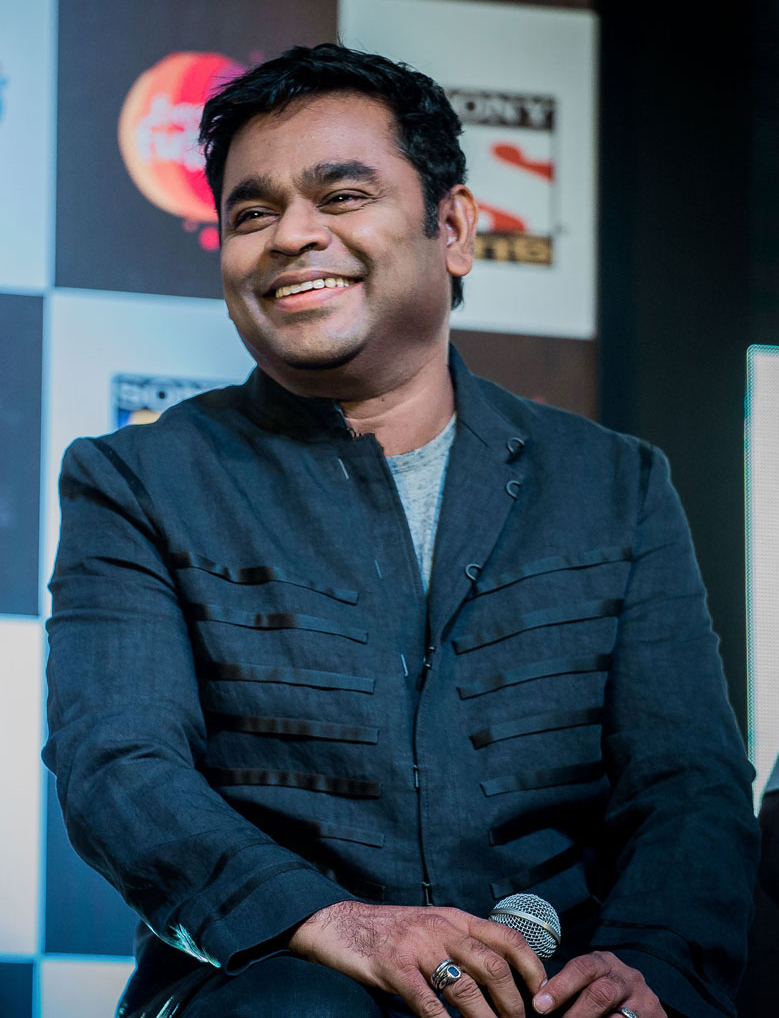
By the time Pritam started composing, A.R. Rahman had already answered Hindi film music's central question: whether global production and synthesizers could carry a story's emotion without losing its melodic identity. "He totally changed the sound of Indian film music," the composing duo Jatin-Lalit said of Rahman's 1990s arrival, and a whole generation of composers built careers inside the space he opened — Pritam among them, even as he pushed the opening toward indie-pop hooks and plainspoken lyrics rather than Rahman's more formal, orchestral grandeur. The debt is structural, not stylistic: Rahman proved the audience would follow; Pritam decided where to take them.
listen: upstream & heresource: Rahmaniac — Voices of Praise (Jatin-Lalit quote on A.R. Rahman's impact) ↗
1995
Tu Hi ReA.R. Rahman
2016
Channa MereyaPritam
listen forBoth songs treat restraint as an emotional trap they spring later: "Tu Hi Re" opens hushed, before Hariharan's classically trained tenor and swelling strings turn it into a wide, string-drenched romantic epic. "Channa Mereya" does the same trick faster, starting close and plain before Arijit Singh's raspier, more broken voice pushes the chorus toward the same kind of orchestral peak. Neither composer is interested in a steady dynamic — the payoff is the size of the gap between the opening whisper and the chorus that finally lets the strings in.