walking upstream…
Bade Ghulam Ali Khan
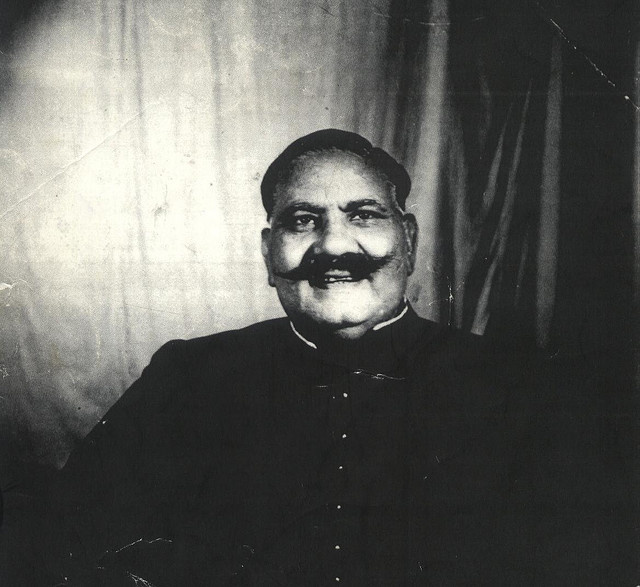 photo: unknown author · public domain ↗
Bade Ghulam Ali Khan
sourcesDarbar Arts — Ustad Bade Ghulam Ali Khan (biography · Hindustani Classical Masters — Ustad Bade Ghulam Ali Khan (decade under Kale Khan; training resumed under his father after Kale Khan's death) · India Art Review — The uniqueness of Patiala gharana (Ali Baksh Khan and Kale Khan's training of Bade Ghulam Ali Khan) · The Revolver Club — Modernist · Wikipedia — Bade Ghulam Ali Khan (partition quote; dhrupad-Jaipur-Gwalior style synthesis)
Born in Kasur, Punjab, on April 2, 1902, Bade Ghulam Ali Khan later summed up his country's central wound in one sentence: "If one child in every home had been taught Hindustani classical music, India would never have been partitioned." He nearly lived it as autobiography. His uncle Kale Khan took charge of his training at five; after Kale Khan's death a decade on, he continued under his father, Ali Baksh Khan, "a well-known singer himself." From that double inheritance he built something new — a Kasur-Patiala style fusing dhrupad's depth, Jaipur's ornamental runs, and Gwalior's embellishments into thumris like "Ka Karun Sajni" and "Yaad Piya Ki Aaye." A stroke felled him in 1961; he returned to the stage anyway, singing until his death in 1968.
the sound in question
Ka Karun Sajni Aaye Na BalamBade Ghulam Ali Khan
walk the tributaries ↓
Kale Khan1900s–1910s · Hindustani classical / Khayal / Thumri
Kale Khan, not his father, was Bade Ghulam Ali Khan's first teacher — "his paternal uncle, Ustad Kale Khan, was his first Guru and he started learning music from him when he was just five years old," one family biography records — and he kept the boy in daily lessons for a decade before his own death ended them. Whatever Bade absorbed in that decade became the floor everything later was built on: the raga grammar and thumri phrasing of the Kasur-Patiala line, learned so early it predates his own memory of learning it, underneath every tradition he later went looking for on his own.
listen: upstream & heresource: Cultural India — Ustad Bade Ghulam Ali Khan biography (training under uncle Kale Khan, then father Ali Baksh Khan) ↗
1909
Kasur gharana khayal and thumri instruction (no surviving recording)Kale Khan
Yaad Piya Ki AayeBade Ghulam Ali Khan
listen for"Yaad Piya Ki Aaye" is built on the register Kale Khan spent a decade drilling into a five-year-old: thumri as conversation, not concert recital. Listen for how conversational the phrasing stays even at its most ornamented — Khan treats each grace note like an aside rather than a display piece, the melody dipping and turning as if he's confiding something rather than performing it. That intimacy, learned before he could have chosen it for himself, is the uncle's decade still audible in the nephew's most famous thumri.
Ali Baksh Khan1900s–1910s · Hindustani classical / Khayal / Thumri
When Kale Khan died after a decade teaching his nephew, the household didn't send teenage Bade Ghulam Ali Khan elsewhere for further training. One biography of the family notes simply that "after Kale Khan Saheb's death he received musical training from his own father," Ali Baksh Khan, a man Cultural India's biography calls "a well-known singer himself." Bade spent the years that followed absorbing raga grammar and thumri phrasing at home, inside the same Kasur-gharana line his father had been steeped in his whole life, before he ever performed for a public that didn't already share his last name.
listen: upstream & heresource: Cultural India — Ustad Bade Ghulam Ali Khan biography (training under uncle Kale Khan, then father Ali Baksh Khan) ↗
1919
Kasur-Patiala khayal instruction (no surviving recording)Ali Baksh Khan
Ka Karun Sajni Aaye Na BalamBade Ghulam Ali Khan
listen forNo recording of Ali Baksh Khan survives, so there's nothing to hold up against his son's voice directly. Listen instead for what home training, rather than public performance, leaves behind in "Ka Karun Sajni Aaye Na Balam": the meend, the long slide between notes that never quite resolves cleanly, treated less like ornament than like breathing, and the way Khan lingers on plain, unshowy syllables rather than rushing toward the next flourish — the patient, unhurried grammar of a lesson repeated at home for years, not a technique built for a stage.