walking upstream…
The Velvet Underground


sourcesWikipedia2 · Red Bull Music Academy
The Velvet Underground came together in New York in 1965 around Lou Reed, a staff songwriter with a taste for doo-wop, R&B, and hard literary realism, and John Cale, a Welsh violist steeped in the downtown avant-garde. Briefly taken up by Andy Warhol and paired with the German singer Nico for their 1967 debut 'The Velvet Underground & Nico,' they married street-level songs about drugs, desire, and the city to Cale's droning viola and sheets of feedback. The records barely sold, but across four albums between 1967 and 1970 the band fused rock and roll with minimalist drone and free-jazz noise, laying groundwork for punk, art rock, and countless independent bands to follow. Cale departed after 1968's abrasive 'White Light/White Heat,' and Reed steered the group toward the plainer songcraft of 1969's self-titled album and 1970's 'Loaded' before leaving himself.
the sound in question
1970
Sweet JaneThe Velvet Underground
walk the tributaries ↓
La Monte Young1960s · Minimalism / Drone / Experimental
Before the band formed, John Cale played in La Monte Young's Theatre of Eternal Music, holding sustained tones for hours at a stretch; Cale has said he carried that drone directly into the Velvet Underground, and the long viola tones under 'Venus in Furs' and 'Heroin' come out of Young's practice of extended, just-intoned held notes.
listen: upstream & heresource: Far Out ↗
1962
The Second Dream of the High-Tension Line Stepdown TransformerLa Monte Young
1967
Venus in FursThe Velvet Underground
listen forSet Young's 'The Second Dream of the High-Tension Line Stepdown Transformer' beside 'Venus in Furs' — both hang on unwavering, slowly beating sustained tones that never resolve, so the harmony sits still and hypnotic while everything else moves against that fixed drone.
Chuck Berry1950s · Rock and roll / Rhythm and blues
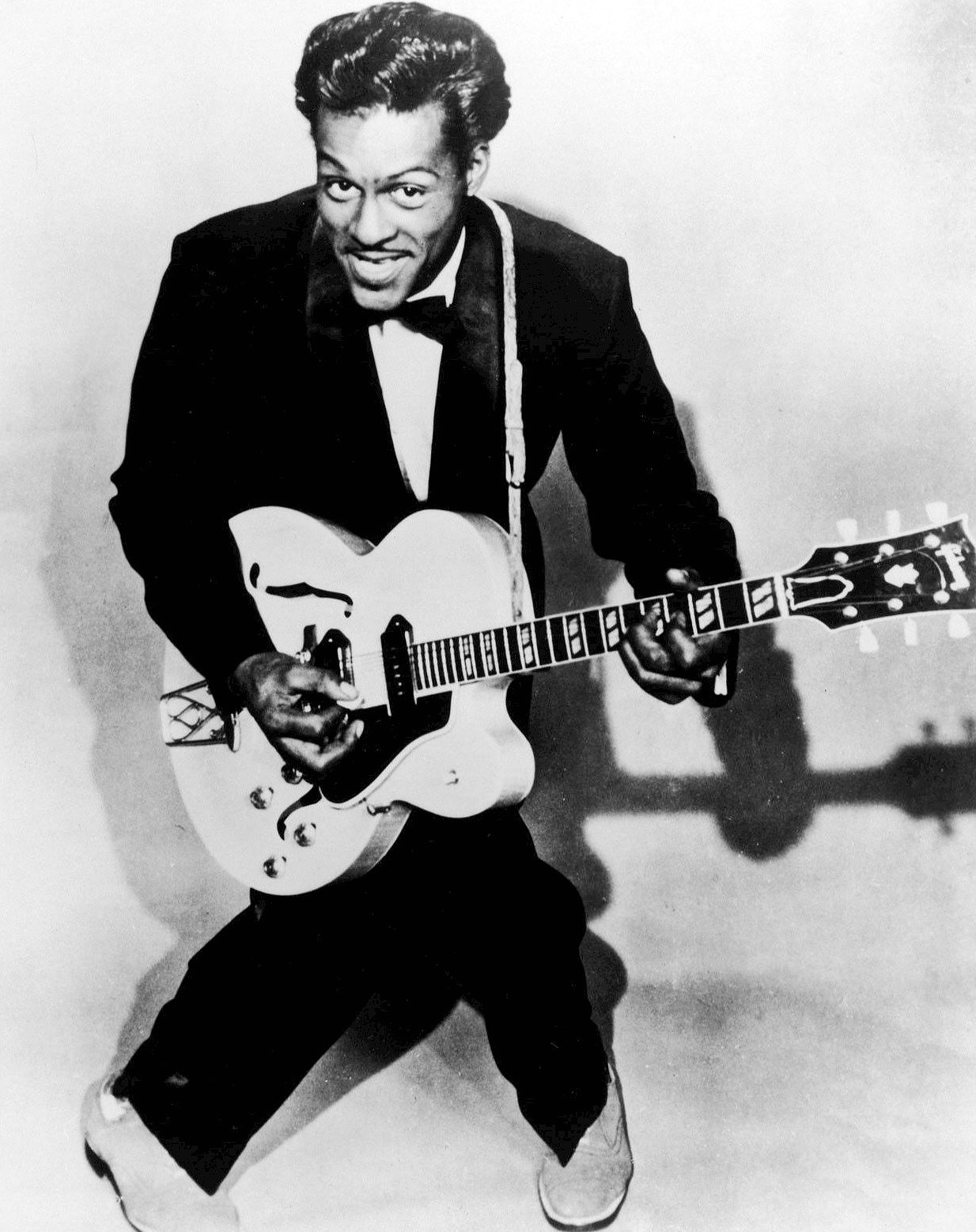
For all their avant-garde leanings, the Velvets thought of themselves as a rock and roll band, and Reed drew on Chuck Berry's bright, chiming, double-stop guitar and its plain love of the form; 'Rock & Roll' is Reed's own testament to that music, built on the kind of ringing rhythm-and-lead figure Berry defined.
listen: upstream & here
1958
Johnny B. GoodeChuck Berry
1970
Rock & RollThe Velvet Underground
listen forCue Berry's 'Johnny B. Goode' before the Velvets' 'Rock & Roll' — both are powered by the same bright, twanging double-stopped guitar licks that lock rhythm and lead together, a straight-ahead rock and roll drive under a lyric about the music itself.
Bo Diddley1950s · Rock and roll / Rhythm and blues
Lou Reed grew up on the R&B and rock and roll of the 1950s and admired Bo Diddley's hypnotic, riff-locked rhythm, in which a song rides one insistent groove rather than moving through changes; the Velvets built much of their propulsion on that same principle of relentless, near-static repetition.
listen: upstream & here
1955
Bo DiddleyBo Diddley
1967
I'm Waiting for the ManThe Velvet Underground
listen forPlay Diddley's self-titled 'Bo Diddley' before 'I'm Waiting for the Man' — both lock onto a single driving rhythmic figure and simply pound it, letting the trance of unbroken repetition, not chord movement, carry the whole track.