walking upstream…
Pete Seeger


sourcesWikipedia — Pete Seeger (birth, parents, early life; lead only) · Acoustic Guitar Magazine — In-depth Q&A with Pete Seeger from the archives, 2002 (Lunsford's five-minute banjo lesson, Seeger's own account) · UNC Press Blog — Doug Orr · The Rutherford Institute — Interview with Pete Seeger, 1981 (Guthrie's influence on his songwriting, in Seeger's words) · Bedford + Bowery — Pete Seeger, the East Village, and the 'Frat House for Musical Revolutionaries,' 2014 (Almanac Singers partnership with Guthrie) · Wikipedia — This Land Is Your Land (censored verses restored at the 2009 Lincoln Memorial performance)
Pete Seeger was born in 1919 in Manhattan to a composer father and a concert-violinist mother, both classically trained, both content to let their son find his own instrument — he chose the ukulele first, then something louder. He found it for good at seventeen, in the summer of 1936, climbing into the hills above Asheville, North Carolina, for Bascom Lamar Lunsford's Mountain Dance and Folk Festival, where he heard a five-string banjo played mountain style. Four years later he met Woody Guthrie at a migrant-labor benefit, moved into his Greenwich Village loft, and co-founded the Almanac Singers; a decade on, as a Weaver, he rode a Lead Belly song to the top of the pop charts before the Red Scare blacklisted him from network television for seventeen years. He kept playing anyway until his death in 2014: for Seeger, the borrowed song was always how you carried a cause.
the sound in question
1962
Turn! Turn! Turn! (To Everything There Is a Season)Pete Seeger
walk the tributaries ↓
Woody Guthrie1940s · Folk / Americana / Talking blues
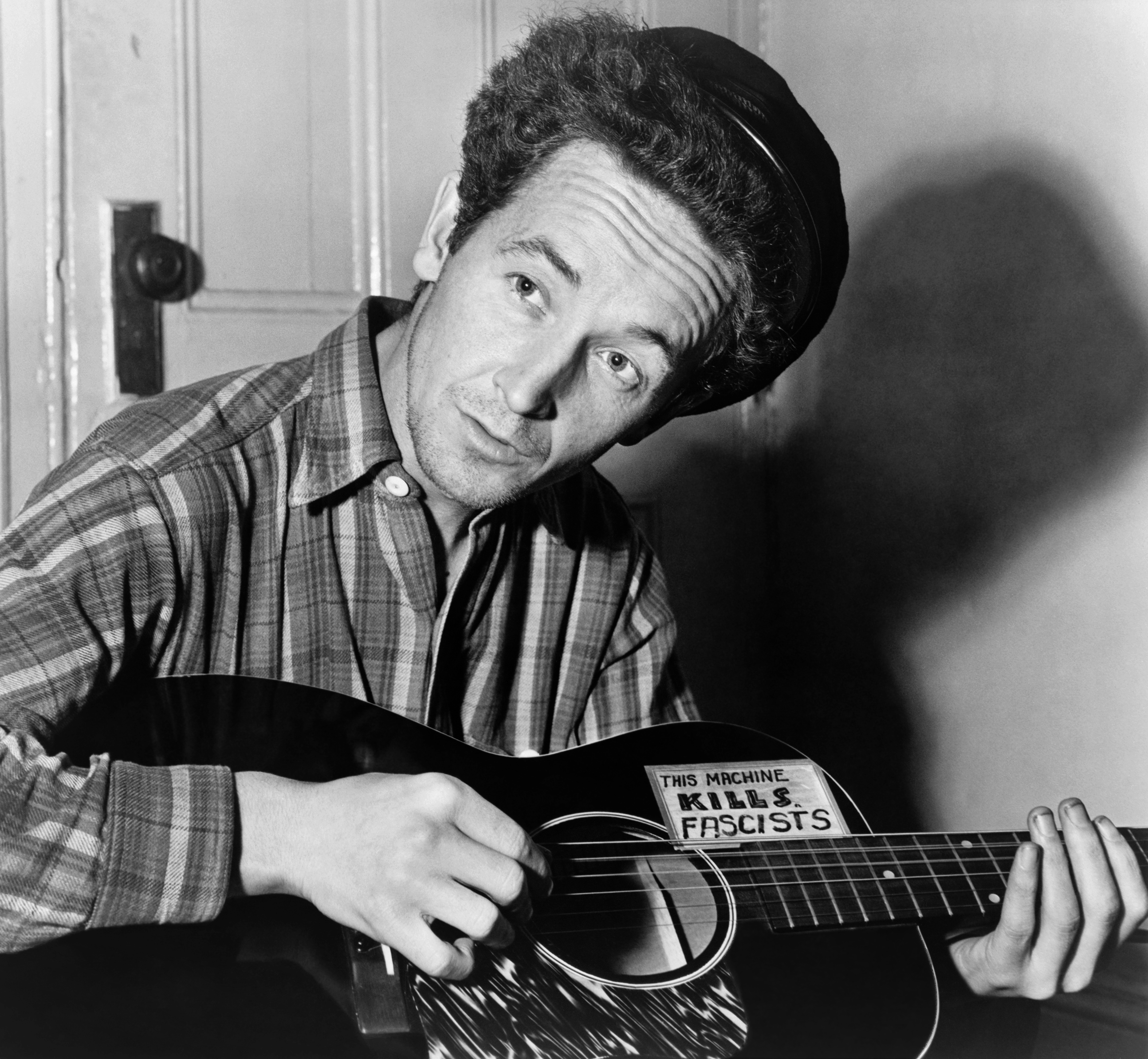
Four years after the banjo lesson, in March 1940, Seeger met Woody Guthrie at a benefit for migrant farm workers and moved into his Greenwich Village loft the next month; by fall they were founding the Almanac Singers out of a cluttered West 10th Street townhouse biographer David King Dunaway called a "frat house for musical revolutionaries." Guthrie, Seeger said, "showed me the old folk songs, which I loved so much," and proved that writing your own was no harder: "Woody showed me that it is not as difficult as you think" — a "live ballad-maker," Seeger called him, "a thoughtful guy making up new songs about real events."
listen: upstream & here
1944
This Land Is Your LandWoody Guthrie
2009
This Land Is Your Land (with Bruce Springsteen, Lincoln Memorial)Pete Seeger
listen forGuthrie's original recording of "This Land Is Your Land" carries verses commercial versions dropped for decades — a "no trespassing" sign that the song walks straight past, a line about a relief office. Sixty-five years later, at the foot of the Lincoln Memorial the day before Barack Obama's inauguration, Seeger sang those buried verses back into a stadium crowd, cueing Bruce Springsteen and thousands of onlookers through the lines publishers had always cut. The tune hadn't moved an inch; what Seeger brought back was the argument Guthrie had written into it and the country had mostly forgotten.
Lead Belly1930s–40s · Country blues / American folk / Songster
Lead Belly died in 1949, before Seeger ever took a lesson from him — but in a 1963 interview Seeger called him his silent teacher: "he was my main music teacher although he didn't know it. I'd follow him around and watch his hands closely. I admired him so." What he wanted most, Seeger admitted, was a coach who couldn't be hired: "if I could find any voice teacher that could teach me to sing like Lead Belly I'd spend every cent to study under him." The Weavers cashed that debt in 1950, riding Lead Belly's "theme song" to the top of the charts.
listen: upstream & heresource: Folk Music Worldwide — 1963 interview with Pete Seeger (Lead Belly as 'silent mentor' and Goodnight, Irene as his 'theme song') ↗
1933
Goodnight, IreneLead Belly
1950
Goodnight, IrenePete Seeger
listen forLead Belly's 1933 prison recording of "Goodnight, Irene" is just his own voice and a droning twelve-string guitar, the melody rising and falling like a work chant with nowhere to rush to. The Weavers' 1950 version keeps that same falling line but wraps it in a string orchestra courtesy of pop arranger Gordon Jenkins and a close four-part harmony, smoothing the blues ballad into something radio-ready without losing the tune underneath — the distance between a man singing to himself in a cell block and a quartet singing to the whole country.
Bascom Lamar Lunsford1920s–30s · Appalachian folk / Old-time
In the summer of 1936, seventeen-year-old Seeger climbed into the hills above Asheville for Bascom Lamar Lunsford's Mountain Dance and Folk Festival, a gathering the country lawyer had founded eight years earlier to keep the region's ballads and reels from disappearing. Lunsford handed him the five-string banjo in a lesson Seeger later measured in minutes: "you pluck up on that middle string, now you pluck up on that first string, and now you put your thumb on that little fifth string." Seventy-seven years on, meeting Lunsford's grandson months before his own death, Seeger's greeting was blunt: "Your granddaddy changed my life."
listen: upstream & heresource: Mars Hill University — Bascom Lamar Lunsford biography (Lunsford's life and the festival he founded) ↗
1928
I Wish I Was a Mole in the GroundBascom Lamar Lunsford
1950
Darling CoreyPete Seeger
listen forPlay Lunsford's 1928 "I Wish I Was a Mole in the Ground" and the debt sits in the right hand: a raw, percussive frailing stroke that never smooths into a strum, the fifth string droning underneath like a held note under the melody. Seeger's own "Darling Corey," recorded in 1950, keeps that same up-picking attack and that same insistent drone, the technique Lunsford handed him in five minutes at seventeen and that Seeger then spent four years chasing before making it his signature for the rest of his career.