walking upstream…
New York Dolls


.jpg)
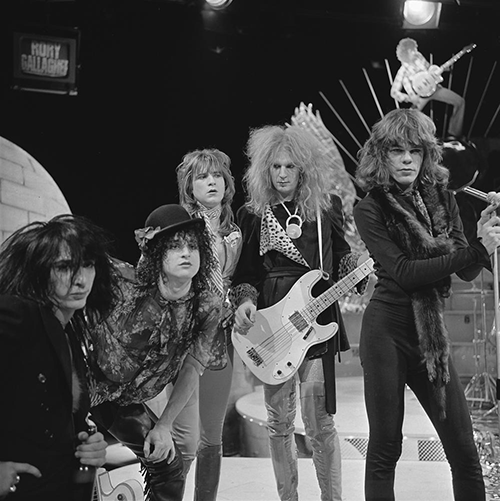 photo: avro · cc by-sa 3.0 nl ↗
New York Dolls
sourcesGrammy.com — Living Legends · Rolling Stones Data — Keith Richards on the New York Dolls (1974 quote on the Jagger/Johansen resemblance) · Uncle Stylus — Looking For A Kiss · Rock and Roll Globe — New York Dolls' Too Much Too Soon at 50 (Shadow Morton's Shangri-Las pedigree) · Stay Thirsty Media — Interview with Sylvain Sylvain ("we're a blues based band")
"So many bands, I couldn't even list them all," David Johansen said in 2022, tracing the wiring of a band he'd formed a decade before punk had a name — the Lovin' Spoonful and Blues Magoos off Manhattan's MacDougal Street, Janis Joplin whenever she played New York, and Mitch Ryder tearing off a tuxedo mid-song at a Murray the K revue that, Johansen said, "totally blew my mind." Formed in 1971, New York Dolls dressed in thrift-store drag and played fast, sloppy, deliberately vulgar rock and roll that most producers wouldn't touch. Todd Rundgren finally did, cutting their self-titled 1973 debut; it sold poorly and outlasted almost everything that outsold it. By the mid-1970s the band had splintered, but the mix — glam trash wired to real songcraft — became the blueprint punk copied wholesale.
the sound in question
1973
Personality CrisisNew York Dolls
walk the tributaries ↓
The Rolling Stones1960s-70s · Rock / Blues rock / Hard rock
Sylvain Sylvain never softened the debt: "The Dolls' music was mostly derived from ripping off the Rolling Stones and Eddie Cochran," he said. "We didn't invent [the power chord], but we perfected it and it became the punk sound." Even Keith Richards noticed. Asked in 1974 about the resemblance, he shrugged it off rather than claimed it: "it's obvious that the guy mimics Mick, and he does look incredibly like him," he said — amused, not flattered. Sylvain took that borrowed power and, by his account, handed it straight to guitarist Johnny Thunders.
listen: upstream & heresource: Guitar World — New York Dolls interview ↗
1968
Street Fighting ManThe Rolling Stones
1973
TrashNew York Dolls
listen forCue the Stones' 1968 "Street Fighting Man" against the Dolls' "Trash" and the theft is structural, not just attitude: both ride a compressed, distorted guitar bed with almost no low end, built for grit over fidelity. Jagger's vocal stays cool and detached over the chaos; Johansen pushes his into a bratty sneer, and the Dolls swap the Stones' martial snare roll for a sloppier, faster backbeat — the same two-chord thrust, played by musicians in more of a hurry.
The Shangri-Las1960s · Girl group / Pop / Rock and roll
The tribute in "Looking for a Kiss" isn't subtle: David Johansen opens the song by quoting the Shangri-Las' own hook from "Give Him a Great Big Kiss," word for word, before the song turns into a grittier, more desperate tale of teenage want. The review site Uncle Stylus called the result a "mean, swampy leanness" wrapped around Johansen's frenetic vocal. The homage outlasted one lyric: for 1974's follow-up, the Dolls hired George "Shadow" Morton, the producer behind the Shangri-Las' own hits, specifically to bring the gongs, gunshots, and girl-group theatrics only he knew how to summon.
listen: upstream & here
1964
Give Him a Great Big KissThe Shangri-Las
1973
Looking for a KissNew York Dolls
listen forPlay the Shangri-Las' 1964 original against the Dolls' 1973 opener and the quotation lands in real time: Mary Weiss speaks "when I say I'm in love, you'd best believe I'm in love, L-U-V" cold, over near silence, before the strings and handclaps arrive. Johansen shouts the same line straight into a wall of overdriven guitar, no pause, no tease — same hook, opposite entrance.
The Stooges1970s · Proto-punk / Garage rock
Sylvain Sylvain traced the wiring back to a basement: "We loved T. Rex and the MC5, of course, and we were listening to the Iggy Pop records. One of the first things we ever learned in Billy's basement was 'No Fun' by the Stooges," he said in 2008. "And David introduced us to Sonny Boy Williamson and Muddy Waters and Howlin' Wolf." The blues stayed the foundation even after the lipstick went on: "We're a blues based band, really," Sylvain said elsewhere that same year. "You got the blues under there." The Stooges gave the band its noise; the blues gave the noise a floor.
listen: upstream & heresource: The Big Get-Even (Ari Surdoval) — Sylvain Sylvain interview (the Stooges' "No Fun," T. Rex, MC5, blues introductions) ↗
1969
No FunThe Stooges
1973
Personality CrisisNew York Dolls
listen forSet the Stooges' 1969 "No Fun" beside "Personality Crisis," the song the Dolls built out of that same basement education, and the kinship is in the disgust, not the tempo — Iggy Pop's flat, sneering delivery rides a stomping two-chord riff; Johansen turns the same sneer faster and more melodic, with piano hammering where the Stooges left space. Neither song resolves — they just repeat the hook until it curdles into a taunt.