walking upstream…
Sex Pistols
.jpg)

 photo: oleifr1 · cc by-sa 4.0 ↗
Sex Pistols
By 1975 Steve Jones and Paul Cook had spent three years playing under a stolen name and stolen gear as an unglamorous covers band called the Strand, killing time at Malcolm McLaren's King's Road boutique for its secondhand rock and roll clothes. McLaren, fresh off a doomed stint dressing the collapsing New York Dolls in red patent leather, heard something usable in Jones's guitar and recruited bassist Glen Matlock and an art-school loiterer named John Lydon, soon nicknamed Rotten for his teeth, to front the reconstituted band. Within two years they'd been banned from BBC radio, denounced in Parliament, and dropped by two labels over "God Save the Queen" alone. They lasted twenty-six months as a working unit before splitting in San Francisco in January 1978, but Never Mind the Bollocks rewired what a rock band was allowed to sound like, mostly by refusal.
the sound in question
1976
Anarchy in the U.K.Sex Pistols
walk the tributaries ↓
New York Dolls1970s · Proto-punk / Glam rock / Hard rock
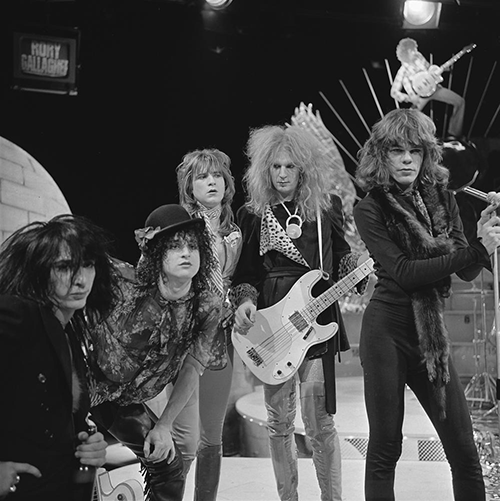
In early 1975 Malcolm McLaren took over as the New York Dolls' last, doomed manager, dressing the collapsing band in red patent leather and a hammer-and-sickle flag for a final jolt of provocation. "He got us a loft on 23rd Street in Chelsea and we started practicing and writing songs and came up with the red-patent-leather show," guitarist Sylvain Sylvain remembered. It didn't save them; the Dolls splintered within months. McLaren flew home to London still riding that adrenaline, and by September had built a new band on the same premise around two boutique regulars, Steve Jones and Paul Cook: strip it down, dress it loud, impossible to ignore.
listen: upstream & heresource: Rolling Stone — New York Dolls' Sylvain Sylvain Remembers Malcolm McLaren (the 1975 red-patent-leather management stint) ↗
1973
Personality CrisisNew York Dolls
1976
Anarchy in the U.K.Sex Pistols
listen for"Personality Crisis" rides David Johansen's yelped, half-camp vocal over Johnny Thunders's fuzzed, barely-in-tune guitar and a boogie piano, glam trash that sounds one bar from falling apart. "Anarchy in the U.K." keeps that same lurching instability but guts the piano and the camp: Steve Jones hammers one distorted chord flat across the verse, and Johnny Rotten swaps Johansen's swagger for a flat, sneering bark aimed at an entire country instead of a party.
The Stooges1970s · Proto-punk / Garage rock
"No Fun" had been in the Sex Pistols' set since their second-ever gig in November 1975, and it was still there at the end: their last show, at San Francisco's Winterland on January 14, 1978, closed with the Stooges cover rather than one of their own songs. Johnny Rotten knelt at the final chord and asked the crowd, "Ever get the feeling you've been cheated?" then dropped the mic and walked off for good. They'd already cut the song properly over a year earlier, in October 1976, days after signing to EMI, and released it as the B-side to "Pretty Vacant."
listen: upstream & here
1969
No FunThe Stooges
1976
No FunSex Pistols
listen forThe Stooges strip rock to one fuzzed riff repeated past comfort, Iggy Pop's voice a flat, bored sneer daring the song to end. The Sex Pistols' 1976 version keeps that same three-chord clamp but hardens the tempo and thickens Steve Jones's guitar into something closer to a wall; Johnny Rotten doesn't imitate Iggy's boredom so much as weaponize it, turning the title's complaint into a threat.
David Bowie1970s · Art rock / Glam rock
Ask Steve Jones to name his favorite guitarist and the answer never wavers: "If I had to pick my number one guitarist of all time, I would say it was Mick Ronson and them albums," he told KEXP in 2018. "The Rise & Fall of Ziggy Stardust and Aladdin Sane were my blueprint of guitar playing." A startling admission for punk's supposed wrecker of guitar heroics — Jones has also said he wanted to sound like Ronnie Wood of the Faces instead, telling Louder that "it didn't come out that way." What came out was Ronson's clipped, melodic economy, filtered through a much dirtier amp.
listen: upstream & here
1972
Ziggy StardustDavid Bowie
1977
BodiesSex Pistols
listen forRonson's guitar on "Ziggy Stardust" answers Bowie's vocal in tight, singing fills, every note picked clean, the solo more melody than noise. "Bodies" takes that same economy and detonates it: Steve Jones plays barely more notes than Ronson did, but distorts them past recognition and stacks them into a wall behind Johnny Rotten's screamed, profane tirade. The precision survives; only the manners are gone.