walking upstream…
T. Rex


T. Rex
sourcesGuardian — Why Marc Bolan was 'the perfect pop star' (Elton John on Chuck Berry, Toby Tyler backstory) · Guardian — Tony Visconti interview (Dylan/Donovan self-image quote) · Telegraph — Marc Bolan · BBC Radio 1 — Keeping It Peel session archive (T. Rex live cover of Eddie Cochran's Summertime Blues) · Billboard — T. Rex's 10 Best Songs (Chuck Berry-inspired riff on Get It On)
Two nearly separate bands share this name. Tyrannosaurus Rex (1967-70) was Marc Bolan and percussionist Steve Peregrine Took, cross-legged and acoustic, singing about wizards and mythical beasts to the underground DJ John Peel's devoted 20,000. Producer Tony Visconti caught the act at London's Middle Earth club in 1967: "the music was kind of tribal, but it had the elegance of Marc's lyrics." T. Rex (1970-77) was the same Bolan gone electric, glittered, and fronting a full band, selling more UK singles than anyone but the Beatles. "We adored Phil Spector," Visconti said of the pivot; Bolan simply plugged in the rock and roll he'd loved since boyhood. He died in a car crash in 1977, two weeks shy of thirty, having invented British glam more or less by himself.
the sound in question
1971
Get It OnT. Rex
walk the tributaries ↓
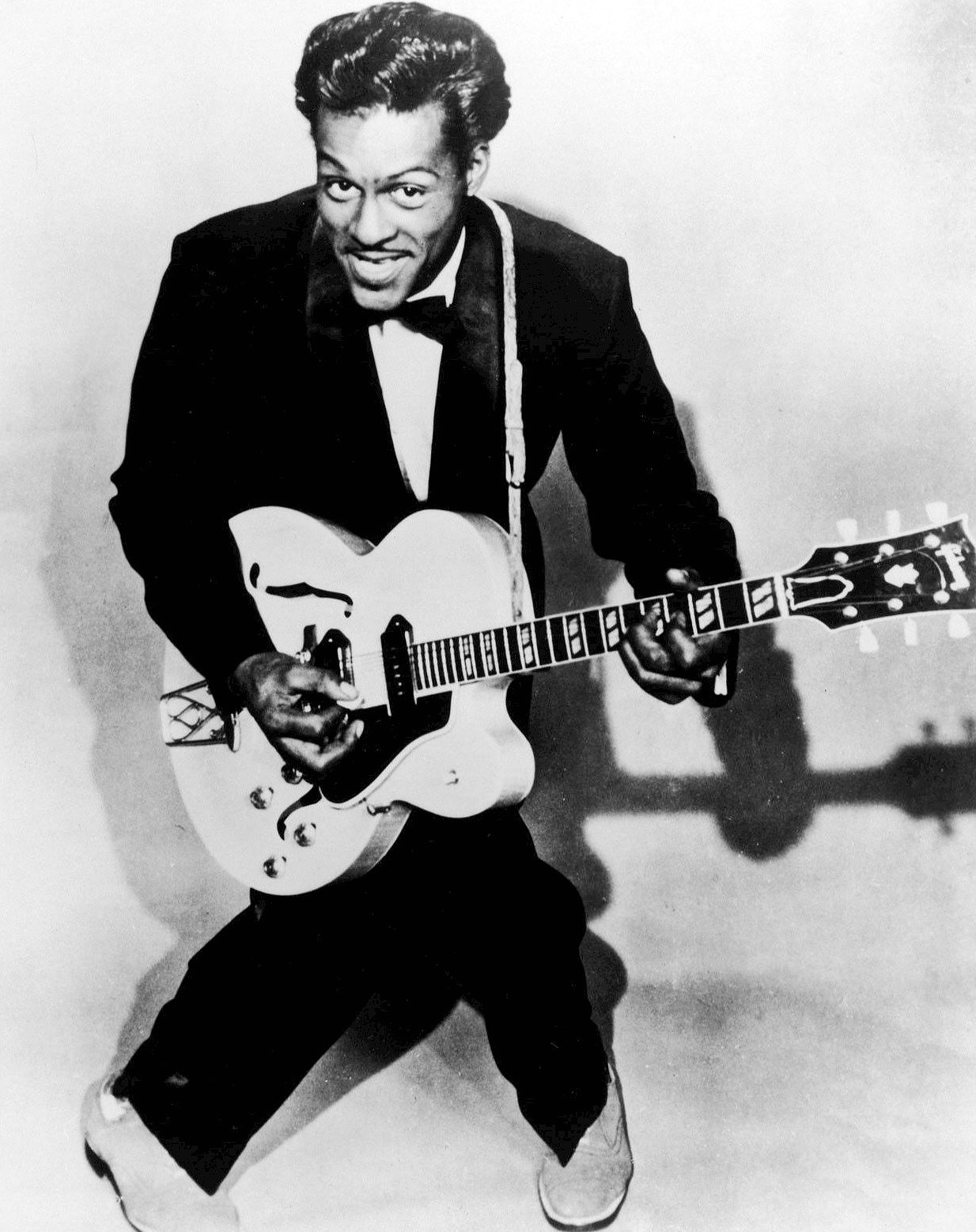
Chuck Berry1950s · Rock and roll / Rhythm and blues
Bolan never hid his debts. "He was only too happy to say, I ripped this off from Chuck Berry, or Muddy Waters, or Johnny Burnette," bandmate Mickey Finn recalled. "I liked that in him, it was a nice quality. He always told everybody. But he did use it magically." Elton John, hearing the acoustic Tyrannosaurus Rex records years before glam existed, put it more bluntly: Bolan was "sitting there in a cloak covered in stars, writing songs that sounded like Chuck Berry, very simple songs." Onstage during T. Rex's imperial run, Bolan even worked the Chuck Berry duck-walk into his strut.
listen: upstream & heresource: Paul Du Noyer — Marc Bolan ↗
1958
Johnny B. GoodeChuck Berry
1971
Get It OnT. Rex
listen for"Johnny B. Goode" runs on a rolling, syncopated guitar figure built to carry a whole song on its own momentum. "Get It On" takes that same boogie chassis, described by one critic as "a Chuck Berry-inspired riff," and buries it under glitter, cowbell, and Bolan's purring come-ons — strip the reverb and studio sheen away and the walking rhythm underneath is still doing Berry's job.
Eddie Cochran1950s · Rock and Roll / Rockabilly
In 1960, one of the American rockers touring Britain played the Hackney Empire, and afterward handed his guitar to a starstruck thirteen-year-old to carry to the waiting car. That boy was Mark Feld, not yet Marc Bolan, and the American was Eddie Cochran, dead in a car crash weeks later on the same tour. Bolan retold the story for the rest of his life. A decade on, T. Rex put the debt on tape directly, cutting a BBC radio session cover of Cochran's own "Summertime Blues" — the teenage encounter turned into an actual recorded performance.
listen: upstream & heresource: Marc Bolan ↗
1958
Summertime BluesEddie Cochran
1970
Summertime Blues (BBC session)T. Rex
listen forCochran's original rides a stomping, hiccupping stop-start rhythm, guitar and drums slamming to a dead stop between each line of a deadpan, wronged-teenager complaint. T. Rex's BBC session take keeps that same lurching stop-start pulse note for note but drags it through Bolan's own strangulated bleat of a voice, half croon and half yelp — the joke of the lyric survives the trip from Cochran's flat Californian drawl all the way to Bolan's glam-era sneer.
Bob Dylan1960s · Folk / Folk rock / Rock
Before either band existed, teenage Mark Feld took a denim cap and an acoustic guitar onto London's folk circuit under the stage name Toby Tyler, singing Dylan covers and Dylan-styled originals. He even taped a version of "Blowin' in the Wind," shelved for decades before it finally surfaced. "Marc fancied himself as a Bob Dylan or a Donovan," producer Tony Visconti said. "He wanted to be seen as a folk-rock poet, but once teenage girls started screaming at the shows he had to become a pop star." The Dylan imitation didn't survive Bolan's fame, but the wordy, image-drunk delivery it taught him did.
listen: upstream & here
1963
Blowin' in the WindBob Dylan
1965
Blowin' in the Wind (Toby Tyler demo)T. Rex
listen forDylan's "Blowin' in the Wind" is plainspoken and unhurried, a lone voice and guitar built entirely around the words. Bolan's own demo of the same song, recorded as Toby Tyler years before Tyrannosaurus Rex, borrows that same bare setup almost note for note — proof that the hiccupping, wordy phrasing he'd later make his own started as a straight Dylan impression.