walking upstream…
KISS



In 1973, Gene Simmons and Paul Stanley set out in New York to build, as Simmons later put it, "the Beatles on steroids: four guys who can write songs, four guys who can sing." They recruited Ace Frehley and Peter Criss, and within months the ambition curdled into spectacle: after Simmons and Criss watched an Alice Cooper show and asked, "what if there was four Alice Coopers?", Kiss split one theatrical monster into four painted characters instead of the New York Dolls' feathers and lipstick they'd studied at the Hotel Diplomat. Beneath the fire-breathing and blood-spitting sat a bar-band songwriting engine built for maximum hook, which is why "Rock and Roll All Nite" outlasted every argument about the makeup.
the sound in question
1975
Rock and Roll All NiteKISS
walk the tributaries ↓
The Beatles1960s · Rock / Pop / Rock and roll
Gene Simmons remembers the exact night: watching the Beatles on the Ed Sullivan Show, "four guys who look alien... singing and playing in ways I hadn't heard before," he told Rock Cellar Magazine, adding that as an immigrant kid he "connected to them because they also didn't feel like they came from here." The fandom hardened into a blueprint. "Kiss really was designed to be the Beatles on steroids," Simmons said elsewhere: a four-man band where, like the Fab Four, "everybody in the band sang."
listen: upstream & heresource: Rock Cellar Magazine — Gene Simmons Q&A ↗
1963
I Want to Hold Your HandThe Beatles
1979
I Was Made for Lovin' YouKISS
listen forListen for how fast both songs get to the hook — no long intro, straight into a singable title-phrase chorus that returns two or three times before the two-minute mark. "We follow the Beatles' songwriting format, A-B-A, verse-chorus-verse basically," Simmons has said, and "I Was Made for Lovin' You" keeps that same economical shape: verse, hook, verse, hook, out — just dressed in disco synths and stadium drums instead of Merseybeat guitars.
Alice Cooper1970s · Shock rock / Hard rock / Glam rock
The whole concept arrived in one night. Simmons and drummer Peter Criss caught an Alice Cooper concert and, in Criss's telling, "looked at one another and said, 'Wow, this guy is really good!'" Back at their loft, the idea multiplied: "what if there was four Alice Coopers?" Cooper had already proven a rock stage could double as a horror set — guillotines, boa constrictors, one theatrical villain. Kiss didn't copy the act; they split it four ways, turning one monster into the Demon, the Starchild, the Spaceman, and the Catman.
listen: upstream & heresource: Louder Sound — the outrageous story of KISS's first 12 months (backs the Alice Cooper and New York Dolls influences) ↗
1972
School's OutAlice Cooper
1975
Rock and Roll All NiteKISS
listen forBoth songs are built for a room to shout back at, not just hear. "School's Out" turns a playground taunt into a coiled hook the crowd can take over from Cooper mid-song; "Rock and Roll All Nite" does the same trick with its title line, the whole band bellowing it until it stops being a lyric and becomes a command. Cooper staged his theater with guillotines and boas; Kiss staged theirs with fire and blood — but the chorus engineered to be chanted, not merely sung, is the same trick underneath.
New York Dolls1970s · Proto-punk / Glam rock / Hard rock
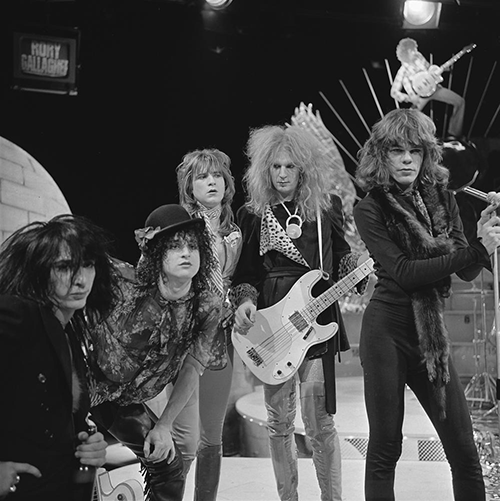
Before Kiss existed, Stanley and Simmons watched the New York Dolls play New York's Hotel Diplomat and came away certain of two things: the musicianship was ragged, and the look was untouchable. Peter Criss later put the debt plainly: "we copied a lot of things. A lot of our ideas, the art of what we did, came from the Beatles, Alice Cooper, the New York Dolls." Rather than chase the Dolls' androgynous, lipstick-and-feathers glam, Kiss swapped in black-and-silver armor and demon paint — the same theatrical instinct pointed at a different costume closet.
listen: upstream & heresource: Louder Sound — the outrageous story of KISS's first 12 months (backs the Alice Cooper and New York Dolls influences) ↗
1973
Personality CrisisNew York Dolls
1974
StrutterKISS
listen forCue up "Personality Crisis" and "Strutter" back to back and the family resemblance is in the walk, not the words — both open on a guitar riff that swaggers rather than drives, built for strutting more than dancing, with vocals that lean on sneer and confidence over range. Kiss scrubs out the Dolls' garage-band sloppiness for tighter, more polished production, but the strut survives the makeover intact — the title of the Kiss song says as much.