walking upstream…
The Beatles



Formed in Liverpool in 1957 as a skiffle group called the Quarrymen, John Lennon and Paul McCartney spent a five-year apprenticeship covering American rock and roll before their songwriting partnership turned that education into original material. What started as mop-top pop built for screaming crowds hardened, within a few years, into restless studio experimentation — tape loops, orchestral arrangements, songs that rewired what a three-minute pop record could sound like. They absorbed rock and roll, girl-group pop, and English music-hall whimsy in roughly equal measure and handed it back unrecognizable. By the time they split in 1970, there was scarcely a corner of popular music left that didn't carry their fingerprints.
the sound in question
1964
A Hard Day's NightThe Beatles
walk the tributaries ↓
Elvis Presley1950s–70s · Rock and roll / Rockabilly / Pop / Gospel
Decades after the Beatles broke up, John Lennon still traced the whole story back to one record. "Nothing really affected me until I heard Elvis," he said. "If there hadn't been an Elvis, there wouldn't have been the Beatles." Elvis Presley's fusion of country twang and gospel-blues abandon on "Heartbreak Hotel" hit Liverpool like a transmission from another planet — proof, to a bored teenager, that a nobody with a guitar could remake the world.
listen: upstream & heresource: Wikipedia — Cultural impact of Elvis Presley (Lennon's "nothing really affected me" quote) ↗
1956
Heartbreak HotelElvis Presley
1963
I Saw Her Standing ThereThe Beatles
listen forPlay "Heartbreak Hotel" against the Beatles' "I Saw Her Standing There" and you won't find a lyric or riff lifted wholesale — the debt here is nerve, not notes. Both records open with a jolt: Elvis's slapback-echoed sneer, then McCartney's spoken countdown into a band trying to sound as electric and as sexually undisguised as the record that started it all for them. It's less a quotation than a dare, answered eight years later.
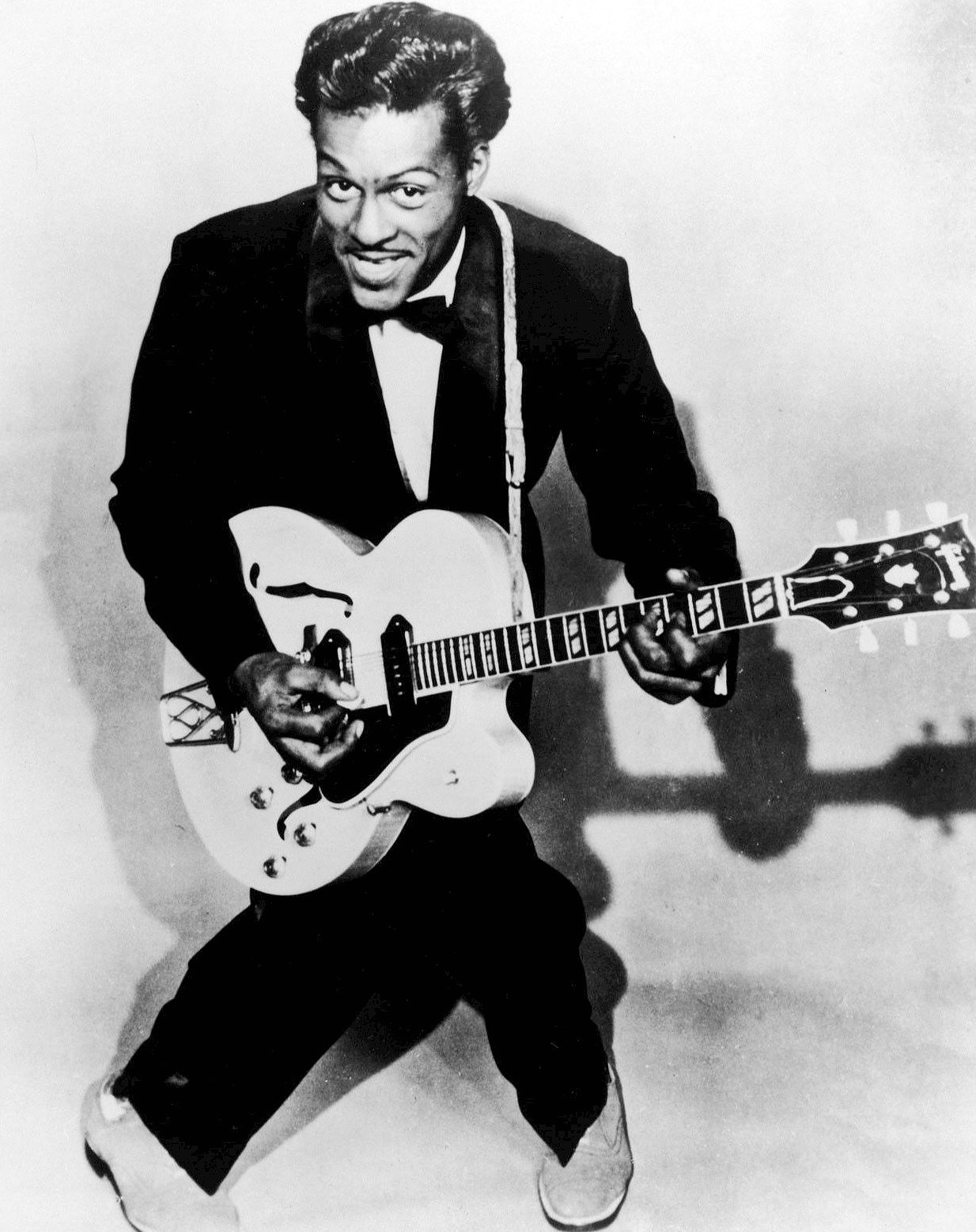
Chuck Berry1950s · Rock and roll / Rhythm and blues
John Lennon was blunt about the debt: "When I hear rock, good rock, the calibre of Chuck Berry, I just fall apart." He wasn't only talking. On "Come Together," Lennon took Berry's "You Can't Catch Me" opening line — "here come a flat-top" — and sang it almost whole as "here come ol' flat-top." Music publisher Morris Levy, who owned the rights to Berry's song, noticed and sued; Lennon settled by recording the original for his 1975 solo album, Rock 'n' Roll.
listen: upstream & heresource: Aaron Krerowicz — The Influence of Chuck Berry on the Beatles (lawsuit, bassline, Lennon quote) ↗
1956
You Can't Catch MeChuck Berry
1969
Come TogetherThe Beatles
listen forSet Chuck Berry's "You Can't Catch Me" against the Beatles' "Come Together" and the theft is unmistakable: the same loping, swampy walk, the same "flat-top" lyric slowed to a crawl and thickened with fuzz. McCartney's bassline carries the groove Berry laid down thirteen years earlier, just dragged half-speed into something murkier and stranger — the blueprint still visible under all the new paint.
Little Richard1950s · Rock and roll / Rhythm and blues / Gospel
In Hamburg, Little Richard took the teenage Paul McCartney under his wing — fed him when the band was broke, and personally taught him to scream. McCartney called the sound "a wild, hoarse, screaming thing, it's like an out-of-body experience. You have to leave your current sensibilities and go about a foot above your head to sing it." When Richard died in 2020, McCartney put it plainly: "I owe a lot of what I do to Little Richard and his style; and he knew it."
listen: upstream & heresource: Grunge — How Little Richard Mentored a Young Paul McCartney (Hamburg mentorship, McCartney quotes) ↗
1956
Long Tall SallyLittle Richard
1965
I'm DownThe Beatles
listen forCue Little Richard's "Long Tall Sally" next to the Beatles' "I'm Down" and listen for the same reckless top of the range: McCartney's opening whoop, notes bent and shredded rather than sung clean, the piano hammering underneath like it might break. It's the exact scream Richard taught him in a Hamburg hotel room, aimed now at a song McCartney wrote so he'd finally have one of his own.