walking upstream…
John Lee Hooker
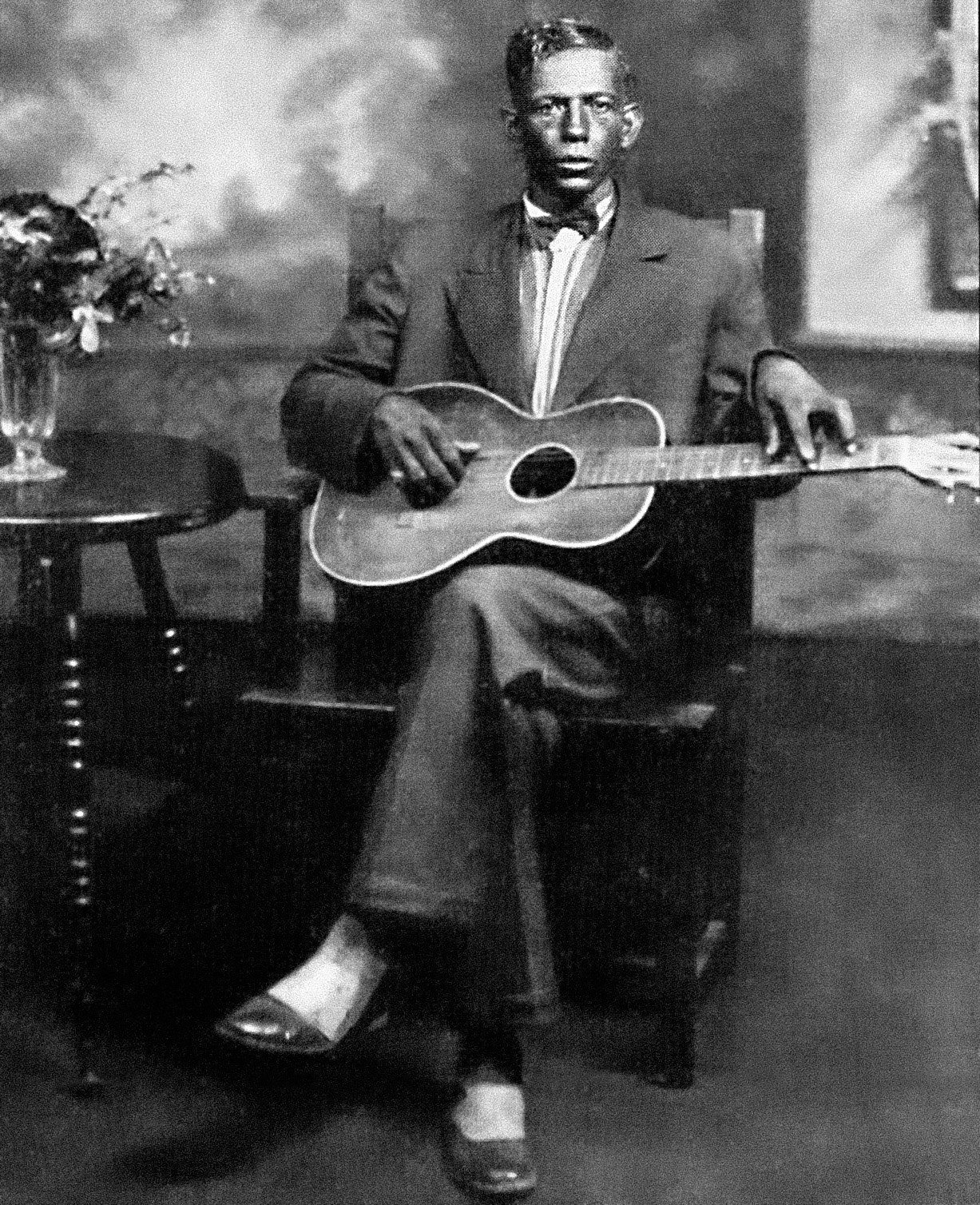
 photo: jean-luc · cc by-sa 2.0 ↗
John Lee Hooker
On August 22, 1917, outside Clarksdale, Mississippi, John Lee Hooker was born the youngest of eleven children to sharecroppers who split when he was small. His mother's second husband, guitarist Will Moore, had carried home a droning, one-chord style from Shreveport, Louisiana, and taught it to the boy; by his teens Hooker had also absorbed touring Delta players like Charley Patton and a young mentor named Tony Hollins, who gave him his first guitar. He left home at fourteen, drifted through Memphis and a decade of gospel singing in Cincinnati, then landed in Detroit in 1943 for factory work and the Hastings Street blues clubs. In 1948 producer Bernard Besman caught him there; the single that followed, "Boogie Chillen'," rode a single hypnotic chord to No. 1 on the R&B chart, and Hooker spent the next five decades reworking that same trance without ever really letting it go.
the sound in question
1948
Boogie Chillen'John Lee Hooker
walk the tributaries ↓
Will Moore1920s · Delta blues
Moore was Hooker's stepfather, a guitarist and farmer who had carried home a droning, one-chord style from Shreveport, Louisiana unlike anything else in the Delta, and by the late 1920s the two were playing parties, fish fries, and dances around Clarksdale together. Decades later, asked where "Boogie Chillen'" came from, Hooker gave Moore the credit outright: "I heard my stepfather Will Moore done it years and years before," he said, recalling that Moore never even had a name for it — "it had that beat, and I just kept that beat up."
listen: upstream & heresource: National Park Service — John Lee Hooker (biography, career, and Will Moore's influence) ↗
Will Moore's droning one-chord style (no recording survives)Will Moore
1948
Boogie Chillen'John Lee Hooker
listen forThere's no recording of Moore's playing to check against — his teaching survives only in what Hooker did with it. So put on "Boogie Chillen'" itself: one chord held and hammered rather than resolved, a foot stomping the floorboards in place of a drummer, a vocal that talks as much as it sings. That refusal to change chords, the whole song worked into something closer to a trance than a tune, is the Shreveport style Moore taught a teenager in Clarksdale two decades earlier, played back almost exactly as he first heard it.
Tony Hollins1940s · Delta blues / Country blues
Hollins was dating Hooker's sister Alice when he taught the teenager guitar and, more consequentially, put an instrument in his hands for the first time. He also handed over a repertoire — he'd cut "Crawlin' King Snake" for the Chicago blues label OKeh Records in 1941, and reportedly taught Hooker his own version of "Catfish Blues" besides. Hooker carried Hollins's song with him for the rest of his career, telling one interviewer plainly, "I got that 'Crawling King Snake' from him."
listen: upstream & heresource: Big Train and the Loco Motives — John Lee Hooker biography (Will Moore and Tony Hollins influences) ↗
1941
Crawlin' King SnakeTony Hollins
1949
Crawling King SnakeJohn Lee Hooker
listen forCue up Hollins's 1941 original first: a loping, midtempo guitar figure with a washboard keeping time underneath, the vocal sliding into the refrain about crawling up to someone's window. Then play Hooker's 1949 version — same title, same window-crawling image, the same coiling repetition — but stripped down and thickened into Hooker's own droning, foot-stomped groove. The words stay Hollins's; the hypnotic pull that made it a hit is pure Hooker.
Charley Patton1920s-30s · Delta blues
Patton never taught Hooker directly — he died in 1934, when Hooker was still a teenager — but Hooker saw him perform in person when Patton came up from the Dockery plantation to play Clarksdale, and the encounter stuck. The National Park Service's account of Patton's legacy credits him with a "hypnotic" style built on three-note figures that "deeply influenced" the younger man, and the debt shows up on record: Hooker later cut his own version of Patton's "Pea Vine Blues," retitled "Pea Vine Special," decades after hearing him play it live.
listen: upstream & heresource: National Park Service — Charley Patton (Patton's influence on Hooker and Pea Vine Blues) ↗
1929
Pea Vine BluesCharley Patton
1959
Pea Vine SpecialJohn Lee Hooker
listen forPatton's 1929 "Pea Vine Blues" — named for the meandering Delta rail line it mourns a lover's departure on — rides a hypnotic, droning guitar figure under a rough, half-hollered vocal. Hooker's own "Pea Vine Special," cut three decades later, keeps Patton's title and structure but flattens the melody into his own single-chord drone, trading Patton's rasp for a murmured, half-spoken delivery. The bones are Patton's; the trance is the same instinct carried forward, decades on.