walking upstream…
ZZ Top

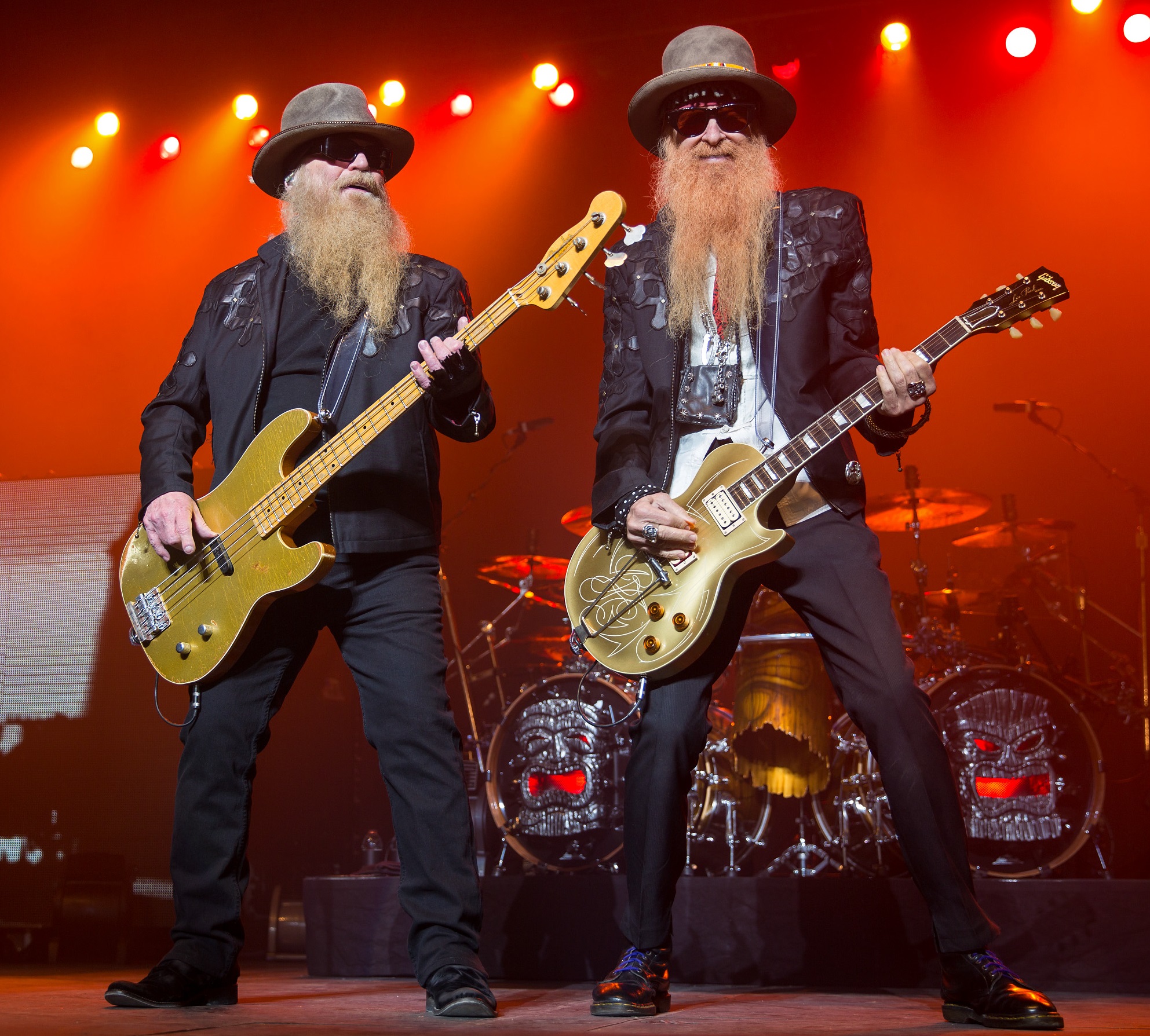
sourcesTexas Monthly — "Still ZZ After All These Years" (Houston upbringing, the Moving Sidewalks opening for the Jimi Hendrix Experience) · Financial Times — "Gimme All Your Lovin' was a perfectly calibrated rock song" (Gibbons on Eliminator's drum-machine breakthrough) · Houston Chronicle — Lanier Greig obituary (1969 formation and name trademark) · setlist.fm — ZZ Top covered songs and artists (confirms the Foxy Lady and Dust My Broom live covers)
Billy Gibbons grew up in a Houston suburb, the son of a society bandleader and pianist, and by his own account was introduced to the blues by his family's housekeeper years before he ever owned a guitar. He formed the psychedelic band Moving Sidewalks as a teenager, then folded it in 1969 to recruit bassist Dusty Hill and drummer Frank Beard as ZZ Top, steering the new trio out of psychedelia toward blues and boogie with an early assist from keyboardist Lanier Greig. Tres Hombres (1973) turned that sound into a hit with 'La Grange'; a decade later, Eliminator (1983) paired the same riffs with a drum machine's 'close-to-perfect time' — Gibbons's own description of the moment — and sold ten million copies. Fifty years and fifteen albums later, he still calls the band 'interpreters,' not innovators.
the sound in question
1973
La GrangeZZ Top
walk the tributaries ↓
Jimi Hendrix1960s · Rock / Blues rock / Psychedelic rock
A friend told the teenage Gibbons there was a song he had to hear — Jimi Hendrix's 'Red House' — and 'that completely turned us upside down,' he told Rolling Stone. Months later his band, the Moving Sidewalks, landed the opening slot on the actual Jimi Hendrix Experience tour of 1968; short on material, they covered Hendrix's 'Purple Haze,' and Gibbons spotted him watching from the wings, 'wide-eyed, grinning.' Backstage at a hotel, Hendrix pulled him aside to show him chords he'd been learning off Jeff Beck's first album — a lesson from the man whose song had already rearranged what Gibbons thought blues guitar could do.
listen: upstream & heresource: Rolling Stone — "Billy Gibbons ↗
1967
Foxey LadyJimi Hendrix
2007
Foxy LadyZZ Top
listen forHendrix's original struts on a fuzzed, sliding riff and a vocal that's part sneer, part come-on. ZZ Top's long-running live version keeps the words and the swagger but drags the riff down into Gibbons's thicker, more distorted tone — the same three chords played like a Texas boogie shuffle instead of a psychedelic strut. It's less a copy than proof of how completely he'd absorbed the lesson Hendrix showed him that night.
Jimmy Reed1950s · Blues / Chicago blues
On Christmas Day 1962, thirteen-year-old Billy Gibbons found a Gibson Melody Maker under the tree — 'the first guitar landed in my lap,' he told Rolling Stone — and by that night he'd worked out the intro to a Ray Charles song by ear before stumbling into something by the Chicago bluesman Jimmy Reed. Reed, not Charles, is the one who stuck. 'He was the good-luck charm,' Gibbons said. 'I'd play Jimmy Reed going to sleep at night — and in the morning.' Every ZZ Top shuffle since traces back to that private, nightly ritual of a kid teaching himself patience one Reed lick at a time.
listen: upstream & heresource: Rolling Stone — "Billy Gibbons ↗
1959
Baby What You Want Me to DoJimmy Reed
1973
Precious and GraceZZ Top
listen forThere's no cover here, just a private inheritance passed down before ZZ Top existed. 'Baby What You Want Me to Do' rides a single lazy guitar figure under Reed's unhurried drawl, refusing to resolve into a chord change until it absolutely must. 'Precious and Grace' runs the same trick at ZZ Top's own tempo: one shuffling riff Gibbons never abandons, the vocal sitting just behind the beat rather than on top of it. What carries over isn't a lick — it's the patience, the willingness to let a groove sit there and do the work.
Robert Johnson1930s · Delta blues / Blues
Gibbons has traced a specific Robert Johnson lick into two of ZZ Top's most enduring songs. Describing the guitar break in 1973's 'La Grange,' he told Rolling Stone: 'The break coming out of the solo, those notes are straight Robert Johnson. He did it as a shuffle. I just dissected the notes.' He returned to the same phrase for that album's 'Jesus Just Left Chicago': 'It's the same chords as "La Grange" with the Robert Johnson lick, but weirder.' One borrowed shuffle, transcribed by ear off a decades-old record, ended up carrying two of the band's signature riffs.
listen: upstream & heresource: Rolling Stone — "Billy Gibbons ↗
1936
I Believe I'll Dust My BroomRobert Johnson
1980
Dust My BroomZZ Top
listen forJohnson's original turns a single fingerpicked slide figure into a call-and-response with his own voice, urgent and unaccompanied. ZZ Top's long-standing live version keeps that same shape but electrifies it: Gibbons's slide guitar takes over the vocal's half of the conversation, turning Johnson's acoustic phrasing into a heavier, sustained electric tone at full band volume. The blueprint survives loud enough to still be legible underneath it.