walking upstream…
Howlin' Wolf
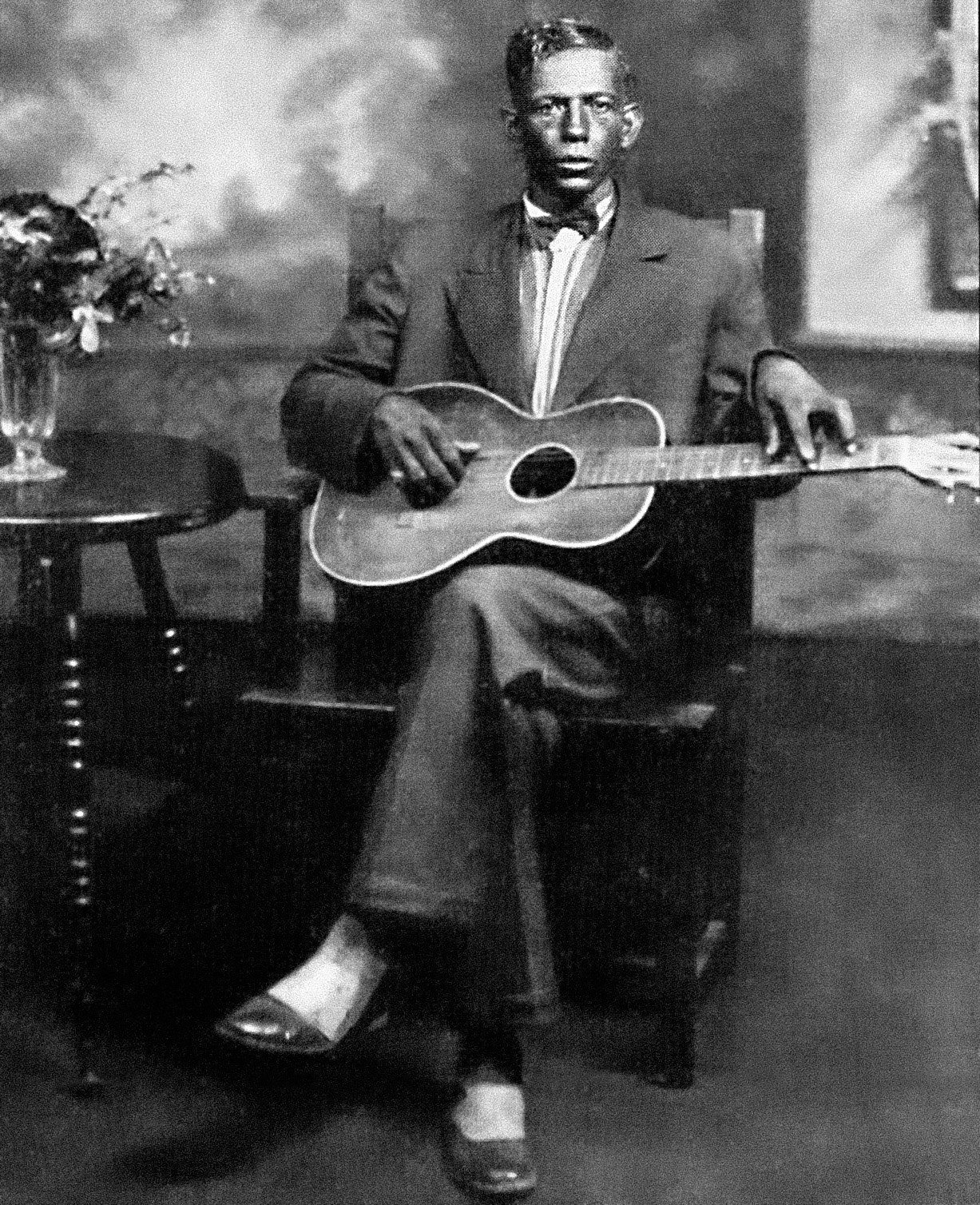

 photo: jeff titon · cc by-sa 4.0 ↗
Howlin' Wolf
sourcesBig Train Blues — The Influence of Charley Patton (Patton's gravelly voice and stage tricks) · American Blues Scene — 10 Things You Didn't Know About Howlin' Wolf (Sonny Boy Williamson II's harmonica teaching lineage) · uDiscover Music — Sonny Boy Williamson (Hadacol Show performance, family connection to Wolf)
Chester Arthur Burnett was born June 10, 1910, in White Station, Mississippi, and named Howlin' Wolf by a grandfather who warned that wolves would come for a boy caught mistreating chickens. His childhood was brutal: turned out by his own mother in winter, then worked and beaten by a great-uncle he eventually fled, walking roughly eighty-five miles barefoot back to his father. What saved him was Dockery Plantation, where Charley Patton taught him guitar, and later Parkin, Arkansas, where his brother-in-law by marriage, the harmonica master Sonny Boy Williamson II, taught him harp. In 1951, Sam Phillips recorded him for the first time and called it the most different record he'd ever heard. Wolf carried Mississippi's whole vocabulary — Patton's showmanship, a country singer's yodel turned inside out — into Chicago and amplified it until it became a blueprint for electric blues.
the sound in question
1960
SpoonfulHowlin' Wolf
walk the tributaries ↓
Charley Patton1920s-30s · Delta blues
For months, twenty-year-old Chester Burnett hovered outside a juke joint at Mississippi's Dockery Plantation just to hear Charley Patton play; eventually Patton let him in and started teaching him guitar. Wolf never forgot the first tune: "the first piece I ever played in my life was ... a tune about hook up my pony and saddle up my black mare" — Patton's "Pony Blues." He also inherited the showmanship, the guitar spun over the shoulder and between the legs, and kept working those tricks into his own act for decades after the lessons ended.
listen: upstream & heresource: uDiscover Music — Charley Patton ↗
1929
Pony BluesCharley Patton
1952
Saddle My PonyHowlin' Wolf
listen forPatton's 1929 "Pony Blues" rides a rough two-line guitar figure under a voice built for open-air distance, no amplifier needed. Wolf's 1952 Chess single "Saddle My Pony" keeps Patton's title, story, and stomping rhythm intact but pushes the guitar into Memphis-studio distortion and roughens the vocal further — the same hook-up-my-pony line, sung by a man who'd learned it note for note twenty years earlier, now running through an electrified Delta blues that's louder, gruffer, and unmistakably his own.
Jimmie Rodgers1920s–30s · Country / Old-time / Blues
Wolf named Jimmie Rodgers, the country singer known as the Singing Brakeman, as one of his biggest idols and said the two met more than once. In a 1967 interview taped by the folklorist Chris Strachwitz, Wolf remembered him plainly: "That was my friend ... I been with him a lot of times ... See, he yodeled. I turned it into something more of a howl." Rodgers's blue yodel — a rural, half-sung, half-warbled break between verses — became the raw material Wolf reshaped into the guttural moan that gave him his stage name.
listen: upstream & heresource: Living Blues #245 — The Brakeman and the Wolf (Jimmie Rodgers' influence, 1967 Strachwitz interview) ↗
1927
Blue Yodel No. 1 (T for Texas)Jimmie Rodgers
1951
Moanin' at MidnightHowlin' Wolf
listen forPlay Rodgers's 1927 "Blue Yodel No. 1 (T for Texas)" against Wolf's 1951 debut single "Moanin' at Midnight" and listen for where the yodel's falsetto break should fall — Wolf puts a ragged, guttural moan there instead. "I couldn't do no yodelin', so I turned to howlin'. And it's done me just fine," he said of the swap. Same structural gap in the verse, opposite texture: Rodgers's high, clean break against Wolf's moan, rising out of his chest like something being forced.
Sonny Boy Williamson II1950s–60s · Blues / Chicago blues / Delta blues
Sonny Boy Williamson II married into Wolf's family in the 1930s, and when the teenage Chester Burnett relocated to Parkin, Arkansas, in 1933, his new in-law began teaching him harmonica — one lesson among many Williamson gave to future stars like Junior Parker and James Cotton. The two later worked the same stage, appearing together on the Hadacol Show, broadcast out of West Memphis radio station KWEM. Wolf never became a harmonica virtuoso on Williamson's level, but the instrument stayed in his hands for the rest of his career, a second voice trading lines with his own.
listen: upstream & heresource: Wikipedia — Howlin' Wolf (biography, Patton and Rodgers testimony, Sonny Boy Williamson II harmonica instruction) ↗
1951
Eyesight to the BlindSonny Boy Williamson II
1956
Smokestack LightningHowlin' Wolf
listen forWilliamson's 1951 "Eyesight to the Blind" leans on a stabbing, bent-note harmonica riff that answers his own vocal line phrase by phrase. Wolf's 1956 "Smokestack Lightning" opens the same way — a repeating harmonica figure, played by Wolf himself, calling back to his own moan between verses instead of just filling space behind it. Neither man treats the harp as decoration; it's a second throat, and the call-and-response Wolf learned from his in-law runs under the whole recording.