walking upstream…
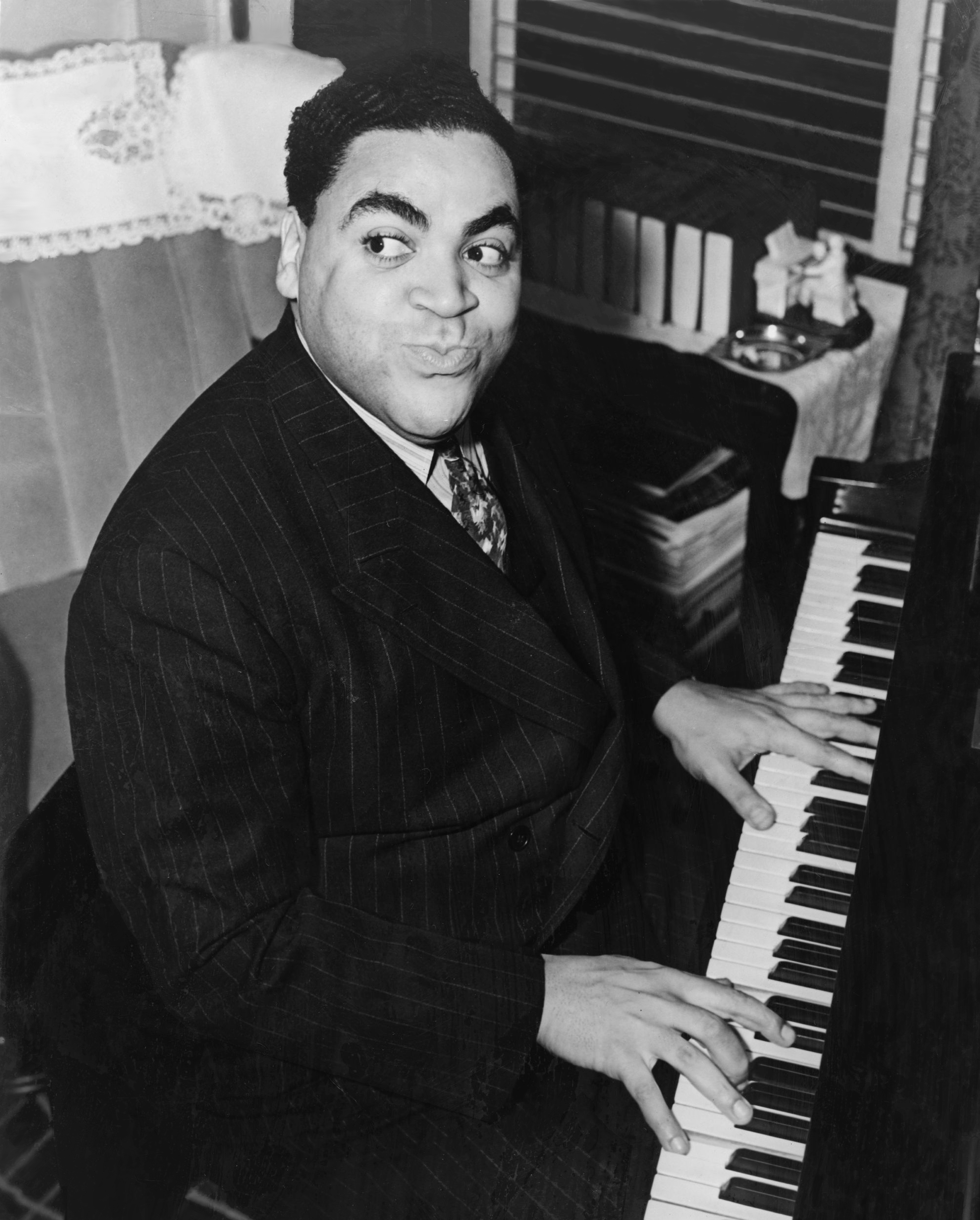
Fats Waller


sourcesRiverwalk Jazz (Stanford) — Harlem Big Three · Musician Guide — Willie the Lion Smith biography (Leroy's audition anecdote, Ellington's testimony) · The Syncopated Times — Fats Waller · JazzProfiles — Thomas 'Fats' Waller 1904-1943 (Giddins/Wilson on Johnson; Armstrong vocal-influence claim) · Internet Archive — 1941 Victor 78rpm disc metadata, Carolina Shout (Waller's cover of Johnson's recording)
When Thomas Waller's mother died, home under his strict minister father's roof became unbearable, and at fifteen he found his way to James P. Johnson's door. Johnson — already the composer of jazz's founding piano solo, "Carolina Shout" — took him in and taught him stride technique for free. Waller repaid the debt in 1941, recording his mentor's own signature piece note for note on Victor. He and Johnson shared the bench at Harlem's punishing rent parties with Willie "the Lion" Smith, forming what Smith himself called the Harlem "big three." Waller became the flashier heir: a hit songwriter ("Ain't Misbehavin'," "Honeysuckle Rose"), jazz's first musician to swing a pipe organ, and a mugging vocal showman modeled partly on Louis Armstrong's gravel. He died of pneumonia on a train outside Kansas City in December 1943, thirty-nine years old, having turned virtuosity into a joke you could dance to.
the sound in question
1934
Honeysuckle RoseFats Waller
walk the tributaries ↓
James P. Johnson1920s · Stride piano / Jazz / Ragtime
When Waller's mother died, home under his minister father's strict roof became unbearable, and he found his way, in his mid-teens, to James P. Johnson's door. Johnson — already the composer of jazz's founding piano solo, "Carolina Shout" — took him in and taught him free of charge. "Johnson and Smith were the mentors, the 'daddies' to Fats Waller," jazz pianist Dick Hyman later said of the arrangement, "...[Waller] went on even to surpass them in some ways." Waller made the debt explicit in 1941, recording his teacher's own signature piece, note for note, on Victor — twenty years after first learning it at Johnson's own piano.
listen: upstream & here
1921
Carolina ShoutJames P. Johnson
1941
Carolina ShoutFats Waller
listen forCue up Johnson's 1921 solo first — the piece that set the test for every Harlem stride pianist, its left hand snapping between low bass notes and mid-register chords while the right hand runs teasing variations over the top. Then play Waller's 1941 remake of the same tune, phrase for phrase: the structure is identical, but Waller's stride swings looser and funnier, the chords a shade fatter, the whole performance grinning where Johnson's is precise. Same shout, twenty years and one very good student later.
Willie "The Lion" Smith1920s-30s · Stride piano / Jazz / Ragtime
At Harlem's Leroy's club, a scruffily dressed sixteen-year-old walked in one night; Smith took one look and nicknamed him "filthy." Then the kid sat down and played James P. Johnson's "Carolina Shout" well enough that Smith gave him a permanent seat on the bench that same night. For the rest of the decade the two shared rent-party duty with Waller as junior partner — "the big three who were most in demand were The Lion, Jimmy Johnson and our shadow, Fats Waller," Smith recalled — and Duke Ellington later credited Smith's "fire, his harmonic lavishness, his stride" as a direct line into Waller's playing.
listen: upstream & here
Echoes of SpringWillie "The Lion" Smith
1934
African RipplesFats Waller
listen forSmith didn't record his lyrical "tone poem" pieces until years after these rent parties broke up — his "Echoes of Spring" wasn't waxed until 1939 — so the recording dates run backward; the real transmission happened live, at the keyboard, in the 1920s. What carries over is the mode itself: away from flashy showpiece stride, toward slower, harmonically rich "descriptive" pieces. Waller's 1934 solo "African Ripples," with its shifting tempos and prettier, more classical voicings, is that same idiom worked out in his own hands.
Louis Armstrong1920s–30s · Jazz
Waller wrote "Ain't Misbehavin'" for the 1929 Broadway revue Connie's Hot Chocolates and personally taught it to co-star Louis Armstrong, who turned it into a solo hit almost overnight. The exchange ran both ways: "Ain't Misbehavin' popularized by the vocal talents of Louis Armstrong, on whose gravelly tone Waller partly modeled his own singing voice," one jazz chronicle records. Waller's own recorded voice — the growled asides, the behind-the-beat mugging — carries that same rasp, borrowed back from the man he'd handed the song to in the first place.
listen: upstream & here
1928
West End BluesLouis Armstrong
1929
Ain't Misbehavin'Fats Waller
listen forPlay Armstrong's wordless scat chorus on "West End Blues" first — that rough, behind-the-beat growl became a template for how a jazz voice could sound like another horn in the band. Then hear Waller's own vocal on "Ain't Misbehavin'" the following year: the same gravel in the tone, the same habit of dragging syllables just behind the beat — though Waller turns it comic where Armstrong plays it dead straight, commentary rather than imitation.