walking upstream…
James P. Johnson
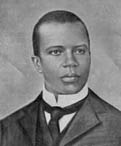

 photo: william p. gottlieb · public domain ↗
James P. Johnson
sourcesWikipedia — James P. Johnson (birth/family, Bruto Giannini classical study, Carolina Shout/Ellington piano-roll story) · Riverwalk Jazz (Stanford) — Runnin' Wild · JazzProfiles — Harlem Piano · Ethan Iverson — In Search of James P. Johnson (Joplin covers, 'Harlem embellishment' description) · Wikipedia — Luckey Roberts (Pork and Beans recording citation trail) · Harlem-Fuss.com — The Recordings of James P. Johnson (discography
James P. Johnson was born February 1, 1894, in New Brunswick, New Jersey, to Josephine Harrison, a choir member and self-taught pianist who filled the house with songs and dances. The family's 1908 move to Manhattan's San Juan Hill put the boy within reach of the city's full musical range, and the leap floored him: "I heard good piano from all parts of the South and West," he said of Jersey City, "but I heard real ragtime when we came to New York." He apprenticed himself to that standard, studying European piano technique while building something new underneath it: a driving, wide-handed left hand that became known as stride. His 1921 solo "Carolina Shout" turned into the test piece every ambitious Harlem pianist learned note for note, Duke Ellington among them. Johnson died November 17, 1955, having spent his last recording years revisiting the ragtime that raised him.
the sound in question
1921
Carolina ShoutJames P. Johnson
walk the tributaries ↓
Luckey Roberts1910s-20s · Ragtime / Stride piano / Broadway musical
In 1913, Johnson went looking for the best pianist in New York and found Luckey Roberts, whose reach across the keyboard was already legend. "Luckey had massive hands that could stretch a fourteenth on the keyboard, and he played tenths as easy as others played octaves," Johnson recalled, describing a left hand built for intervals most players couldn't manage. Johnson studied that technique directly, and the debt outlived the lesson: twenty-five years later, on a solo session cut for the Library of Congress on December 24, 1938, Johnson recorded Roberts's own 1913 tune "Pork and Beans" himself.
listen: upstream & heresource: Ethan Iverson — James P. Johnson (1) (Davin interview reprint ↗
1913
Pork and BeansLuckey Roberts
1938
Pork and BeansJames P. Johnson
listen forRoberts's "Pork and Beans" is built on the wide-stretch left hand Johnson singled out — tenths struck as casually as octaves, driving the beat while the right hand ornaments the melody above it. Johnson's 1938 solo recording of the same tune keeps that architecture but pushes harder into it: listen for the added syncopation and rhythmic push under the tune, stride technique applied to the teacher's own composition a quarter-century after Johnson first studied his hands.
Scott Joplin1900s-10s · Ragtime
Ragtime reached Johnson secondhand at first. "In New York, a friend taught me real ragtime," he said. "His name was Charley Cherry. We played Joplin, then I copied him, then he corrected me." Pianist Alberta Simmons later taught him full Scott Joplin rags by ear — "Maple Leaf Rag" and "Sunflower Slow Drag" among them. Johnson never let the repertoire go: decades later he returned to Joplin's tunes on record, reworking them in his own thickened, syncopated idiom.
listen: upstream & here
1899
Maple Leaf RagScott Joplin
1946
Maple Leaf RagJames P. Johnson
listen forJoplin's own 1916 piano roll of "Maple Leaf Rag," cut for the player-piano manufacturer Aeolian, is metronomic and evenly stated — the mechanical roll captures a composer playing his own melody close to the printed sheet. Johnson's solo recording of the same tune, cut at a 1946 concert led by soprano saxophonist Sidney Bechet, keeps the melody intact but loosens the time and thickens the left hand — what critic Ethan Iverson calls Joplin's music "with Harlem embellishment added."
Eubie Blake1910s-20s · Ragtime / Stride piano / Broadway musical
In the summer of 1914, Johnson made a trip to Atlantic City specifically to hear another pianist he'd been told about. "I went for a visit to Atlantic City and heard Eubie Blake (who composed Shuffle Along later), one of the foremost pianists of all time," he said — placing Blake, alongside Roberts, among the handful of East Coast players Johnson measured his own playing against before 1920. The two never recorded together; this was rivalry more than mentorship, one virtuoso clocking another.
listen: upstream & heresource: Ethan Iverson — James P. Johnson (1) (Davin interview reprint ↗
1917
Charleston RagEubie Blake
1921
Carolina ShoutJames P. Johnson
listen forBlake's "Charleston Rag," preserved on his own 1917 piano roll, is a test piece built to show off hand independence — a steady, syncopated left hand under rapid right-hand runs. Johnson's "Carolina Shout," cut four years later, works the same East Coast "tickler" vocabulary: a driving stride bass under intricate right-hand breaks, the shared toolkit two rival virtuosos were both refining in the years Johnson names as when he sized Blake up.