walking upstream…
Willie "The Lion" Smith
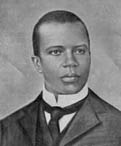
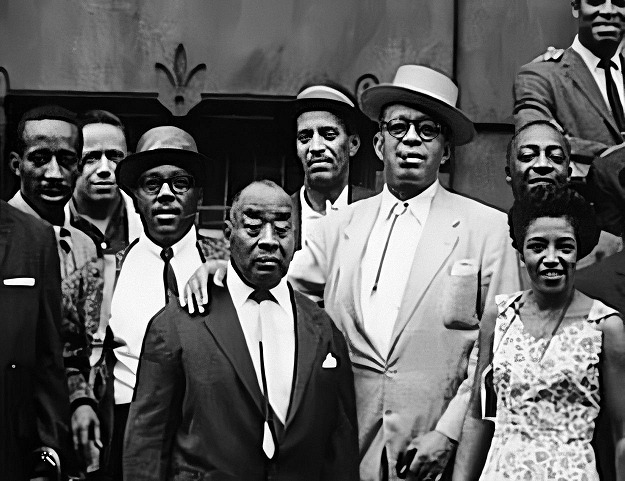
 photo: william p. gottlieb · cc by-sa 4.0 ↗
Willie "The Lion" Smith
sourcesNJN Public Television — Willie the Lion documentary synopsis (Smith's own words on ragging his mother's hymns) · BlackPast.org — William [Willie 'the Lion'] Smith (names his mother, Ida Oliver, from Smith's memoir) · The New York Times — obituary, 1973 (gives Smith's birth as Nov. 24, 1893, contradicting his own claimed 1897) · American Heritage — Maple Leaf Rag by Rudi Blesh (names Smith among the Harlem pianists who knew Joplin's 'Euphonic Sounds') · NPR (A Blog Supreme) — Stride Piano's Uptown Ruler (Roberts as a stated inspiration; birth-year discrepancy; Pork and Beans) · NPR — Jazz Profiles · The Syncopated Times — Profiles in Jazz by Scott Yanow (career chronology; Jan. 10, 1939 Commodore session; 1957 Grand Award LP) · J. The Jewish News of Northern California — Remembering Willie 'The Lion' Smith (Roberts/Johnson/Waller as stride compatriots) · AllMusic — Pork and Beans (session details
Willie "The Lion" Smith told the story of his own name the way he told everything: with a boast attached. Manning an artillery gun on the French front for forty-nine straight days in 1918 earned him the nickname, he always said, and he wore it for life — derby tipped, red vest on, cigar lit. He was less reliable about his birthday: he claimed November 25, 1897, for five decades, though his WWI draft card and, later, his own New York Times obituary both give November 1893. Raised in Newark on hymns, ragtime, and the Hebrew he picked up on his mother's laundry rounds, Smith won a piano in a newspaper contest at twelve and spent the next decade in Harlem's rent parties beside James P. Johnson and Fats Waller, hammering out the two-fisted "stride" style he'd always insist he invented alone.
the sound in question
1939
Echo of SpringWillie "The Lion" Smith
walk the tributaries ↓
His mother, Ida Oliver, was a churchgoing woman who kept a battered organ in the family's Newark basement and taught her son the hymns she knew. Smith's own account of what happened next is the whole record in miniature: "I used to hear my mother play a hymn," he recalled in the public-television documentary Willie the Lion, "and I used to take it and play it in ragtime. I used to go to a saloon, dance, sing and play, then pass my hat around." That transformation — devotional melody bent into syncopated dance music — is the founding move of his style, made before he'd heard a professional ragtime pianist.
listen: upstream & here
No known recording — family organ, NewarkIda Oliver Smith
1939
Morning AirWillie "The Lion" Smith
listen forIda Oliver Smith never recorded — there's no known recording of a self-taught Newark church organist to hold up here. What survives is the shape she left behind: on "Morning Air," cut solo for Commodore Records in January 1939, listen past the stomping left hand to the unhurried, almost hymn-like melody riding over it — the lyrical, churchy side of Smith's writing that critics have long singled out as distinct from his cutting-contest showpieces, and the clearest trace of a Newark basement organ in his whole catalog.
Scott Joplin1900s-10s · Ragtime
At twelve, Smith won an upright piano in a newspaper guessing contest and taught himself from the sheet music circulating through Newark's saloons — Scott Joplin's "Maple Leaf Rag" foremost among it, by his biographers' account. He graduated fast to Joplin's hardest late rag, "Euphonic Sounds": critic Rudi Blesh named Smith directly among the young virtuosos who "knew" the piece, calling it the technical proving ground for the emerging "Harlem, or Eastern, style of ragtime." Joplin supplied both Smith's first repertoire and the bar he had to clear to be taken seriously as a tickler.
listen: upstream & here
1899
Maple Leaf RagScott Joplin
1957
Maple Leaf RagWillie "The Lion" Smith
listen forJoplin's own 1916 piano roll of "Maple Leaf Rag," cut for the player-piano maker Aeolian, states the tune plainly and in strict tempo — a composer close to his own sheet music. Smith's 1957 solo recording, made for the LP The Legend of Willie "The Lion" Smith, keeps the same melody but loosens the beat and thickens the left hand into the rolling stride pattern Harlem pianists built on top of ragtime — the gap between the source and forty years of what Newark's saloons did with it.
Luckey Roberts1910s-20s · Ragtime / Stride piano / Broadway musical
By the time Smith and James P. Johnson were finding their way around Harlem, Charles "Luckey" Roberts had already been a professional for two decades — a vaudeville prodigy from age four, famous for a reach that could stretch a fourteenth on the keyboard. NPR's Nick Morrison put the debt plainly: Smith "played pieces by one of his stride-piano inspirations, Luckey Roberts, and (quite rightly) always gave Roberts high praise," a compliment Smith kept paying on record for the rest of his career, into his sixties.
listen: upstream & heresource: JazzProfiles — Harlem Piano ↗
1913
Pork and BeansLuckey Roberts
1966
Pork and BeansWillie "The Lion" Smith
listen forRoberts's own 1913 recording of his rag "Pork and Beans" shows off exactly the massive-handed stretch that awed his fellow pianists — tenths played as easily as octaves. Smith's version, cut solo in a Villingen, Germany studio in November 1966 as part of a tribute set to his old Harlem circle, keeps Roberts's tune and its cutting-contest bravado intact five decades later, the clearest evidence on record of which rival he rated highest.