walking upstream…
Scott Joplin
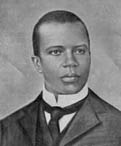 photo: unknown author · public domain ↗
Scott Joplin
Scott Joplin left no diary, no personal letters, and — by the account of his own biographer, Edward Berlin — colleagues whose "reminiscences have proven to be notoriously unreliable." Nearly everything about his early years is reconstructed from census forms and decades-later memory. What's documented: born near Linden, Texas, sometime between June 1867 and January 1868, to a formerly enslaved laborer and a freeborn mother, he was picking out tunes on a neighbor's piano by seven. (A relative's oft-repeated recollection of a fiddling father and banjo-playing mother is, per Berlin's own genealogical research, unsupported anecdote.) What followed was a decades-long, quietly stubborn campaign to drag a music born in saloons into rooms built for Wagner — publishing rag after rag while sketching, abandoning, and finally finishing an opera. He died in a Manhattan asylum in 1917, largely unrecognized, having predicted his own vindication almost to the year.
the sound in question
1899
Maple Leaf RagScott Joplin
walk the tributaries ↓
Julius Weiss1870s-80s · Classical / Opera / German-American choral music
Around 1877, a German immigrant named Julius Weiss arrived in Texarkana to tutor a lumberman's children and, on the side, began giving free lessons to an eleven-year-old Black neighbor: piano, ear training, harmony, and — as the Texas State Historical Association's account puts it — "extensive knowledge and enthusiasm for opera, a fact that probably indicates some conservatory background in his own training." Joplin never let the debt lapse; he corresponded with Weiss for life and sent him money after moving to New York. The same account is direct about where that led: "the influence of mid-nineteenth-century German operatic style and forms is especially noticeable in Joplin's opera, Treemonisha."
listen: upstream & heresource: Handbook of Texas Online — Joplin, Scott (bio, Julius Weiss corroboration) ↗
1880
No known recordingJulius Weiss
listen forThere's nothing to press play on here. Weiss's teaching survives only in the census and a scholar's account; Joplin himself never heard his finished opera performed, since Treemonisha wasn't staged with a full orchestra until decades after his death, so no recording of "A Real Slow Drag," its closing dance number, exists in his own hand or voice. What's left is the paper trail: historians tracing the opera's operatic scaffolding — its arias, its formal set pieces — directly back to the boy who once had Wagner explained to him by a piano teacher he kept paying, in letters and cash, until the end of his life.
In February 1901, a St. Louis newspaper — sources disagree on which one — profiled Alfred Ernst, director of the city's Choral Symphony Society, under the headline "To Play Ragtime in Europe." Ernst had taken an interest in the Sedalia composer and described one session in his own words: "Recently I played for him portions of 'Tannhäuser.' He was enraptured. I could see that he comprehended and appreciated this class of music. It was the opening of a new world to him." Biographers James Haskins and Kathleen Benson credit that afternoon with pushing Joplin toward what "few other Black musicians would dare consider: he would presume to write ragtime opera."
listen: upstream & heresource: James Haskins & Kathleen Benson — Scott Joplin ↗
1901
No known recordingAlfred Ernst
listen forNeither man left a recording. Ernst's choral society never made it onto disc, and no piano roll survives of Joplin playing "The Chrysanthemum," the piece he published three years after this encounter and subtitled, tellingly, "An Afro-Intermezzo." What's documented instead is the shape on the page: ragtime historian Dave Jasen has argued the piece belongs with the more European end of Joplin's catalog — an intermezzo, not a dance rag, its harmonic patterns closer to parlor music than saloon music. It's the nearest surviving evidence of the direction Ernst pushed him toward, even if no one ever captured Joplin himself playing it.