walking upstream…
Luckey Roberts
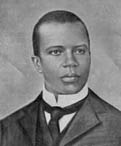
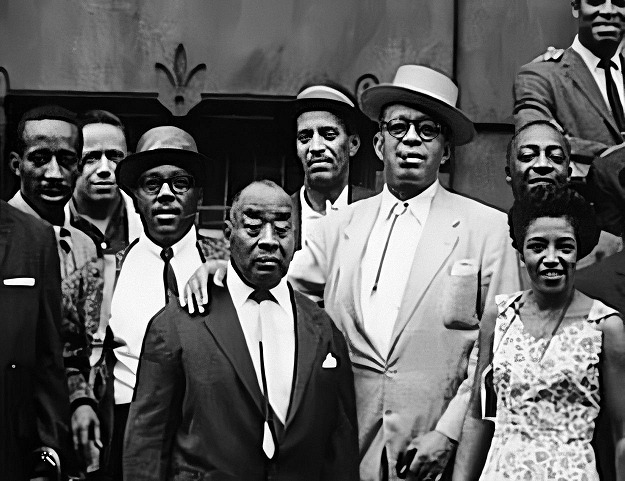
His mother died three weeks after his birth in Philadelphia; his father, unable to raise him, placed the infant with a Quaker vaudeville family, the Ringolds, who had him sleeping onstage in a touring Uncle Tom's Cabin troupe before he could walk far. By five he was tumbling for Mayme Remington's Ethiopian Prodigies; by six he had a carnival piano job in just one key, B natural — "Everybody was hoarse after a day or two," he recalled. His birth year is still disputed (paperwork ranges 1887 to 1895), but by his twenties on New York's rent-party circuit, Roberts's reach — a fourteenth stretch, tenths played as easily as octaves — had made him what critic Nat Hentoff called stride piano's dean, teaching James P. Johnson, Duke Ellington, even George Gershwin. He arrived already a giant; tracing what shaped him means tracking a scene he'd soon tower over.
the sound in question
1946
Ripples of the NileLuckey Roberts
walk the tributaries ↓
One-Leg Willie Joseph1900s · Ragtime
Nat Hentoff's 1960 liner notes list the older "ticklers" Roberts studied hardest as a young rent-party pianist: Jesse Pickett, Sam Gordon, Jack the Bear, Lonnie Hicks, and, ahead of them all, one-legged Willie Joseph, a Boston Conservatory dropout who'd traded a classical career for ragtime after the color line cost him a competition he'd won outright. Jazz historian Con Chapman, citing Eubie Blake's biographer Al Rose, put a number on the debt: Roberts "never failed to name him among the all-time greats." Joseph left no recording of the playing that earned that praise — only two men's testimony that it existed.
listen: upstream & here
No known recordingOne-Leg Willie Joseph
1958
Nothin'Luckey Roberts
listen forThere's nothing of Joseph's own playing to cue up — he died around 1908, before recording reached Black pianists, and no composition survives under his name. What Roberts left behind instead is the kind of feat that made Joseph legendary among his peers: hands that stretched a fourteenth, tenths played as easily as octaves, a tremolo James P. Johnson called "terrific." On the 1958 recording of "Nothin'," listen for exactly that — a two-fisted display built to overwhelm a room, the party-piece style of a generation with nowhere but rent parties and cutting contests to prove what a conservatory wouldn't let them.
Scott Joplin1900s-10s · Ragtime
By the time Roberts started publishing rags in the 1910s, Scott Joplin's "classic rag" style was the standard every ambitious pianist in the idiom answered to, whether he wanted to or not — Roberts's own first published piece came back from its arranger sanded down into, as biographer Bill Edwards puts it, "a Scott Joplin-styled rag." Decades later, listening to Roberts's rare 1946 sides, critic Gary Giddins caught the debt surfacing on Roberts's own terms, hearing "borrowing from Scott Joplin" folded into the wilder "Shy and Sly."
listen: upstream & heresource: ragpiano.com — "Charles Luckeyth 'Luckey' Roberts," Bill Edwards (biography; Junk Man Rag arranged toward a "Scott Joplin-styled rag") ↗
1899
Maple Leaf RagScott Joplin
1946
Shy and SlyLuckey Roberts
listen forCue up Joplin's 1899 "Maple Leaf Rag," the published template every rag after it had to answer to: a steady, four-square left hand under a disciplined, symmetrical melody. Then play Roberts's 1946 recording of "Shy and Sly" and listen for where that discipline slips — the same oom-pah bass turns loose and unpredictable, the melody buckling into the tremolo runs and rhythmic feints Giddins flagged as Roberts working a Joplin phrase into something rowdier, and entirely his own.
Jesse Pickett1890s · Ragtime
The same Hentoff notes that put Willie Joseph at the top of Roberts's list also name Jesse Pickett, an older tickler active on the same circuit since the 1890s. Unlike Joseph, Pickett left something to check the debt against: a novelty piece called "The Dream," preserved only because Roberts's friend and rival Eubie Blake learned it from Pickett directly and recorded it decades later, in 1969. Whatever Roberts himself absorbed from Pickett in that same scene never made it onto paper — it survives, if anywhere, in the loose, rolling left hand of Roberts's own early rags.
listen: upstream & heresource: Geoff Grainger — Jesse Pickett composer discography ("The Dream Rag," 1896, sole surviving composition) ↗
No known recording — Pickett's "The Dream"Jesse Pickett
1958
Spanish FandangoLuckey Roberts
listen forPickett's tune has no recording of its own; what survives is Blake's 1969 memory of it, built on a rocking, habanera-derived bass rather than a straight march beat. Play Roberts's 1915 "Spanish Fandango," recorded in 1958, against that memory and listen for the same loosened pulse: instead of the stiff oom-pah standard ragtime settled into, the left hand swings in an unevenly weighted, Spanish-tinged figure — the kind of pattern the old rent-party ticklers traded among themselves well before it had a name.