walking upstream…
Dizzy Gillespie
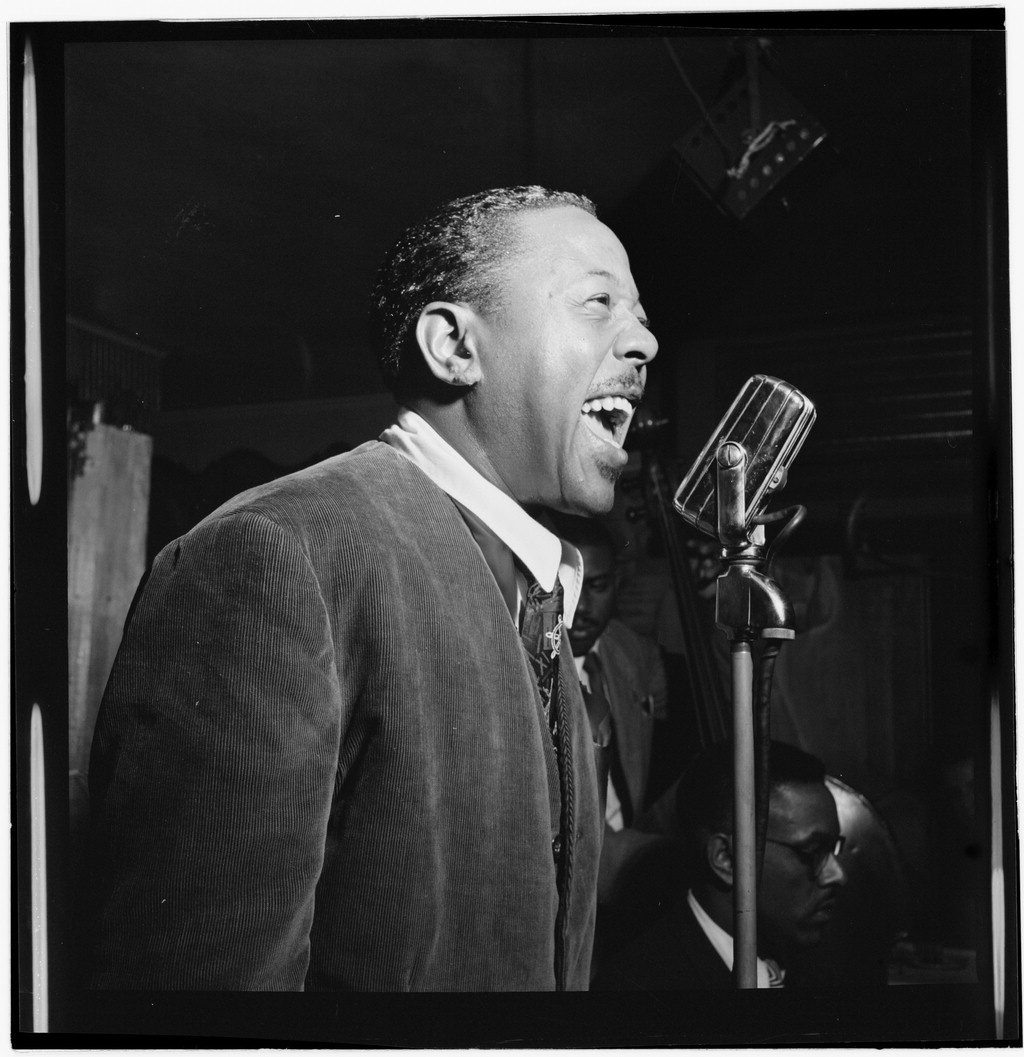


 photo: william p. gottlieb · public domain ↗
Dizzy Gillespie
sourcesPolar Music Prize — Dizzy Gillespie laureate biography (bio; Eldridge radio inspiration and Teddy Hill band) · Grammy — 'Bird And Diz' At 70 (Parker/Gillespie partnership, "dyad of thunderous significance") · JazzArts Charlotte — Dizzy Gillespie, Chano Pozo, and Afro-Cuban Jazz (Bauzá quote, Manteca composition)
John Birks Gillespie was born in Cheraw, South Carolina, in 1917, the ninth child of a brick mason who led the town band. As a teenager he dreamed of a jazz career listening to Teddy Hill's orchestra and Roy Eldridge over NBC national radio; by 1937 he was in New York, in Hill's own band, in the chair Eldridge had just left. At the Three Deuces on 52nd Street in 1945 he found his true foil in Charlie Parker, and their sessions that year — "Salt Peanuts," "Shaw 'Nuff," "Groovin' High," "Hot House" — invented bebop's vocabulary in real time. He had already begun absorbing something else: in Cab Calloway's trumpet section, bandmate Mario Bauzá had turned him toward Afro-Cuban rhythm, and Bauzá's later introduction to conga player Chano Pozo produced "Manteca." The bent horn and balloon cheeks came after — the harmonic revolution came first.
the sound in question
1946
A Night in TunisiaDizzy Gillespie
walk the tributaries ↓
Roy Eldridge1930s–40s · Jazz / Swing
Dizzy grew up wanting one specific job. As a teenager in Cheraw, he tuned in to Teddy Hill's orchestra on NBC radio and latched onto Roy Eldridge's trumpet inside it — three years later he was standing in Eldridge's old chair in Hill's own band, having replaced him outright. Britannica's biography of Eldridge credits him with a style "resembling jazz saxophone improvisation: very fast, scalelike passages," full of "harmonically unorthodox choices of notes and leaps into the high register" that, it says, "provided the basis for Dizzy Gillespie's enormously influential modern jazz trumpet style."
listen: upstream & heresource: Britannica — Roy Eldridge (trumpet style and influence on Gillespie) ↗
1937
Heckler's HopRoy Eldridge
1945
Groovin' HighDizzy Gillespie
listen forEldridge's 1937 "Heckler's Hop" runs on exactly the trick Britannica singles out — scalelike lines launched into the horn's top register at a clip that dares the listener to keep up. Cue up Gillespie's "Groovin' High" eight years later and the same instinct has hardened into a system: faster still, harmonically stranger, the upper-register leaps now landing on chord tones swing trumpet hadn't reached for. Eldridge kicked the door open; Gillespie is the one who ran through it.
Charlie Parker1940s · Bebop / Jazz
By March 1945, Gillespie had hired Parker to complete the front line of his new quintet at the Three Deuces on 52nd Street — the first rhythm section, historians note, fully suited to Parker's ideas. What the pair cut to wax that year became the record of their invention: "Salt Peanuts," "Shaw 'Nuff," "Groovin' High" — built, one jazz historian notes, around an onomatopoeic two-note "bebop" phrase baked into its main theme — and "Hot House." Grammy would later call the partnership "a dyad of thunderous significance."
listen: upstream & heresource: Jerry Jazz Musician — Great Encounters #23 ↗
1945
Ko-KoCharlie Parker
1945
Shaw 'NuffDizzy Gillespie
listen forParker's "Ko-Ko" opens on a written horn fanfare fast enough to blur, then drops into an improvised alto line that never once resolves back onto the tune underneath it. "Shaw 'Nuff," cut the same year, hands that same unison-horn maneuver to two players at once — Gillespie and Parker racing the melody in lockstep before peeling off into solos that sound like a private argument only they can follow. It's the same nerve, doubled.
Mario Bauzá1940s · Afro-Cuban jazz / Big band / Latin jazz
When Mario Bauzá joined Cab Calloway's orchestra in 1938, he lobbied to bring in a young trumpeter he knew from the scene — Gillespie. Inside that same trumpet section, Bauzá planted an idea Gillespie never shook: "with Mario Bauzá in the band, I really became interested in bringing Latin and especially Afro-Cuban influences into my music," he recalled, pointing to a bass pattern broken up from the usual "boom, boom, boom, boom" into "boom-be, boom-be, boom-be, boom-be." Nine years later, Bauzá introduced him to conga player Chano Pozo — and "Manteca" followed.
listen: upstream & heresource: World of Jazz — Mario Bauzá (Cab Calloway connection, Chano Pozo introduction) ↗
1943
TangaMario Bauzá
1947
MantecaDizzy Gillespie
listen forBauzá's 1943 "Tanga" locks a jazz horn section over a Cuban clave the rhythm section never abandons for a straight walk — syncopated, insistent, underneath soloists improvising as if over a swing tune. "Manteca," cut four years later, runs the same trick at big-band scale: Chano Pozo's conga pattern holds the clave down below, and Gillespie's bridge is the one place the band lets go and swings straight, before the vamp pulls everything back into the groove Bauzá had already proven would hold.