walking upstream…
Sarah Vaughan


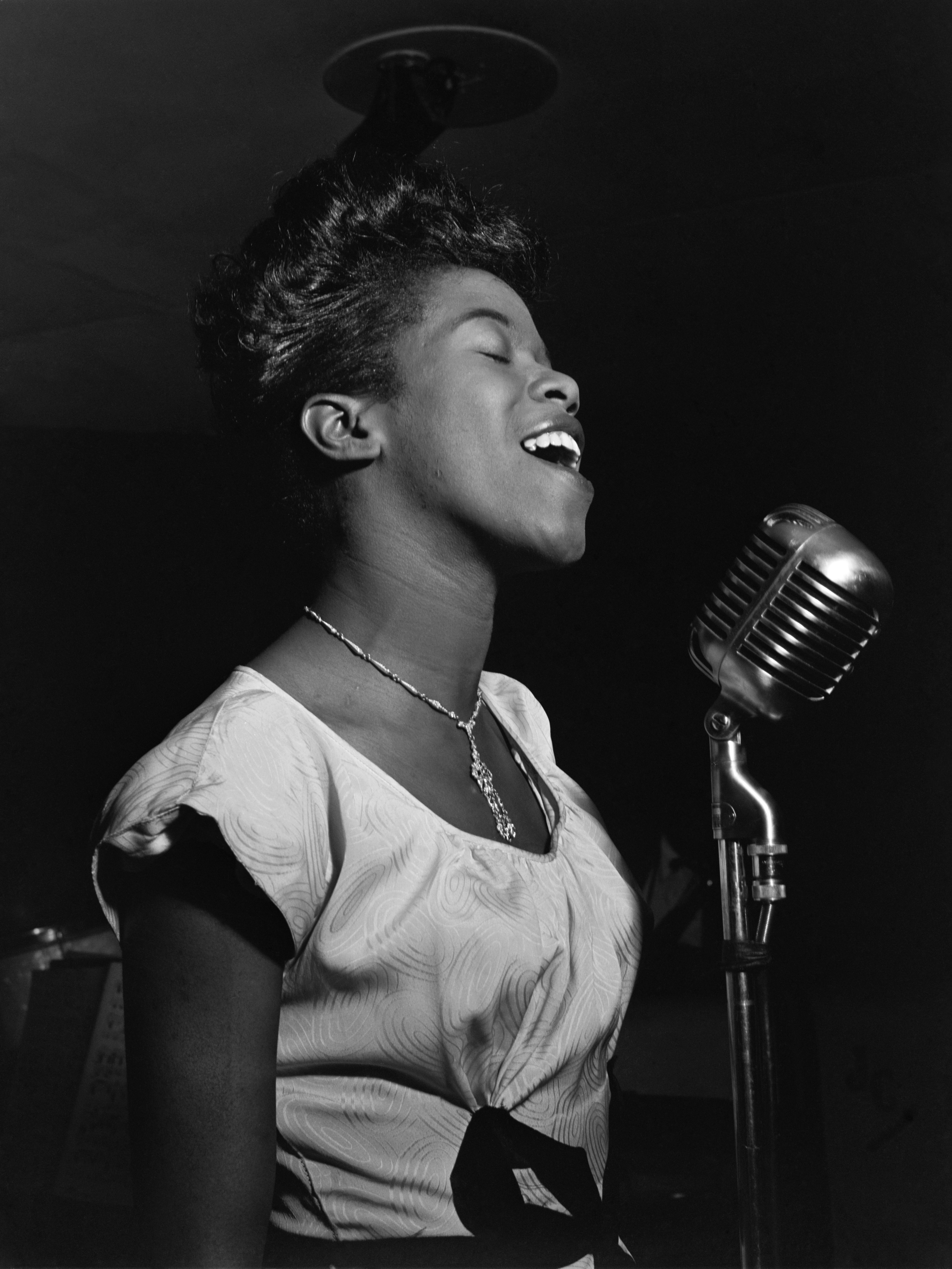 photo: william p. gottlieb · public domain ↗
Sarah Vaughan
sourcesThe New York Times — "Sarah Vaughan, 'Divine One' Of Jazz Singing, Is Dead at 66" (Hines/Eckstine years; Parker and Gillespie playing on her early solo sides) · National Jazz Archive — Sarah Vaughan interviewed by Les Tomkins, 1977 ("two good teachers"; no vocal training) · Down Beat, May 30, 1957 — Don Gold cover story ("I thought Bird and Diz were the end") · michaelminn.net — Sarah Vaughan Discography · Wikipedia — A Night in Tunisia (composition history; January 1944 Gillespie-Pettiford recording; Vaughan's December 1944 "Interlude")
Sarah Vaughan won the Wednesday amateur-night prize at Harlem's Apollo Theater in October 1942 singing "Body and Soul," and within six months was second pianist and vocalist in Earl Hines's big band, wedged onstage between saxophonist Charlie Parker and trumpeter Dizzy Gillespie in what's remembered as bebop's incubator group. She had never studied voice. "Well, not trained," she said later, "because I never had any lessons singing" — only childhood piano and organ lessons and a Newark Baptist choir. What she had instead were two young bandmates remaking jazz beside her nightly, and by her first solo session that December she was already singing like she wanted to be one of their horns.
the sound in question
1954
Lullaby of BirdlandSarah Vaughan
walk the tributaries ↓
Charlie Parker1940s · Bebop / Jazz
Vaughan joined Earl Hines's band in 1943 with Parker in the saxophone section, then recorded directly alongside him from 1945 on, his alto audible on her earliest sides for the Guild label. Explaining why her singing changed, she didn't point to another vocalist: "I thought Bird and Diz were the end," she told Down Beat in 1957. "I think their playing influenced my singing. Horns always influenced me more than voices." The lesson wasn't phrasing borrowed from a singer; it was Parker's instrument, chased until her own voice moved the same way.
listen: upstream & here
1945
Now's the TimeCharlie Parker
1954
Shulie a BopSarah Vaughan
listen forParker's 1945 "Now's the Time" rides a slow blues with the angular, off-the-beat accents that defined bebop phrasing, notes landing just behind or ahead of where the ear expects them. On "Shulie a Bop," cut nine years later, Vaughan scats through the tune in the same clipped, horn-like eighth notes, bending into blue notes rather than singing them straight, the vocal equivalent of an alto saxophone taking a chorus, exactly the kind of transfer she described in her own words.
Dizzy Gillespie1940s · Bebop / Jazz
Twenty years after leaving Hines's band, Vaughan still called Parker and Gillespie "two good teachers" — "if those weren't two good teachers, you just couldn't get any!" she told an interviewer in 1977, recalling how she "matched up" to them onstage. Gillespie backed that mentorship with tape: at her very first solo session, December 31, 1944, he played trumpet behind her on "Interlude," a vocal rendition of his own new composition, cut for the Continental label under that original title, years before the tune, renamed "A Night in Tunisia," became a jazz standard.
listen: upstream & here
1944
A Night in TunisiaDizzy Gillespie
1944
Interlude (A Night in Tunisia)Sarah Vaughan
listen forThe surviving January 1944 acetate of Gillespie's group, muffled but audible, is built on the tune's signature vamp: an unsettled bass line rocking between two chords a half-step apart, under Gillespie's daring trumpet breaks. Eleven months later, Vaughan's "Interlude" opens on that same eerie vamp, then sings the melody Gillespie had only played, phrasing the angular line like a horn solo rather than a lyric, his composition given words for the first time with the composer himself audible on trumpet behind her.