walking upstream…
Björk


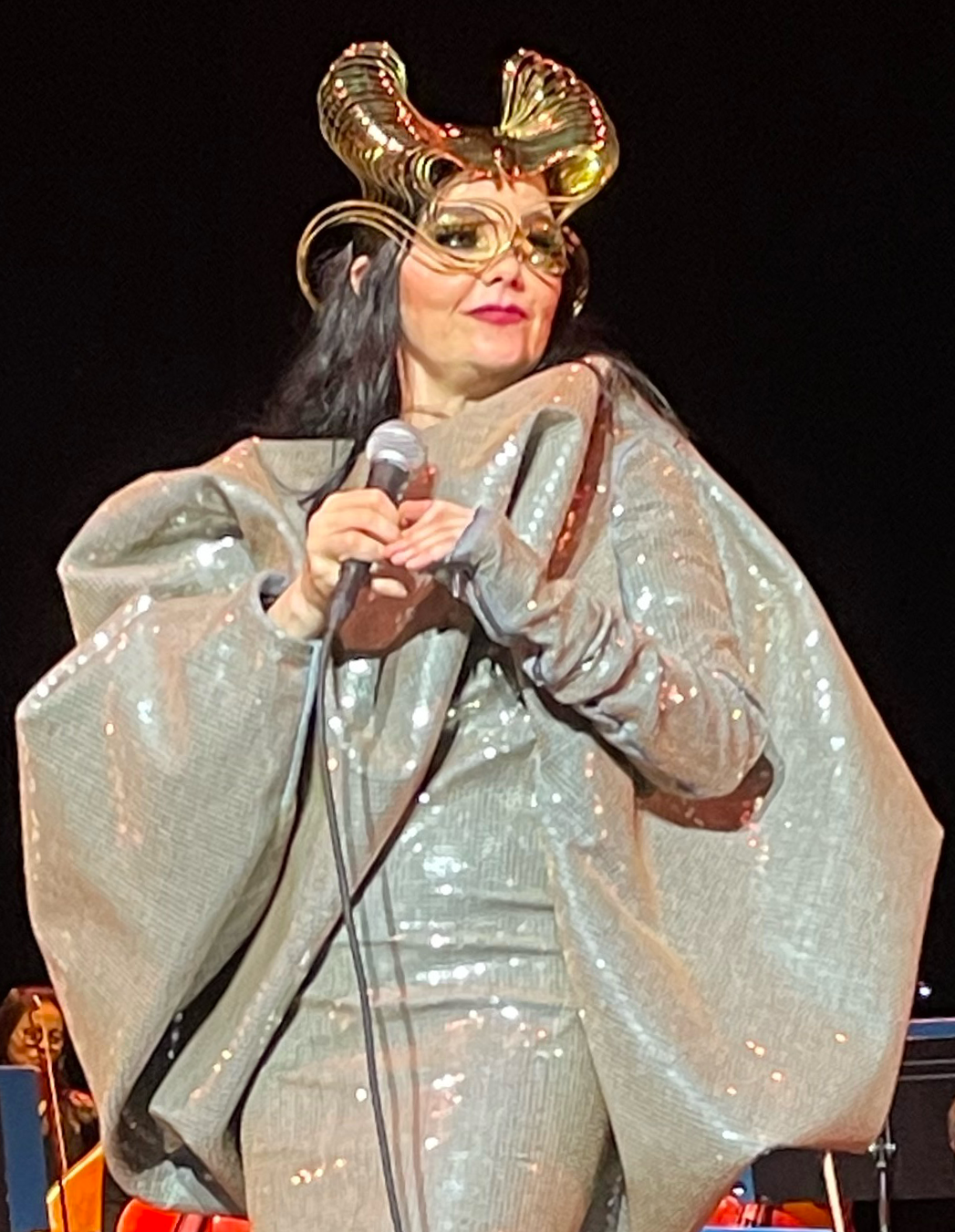
Björk Guðmundsdóttir was born in Reykjavík in 1965 and spent the 1980s in the city's punk and post-punk scene before fronting the Sugarcubes, the Icelandic band whose surprise 1988 hit briefly made her the most recognizable voice out of Iceland. When the band folded in 1992 she left for London, chasing club, orchestral, and electronic textures no Reykjavík studio could offer. Debut (1993) and Post (1995) rebuilt her as a solo artist answering to no genre; by Medúlla (2004) she had gone further still, building an entire album almost solely from the human voice — hers, layered and multiplied, alongside guest singers and beatboxers. Across five decades, the constant has been the same restless conviction: the voice is not a delivery system for a song, it is the instrument, rebuilt from scratch on every record.
the sound in question
1995
Army of MeBjörk
walk the tributaries ↓
Joni Mitchell1970s · Folk / Folk rock / Jazz
As a teenager in Reykjavík, Björk found Joni Mitchell almost by accident — 'the wrong albums arrive to shore' in Iceland, she told Pitchfork in 2015, and the ones that reached her were Don Juan's Reckless Daughter and Hejira. Of the first Mitchell record she owned, she has said she knew it 'by heart, every instrument, every noise, every word.' Three decades later, when Nonesuch Records gathered artists to cover Mitchell's songs for a 2007 tribute album, Björk picked a deep cut from The Hissing of Summer Lawns and sang it herself.
listen: upstream & heresource: Pitchfork — The Invisible Woman ↗
1975
The Boho DanceJoni Mitchell
2007
The Boho DanceBjörk
listen forMitchell's 1975 original moves in loose, conversational phrases, her voice sliding around the beat instead of locking to it, more spoken confidence than melody. Björk's 2007 cover keeps that same wandering phrasing intact but drops it into an arrangement Mitchell never touched — icy synth pulses and a skittering, semi-mechanical percussion track underneath, so the identical vocal line ends up sounding like it was recorded decades apart, which it was.
Karlheinz Stockhausen1950s–60s · Electronic / Avant-garde / Musique concrète
In 1996, Björk did the interviewing herself, sitting down with Karlheinz Stockhausen for Dazed & Confused. Worried aloud that she'd never have time to make everything she wanted to make, she got a blunt answer back: 'No, you can only do a very small portion of what you want to do. That is natural.' Eleven years later, writing his Guardian obituary, she called his lectures 'the most hopeful of figures: the twenty-first century was going to be great' — the same faith in electronics as a genuinely new language that pushed her, by 2004, toward an album built from voices alone.
listen: upstream & heresource: The Guardian — Björk's essay on Karlheinz Stockhausen (his death; 'most hopeful of figures'; the Cologne studio memory, 2008) ↗
1968
StimmungKarlheinz Stockhausen
2004
Pleasure Is All MineBjörk
listen forStimmung asks six singers to hold single vowels and let the overtones inside each note slowly separate and shimmer — the piece barely counts as 'sung,' just breath and pitch stretched into pure texture. 'Pleasure Is All Mine,' built from Björk's own layered voice, beatboxers, and Tanya Tagaq's throat singing, does the same thing from a different angle: no instrument anywhere on the track, just the human voice pulled apart into rhythm, drone, and overtone until it stops sounding like singing at all.
Kate Bush1980s · Art pop / Progressive pop / Alternative rock
In September 2022, with Bush's 'Running Up That Hill' newly inescapable on the radio again, Björk gave NME a blunt piece of overdue history. 'I was always quite offended by how often Kate Bush was written about like she was insane or a crazy witch — or me being a crazy elf,' she said, naming Bush as one of the pioneering producers critics preferred to file as 'just a singer.' It's the shared insult that explains the debt: two women who built and ran their own studios, treated as novelty acts instead of engineers.
listen: upstream & heresource: NME — Björk hits back at the sexism levelled against her and Kate Bush (Kate Bush influence; shared 'insane'/'crazy elf' reception, 2022) ↗
1978
Wuthering HeightsKate Bush
1993
Human BehaviourBjörk
listen forBush's voice on 'Wuthering Heights' does what no other 1978 radio hit dared: it leaps a full octave mid-phrase, swooping and cracking exactly where a more polished singer would smooth the line out. That same untidy, register-jumping swoop drives the opening minute of 'Human Behaviour' — Björk's voice arcs and catches instead of gliding, treated as a wild instrument rather than a clean carrier for melody, the nerve Bush pioneered still audible fifteen years later.