walking upstream…
Kate Bush



Kate Bush was sixteen when a Pink Floyd guitarist heard her family's rejected demo tape and paid for a better one. She had already taught herself piano in a barn behind her parents' Kent farmhouse, worshipping two heroes on her bedroom wall: an eleven-year-old's crush on Elton John's fingers, and a teenager's fascination with David Bowie's audacity. She spent her advance not on a studio but on dance classes with Bowie's own movement teacher, Lindsay Kemp, learning to build a song into a small production before she released one. At nineteen she topped the UK singles chart with the self-written "Wuthering Heights" -- the first woman to do it -- arriving in pop as a fully formed character actor who happened to sing. Everything she took from her earliest heroes -- theatrical nerve, pianistic ambition, atmospheric weight -- she kept reassembling into records that sounded like no one else's.
the sound in question
1985
Running Up That Hill (A Deal with God)Kate Bush
walk the tributaries ↓
David Bowie1970s · Art rock / Glam rock
Bush pinned Bowie's photograph on her bedroom wall next to her other idol, and later put the reason plainly: "David Bowie had everything. He was intelligent, imaginative, brave, charismatic, cool, sexy and truly inspirational both visually and musically." It wasn't one song that hooked her but his refusal to repeat himself -- she was drawn to how "he made every album different, and explored uncharted territory." Before she recorded a note of her own, she spent her EMI advance on dance classes with Bowie's own movement teacher, Lindsay Kemp, learning that a song could be staged, not just sung.
listen: upstream & heresource: Music Musings & Such — Present and Modern Love ↗
1972
StarmanDavid Bowie
1978
Wuthering HeightsKate Bush
listen forPlay Bowie's 1972 "Starman" beside Bush's 1978 breakthrough and listen for the same theatrical trick: a voice pitched between speech and opera, straining upward at the chorus like a character stepping into a spotlight rather than a singer confessing something true. Both tracks build a whole persona in a few minutes -- Bowie's alien messenger, Bush's ghost calling through a window -- with strings and staging doing as much work as the lyric. It's a kinship of ambition, not a direct lift: no single Bowie record is her acknowledged model here, but the theatrical nerve is unmistakably shared.
Elton John1970s · Pop / Rock / Piano rock
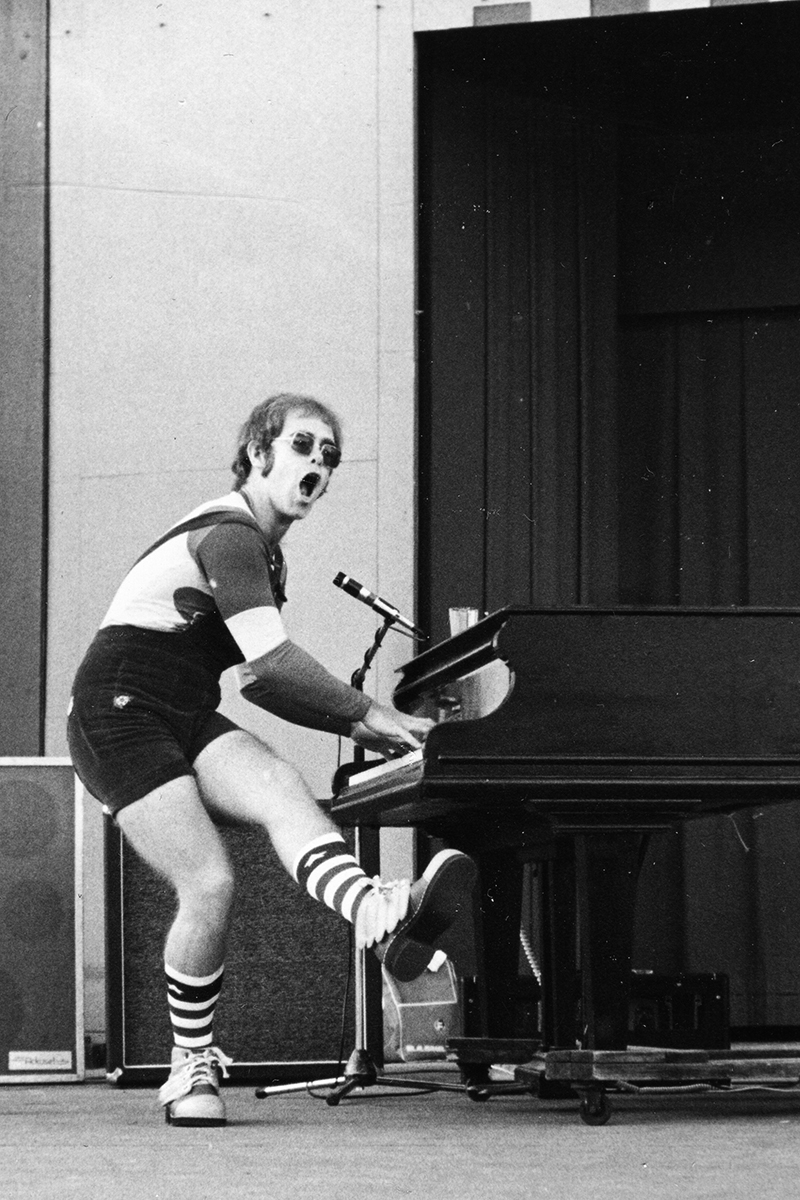
In a 1985 interview she named her first idol without hedging: "I was such a big fan of Elton John...he was the first musical hero I had in that I aspired so much to what he was doing...he was the only one I'd ever seen who wrote songs and accompanied himself on the piano." Six years later she made the debt literal, covering "Rocket Man" for a tribute album, writing in the liner notes that from age eleven he'd been her biggest hero and she'd hoped one day to "play the piano like him" -- a hope she'd long since fulfilled.
listen: upstream & heresource: Musician magazine, "Reaching Out" (1985, archived at gaffa.org) — Bush names Elton John her first musical hero ↗
1972
Rocket ManElton John
1991
Rocket ManKate Bush
listen forBush's 1991 "Rocket Man" keeps Elton John's melody and lyric intact but strips out the original's orchestral lift-off, replacing rocket-launch strings with a loping reggae skank, concertina and uilleann pipes -- turning a countdown into something closer to a lullaby. Put the two versions back to back and the piano hero she named in 1985 is still audible underneath: the same chord changes and vocal shape, rebuilt in an entirely different instrumental language.
Pink Floyd1970s · Progressive rock / Psychedelic rock / Art rock
Gilmour didn't just admire the teenage Bush's demo -- he paid for a better one and produced her first two albums outright, doors his own reputation opened that a rejected homemade tape never could. The debt showed up in her ambition, not just her career: writing "Breathing" in 1980, she said, "I call that my little symphony...every writer, whether they admit it or not, loves the idea of writing their own symphony" -- the same widescreen scale Pink Floyd built entire albums around.
listen: upstream & heresource: Music Musings & Such — Only the Fools Blew It ↗
1975
Welcome to the MachinePink Floyd
1980
BreathingKate Bush
listen forPlay Pink Floyd's 1975 "Welcome to the Machine" against "Breathing" and listen for the shared machinery: one critic reviewing the song noted its mechanical hum in the second verse "evokes memories of Pink Floyd's luddite threnody Welcome to the Machine" -- the same synthesized drone suggesting something inhuman grinding on beneath a human voice. Bush's song imagines a fetus absorbing nuclear fallout rather than an industry devouring artists, but the dread is built from an identical texture.