walking upstream…
A Tribe Called Quest


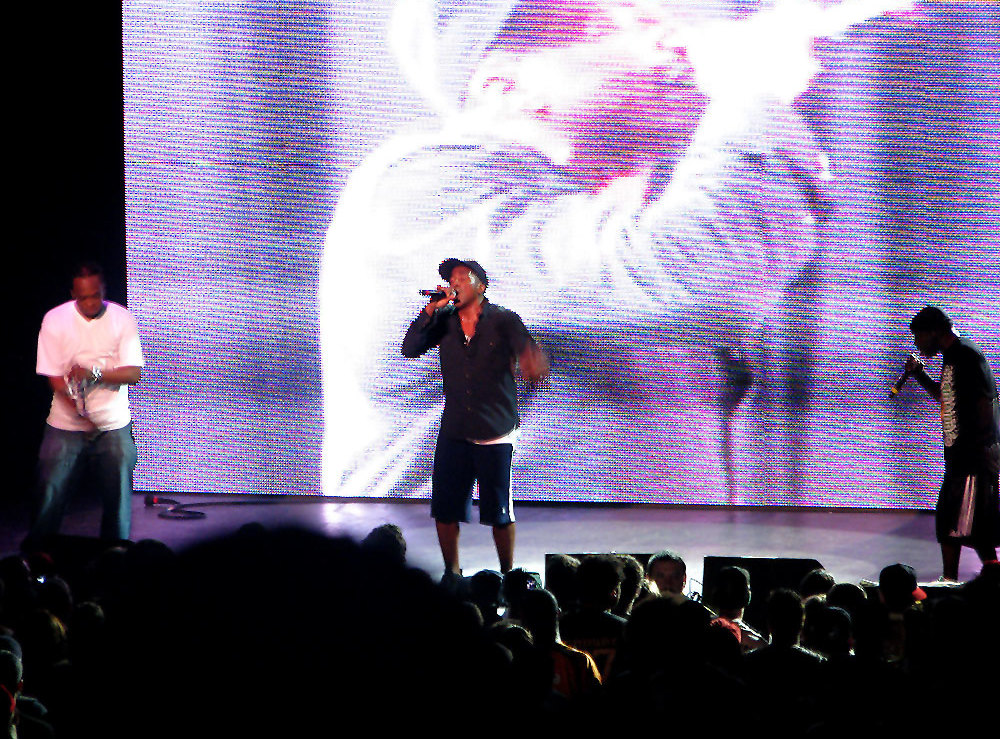 photo: chalice l. (flickr: hicharice) · cc by-sa 2.0 ↗
A Tribe Called Quest
sourcesWikipedia — A Tribe Called Quest (formation, Native Tongues co-founding, discography) · Wikipedia — Q-Tip (musician) (jazz upbringing, pause-tape beats) · Tracklib — The Jazz-Funk Keyboardist Who Mentored Hip-Hop Legends (piano-for-rap lessons, "Master Wel," Q-Tip's Award Tour quote) · WhoSampled — Award Tour / We Gettin' Down (sample pair confirmation) · Ambrosia For Heads — De La Soul on the Native Tongues' Boston-gig origin (Dave/Trugoy quotes) · Wikipedia — De La Soul (eclectic sampling, Native Tongues Posse) · Grammy.com — How Native Tongues Expanded Hip-Hop (movement's impact, De La Soul's jazz-tinged sound) · Wikipedia — "Me Myself and I" (De La Soul song) (Q-Tip/Ali Shaheed Muhammad video cameos)
In 1985, two Queens teenagers, Kamaal Fareed and Malik Taylor — soon Q-Tip and Phife Dawg — began trading rhymes over pause-tape beats Q-Tip built from his father's jazz records. Their high-school classmates in Jungle Brothers named the fledgling group in 1988, the year Q-Tip and Phife helped found the Native Tongues, a loose alliance of rappers who swapped gangster rap's menace for eclecticism and Afrocentric humor. Their unhurried 1990 debut, People's Instinctive Travels and the Paths of Rhythm, was followed by The Low End Theory and Midnight Marauders, which fused rap so completely to jazz's harmonic language that critics still call them blueprints for the genre. Phife Dawg died in 2016, eight months before the group's final album topped the charts — proof the sound he and Q-Tip built together still had an audience.
the sound in question
1993
Electric RelaxationA Tribe Called Quest
walk the tributaries ↓
Miles Davis1950s–70s · Jazz / Modal jazz / Jazz fusion
Q-Tip's father filled their home with jazz, and by twelve Q-Tip was flipping those records into pause-tape beats. The specific lesson, though, came from Davis's own words: reading an old interview where Davis discussed "the musicality of space," Q-Tip realized "it's what's between the notes that makes us stick out." He tore up the straight, bar-for-bar verse he'd already written for "Bonita Applebum" and rebuilt it, months later, until it "kinda broke it down like a conversation" — the silences doing as much work as the syllables.
listen: upstream & heresource: Red Bull Music Academy — Q-Tip lecture (Miles Davis's concept of "space" shaping Bonita Applebum) ↗
1959
All BluesMiles Davis
1990
Bonita ApplebumA Tribe Called Quest
listen forCue "All Blues" and notice how much Davis leaves unplayed — phrases that trail into open air instead of resolving on the beat. "Bonita Applebum" works the same trick vocally: Q-Tip lets lines hang a half-beat past where a typical rap cadence would land, drifting in and out of the sampled groove rather than stacking words on top of it. The pause, in both recordings, is the hook.
Weldon Irvine1970s · Jazz-funk / Soul / Jazz
Weldon Irvine offered free piano lessons to Queens teenagers in exchange for rap coaching — "Master Wel," he called himself when the student became the teacher. Q-Tip was one of them, and years later he repaid the debt on record, sampling Irvine's 1975 Rhodes line for "Award Tour": "It's all about that bassline. I just wanted to flip it, so I went through some more records and I got that Rhodes to counter the melody in the bassline." In 2008, on his song "Shaka," Q-Tip named Irvine again, among the mentors and the dead he still carried.
listen: upstream & heresource: Wikipedia — Weldon Irvine (mentorship bio, the 2008 "Shaka" tribute) ↗
1975
We Gettin' DownWeldon Irvine
1993
Award TourA Tribe Called Quest
listen forPlay "We Gettin' Down" and find the warm, four-note Rhodes figure gliding under the horns partway through — the same phrase anchors "Award Tour" from its opening bar, looped tight beneath Q-Tip and Phife's trade-off verses. Irvine let the riff breathe inside a full band; Q-Tip isolates it, stripping away everything but the hook until the borrowed chord becomes the record's actual bassline, exactly as he described flipping it.
De La Soul1980s–90s · Hip hop / Alternative hip hop / Jazz rap
The Native Tongues began with a phone call. "Afrika [Baby Bam] called me that night, like, two in the morning," Q-Tip told one interviewer. "Yo these kids, De La Soul, you gotta meet 'em!... it was just fuckin' love at first sight." De La Soul's Dave, later known as Trugoy the Dove, places the origin at a shared Boston gig instead: "To begin with, it was us, Tribe, and Jungle... we invited them to the studio." Q-Tip and bandmate Ali Shaheed Muhammad later turned up as cameos in De La Soul's own video for "Me Myself and I."
listen: upstream & heresource: Consequence of Sound — Q-Tip on meeting De La Soul ("love at first sight" quote) ↗
1989
Me Myself and IDe La Soul
1990
Can I Kick It?A Tribe Called Quest
listen forBoth tracks build a verse on top of one looped, unmistakable bassline borrowed from outside hip-hop's usual sources — Funkadelic's groove drives "Me Myself and I," Lou Reed's "Walk on the Wild Side" underpins "Can I Kick It?" Neither group buries the source: the bass stays up front, barely altered, while the rapping stays loose and conversational, never rushing to fill the space the sample already occupies. Same trick, worked a year apart, by groups sharing one crew.