walking upstream…
Kanye West
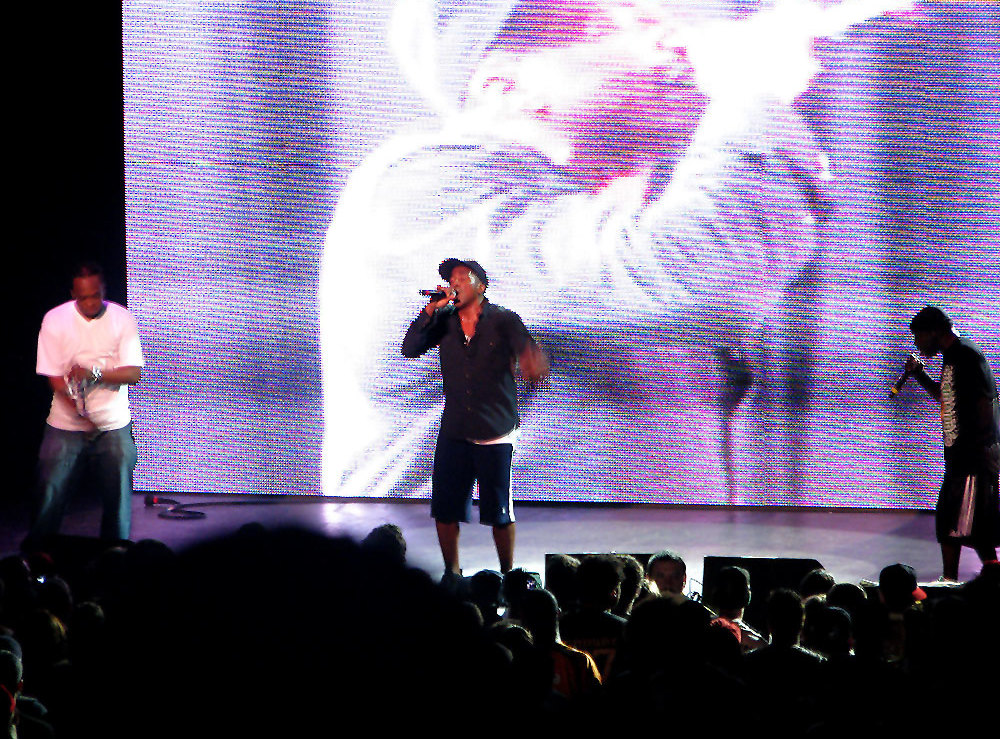


 photo: david shankbone · public domain ↗
Kanye West
In 1997 a Chicago State University sophomore named Kanye West took his tuition money, dropped out, and traded a business degree for a producer's chair — the chipmunk-pitched soul loops that would define hip-hop's next decade. Jay-Z heard the style on Beanie Sigel's "The Truth" and pulled him into Roc-A-Fella Records, where West's work rebuilding The Blueprint (2001) around sped-up vocal samples announced a new production language before he ever picked up a microphone. When executives balked at signing him as a rapper, he made The College Dropout (2004) largely to prove them wrong, then spent two decades refusing to repeat himself — orchestral maximalism, industrial minimalism, gospel choirs — insisting, however chaotically, that the producer could be the star.
the sound in question
2004
Jesus WalksKanye West
walk the tributaries ↓
A Tribe Called Quest1990s · Hip hop / Jazz rap / Alternative hip hop
At Phife Dawg's 2016 memorial inside Harlem's Apollo Theater, Kanye didn't offer condolences so much as a confession: "Tribe made Kanye West. Made the kid with the pink Polo. Made it so I could dress funny." He described buying Low End Theory as the first album he ever bought, the tape that got him sent to detention for playing it during the school week at his stepfather's house in suburban Chicago. "Anything I ever did wrong," he told the crowd, "blame Tip and Phife 'cause y'all raised me."
listen: upstream & heresource: Rolling Stone — Kanye West's tribute to Phife Dawg (Apollo Theater memorial, April 2016, verbatim remarks on A Tribe Called Quest) ↗
1991
ExcursionsA Tribe Called Quest
2003
Through the WireKanye West
listen forPlay Tribe's "Excursions" and hear Ali Shaheed Muhammad's warm, dusty double-bass loop sit almost unchanged under Q-Tip's verses — a whole track built on trusting one great sample. West's "Through the Wire" applies that same reverence for the untouched original to a human voice instead: a Chaka Khan vocal pitched up into the yelping tone that would define his early sound. Different raw material, same faith that the source can carry the song by itself.
Daft Punk1990s–2000s · House / French house / Electronic / Disco
Kanye didn't know Daft Punk existed until his tour DJ A-Trak played him some in the mid-2000s. "Kanye heard 'Touch It' and thought that beat was cool," A-Trak recalled. "I said, 'He just swooped up Daft Punk.' And Ye said, 'Who?'" Hearing "Harder, Better, Faster, Stronger" for the first time, Kanye announced he'd sample it. Daft Punk, meeting him afterward, were generous rather than proprietary — "The song is really great and we really like it," Guy-Manuel de Homem-Christo said — and the two acts later shared a Grammy stage before Daft Punk returned the favor, co-producing tracks on Kanye's 2013 album Yeezus.
listen: upstream & heresource: Stereogum — The Number Ones ↗
2001
Harder, Better, Faster, StrongerDaft Punk
2007
StrongerKanye West
listen forDaft Punk's original rides a vocoder hook — "work it harder, make it better" — repeated like a mechanical mantra over a four-on-the-floor pulse. West's "Stronger" lifts that exact vocal line nearly whole, but drops a booming hip-hop drum break underneath it and lets Auto-Tuned ad-libs talk back to the robot voice, so the French house loop suddenly has somewhere to strut.
Wu-Tang Clan1990s · Hip hop / East Coast hip hop / Hardcore hip hop
"Wu-Tang? Me and my friends talk about this all the time," Kanye told MTV News in 2007, sizing up his own debt. "We think Wu-Tang had one of the biggest impacts as far as a movement. From slang to style of dress, skits, the samples. Similar to the style I use, RZA has been doing that." RZA had spent the early '90s building whole songs around one lifted soul loop, an ethic Kanye absorbed wholesale before pushing it somewhere gentler — swapping RZA's grimy menace for pitched vocals and gospel warmth he'd call "chipmunk soul."
listen: upstream & heresource: MTV News — Kanye on Wu-Tang Clan's impact and RZA's influence on his production style (March 2007, via Wayback Machine) ↗
1993
C.R.E.A.M.Wu-Tang Clan
2003
Slow JamzKanye West
listen forCue up "C.R.E.A.M." and hear RZA let a single chopped soul loop, lifted from the Charmels, carry the entire track, murky and unresolved under Method Man's hook. Then play "Slow Jamz," where West takes that same one-loop devotion and brightens it: a Luther Vandross vocal sped into a helium croon, the pitch-shift itself becoming the hook. Same architecture, one sample endlessly trusted, tuned from menace to warmth.