walking upstream…
Tom Waits


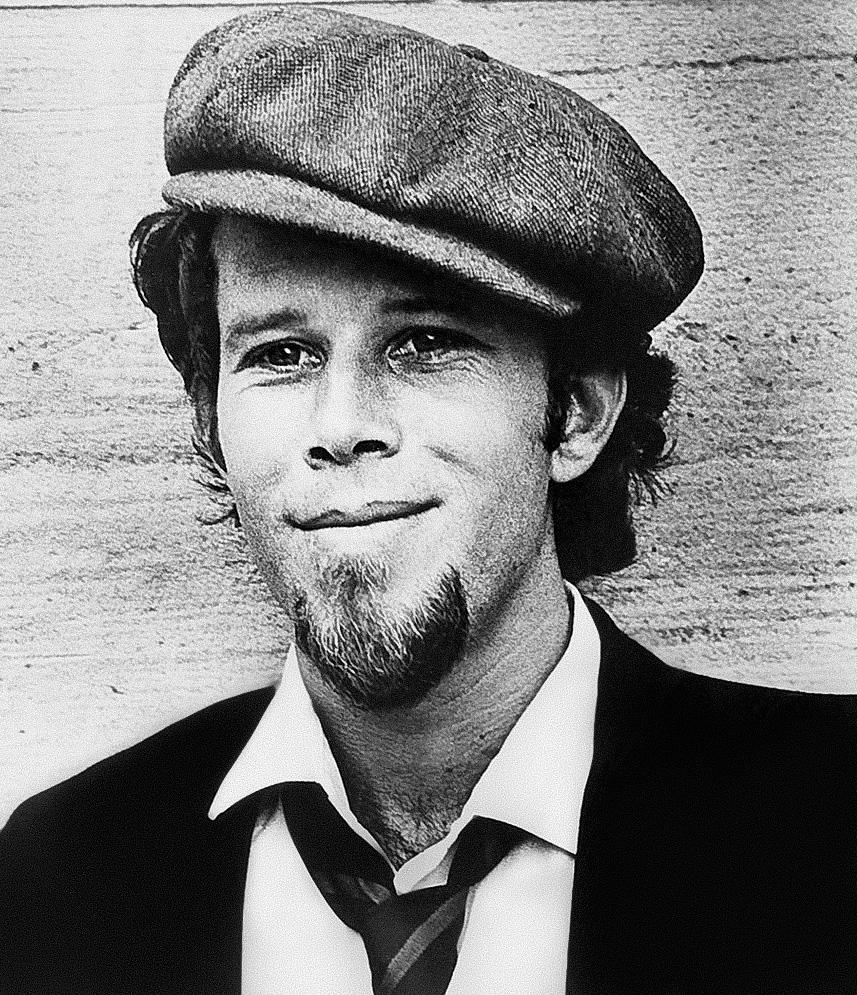
In a dream around 1981, Tom Waits found himself flipping through a bin at a Salvation Army store and pulled out one of his own records — a bargain-bin relic staring back at him. Born in Pomona, California, in 1949, he'd spent a decade as a boozy troubadour, from Closing Time (1973) through Heartattack and Vine (1980), a persona he later called borrowed wholesale: "I hatched out of the egg I was living in," he said, "nailed one foot to the floor and kept going in circles, making the same record." Marrying Kathleen Brennan in 1980 broke the cycle. She played him Captain Beefheart and Harry Partch, field recordings and Caruso; by Swordfishtrombones (1983), Waits had traded the barstool for a junkyard orchestra, and he never went back.
the sound in question
1985
Jockey Full of BourbonTom Waits
walk the tributaries ↓
Captain Beefheart1970s · Avant-garde rock / Blues rock / Experimental rock
Waits insists he barely knew Beefheart's music before Brennan played it for him — despite sharing a manager, Herb Cohen, and touring behind Beefheart's mentor Frank Zappa. "I was such a one-man show," he told his biographer Barney Hoskyns, "very isolated in what I allowed myself to be exposed to." Brennan closed that gap, and by 1983 Beefheart could hear himself in the results: he accused Waits of lifting Swordfishtrombones' fish imagery straight from his own Trout Mask Replica. "He was angry when Swordfishtrombones came out," Waits recalled. "To me, it was more of a tribute."
listen: upstream & heresource: Exclaim! — Jason Schneider, "Tom Waits Opens Up about 'Bad As Me,' Reflects on Captain Beefheart" (Trout Mask Replica / Swordfishtrombones) ↗
1969
Moonlight on VermontCaptain Beefheart
1983
16 Shells from a Thirty-Ought SixTom Waits
listen forHoskyns's biography names "16 Shells from a Thirty-Ought Six" as the song where the debt became unmistakable — its rhythm built not from a drum kit but from Victor Feldman hammering a brake drum and bell plate into a lurching clatter. The Magic Band pioneered exactly that appetite for junk-metal percussion and a vocal sliding between howl and half-spoken drawl; "Moonlight on Vermont" represents the sound, not the specific track Waits named. He later admitted the mark never faded: "Once you've heard Beefheart it's hard to wash him out of your clothes. It stains, like coffee or blood."
Kurt Weill1920s–30s · Cabaret / Musical theatre
Waits came to Kurt Weill backwards: critics told him his songs sounded like Weill's before he'd heard any. "I didn't really listen to him until I had people tell me I sounded somewhat like him," he told Terry Gross on Fresh Air, "so I said: well, I better start listening to that stuff." What he found matched his own instincts: "I liked it, it was really angry. I guess I like beautiful melodies telling me terrible things." In 1985 he made it literal, recording Weill and Brecht's "What Keeps Mankind Alive?" — first heard in 1928's The Threepenny Opera — for Hal Willner's tribute album Lost in the Stars.
listen: upstream & heresource: Fresh Air (NPR) — Tom Waits interview with Terry Gross, May 21, 2002 (Kurt Weill and Louis Armstrong influence) ↗
1930
What Keeps Mankind Alive?Kurt Weill
1985
What Keeps Mankind Alive?Tom Waits
listen forBoth versions carry the same tune — a marching, minor-key waltz that swings between a jaunty oom-pah brass line and a lyric that never softens its indictment of the comfortable classes. Waits doesn't smooth out Weill's cabaret bite; his gravelled voice simply replaces the operatic delivery, keeping the same tension between a lovely melody and a bitter message that first drew him to Weill's writing. Listen for how neither version resolves happily — the tune keeps circling instead of landing, exactly the mismatch of pretty music and ugly news Waits said he liked.
Louis Armstrong1920s–30s · Jazz
Asked point blank on Fresh Air whether Armstrong shaped him, Waits didn't hedge: "You can't ignore the influence of someone like Louis Armstrong. He's like a river, he's like a country to be explored... he came out of the ground just like a potato. He's completely natural." The debt surfaces by name on Blood Money (2002): Waits and Brennan titled a song "A Good Man Is Hard To Find" as a nod to Armstrong's own recording of the standard, which Waits called an attempt to "tip my hat somewhat" to his idol — new words and music filed under a borrowed title.
listen: upstream & heresource: Fresh Air (NPR) — Tom Waits interview with Terry Gross, May 21, 2002 (Kurt Weill and Louis Armstrong influence) ↗
1959
A Good Man Is Hard to FindLouis Armstrong
2002
A Good Man Is Hard To FindTom Waits
listen forWaits's "A Good Man Is Hard To Find" keeps Armstrong's title but writes an entirely new song — the tribute lives in the voice, not the melody. Both men built a signature out of a ruined instrument: gravel where a clean tenor might sit, warmth riding on top of the wreckage instead of erased by it. One outlet observed a "roughness that was uniquely combined with heart and swagger" running through both careers. No confirmed recording of Armstrong performing this standard has surfaced, so play Waits's creaking baritone against any late Armstrong side — the kinship is in the grain, not a shared note.