walking upstream…
Ray Charles


Glaucoma took his sight by degrees, starting at four; by seven, in rural Florida, Ray Charles Robinson was completely blind. He'd already found the piano — at three, at Wylie Pitman's Red Wing Cafe, hearing boogie-woogie for the first time — and the Florida School for the Deaf and the Blind gave him braille notation, then set him loose on Bach and Chopin alongside it. His mother's death in 1945 sent him out to earn a living at fourteen, and his first Seattle recordings, cut in 1949, leaned so hard on the smooth piano-trio sound of the day that people swore it was someone else singing. It took until his Atlantic sessions of the early 1950s for the imitation to crack open into something unmistakably his: gospel testimony reworked as secular confession, the church holler married to the barroom ache, a fusion the industry would later just call soul.
the sound in question
1960
Georgia on My MindRay Charles
walk the tributaries ↓
Louis Jordan1940s · Jump blues / R&B / Swing
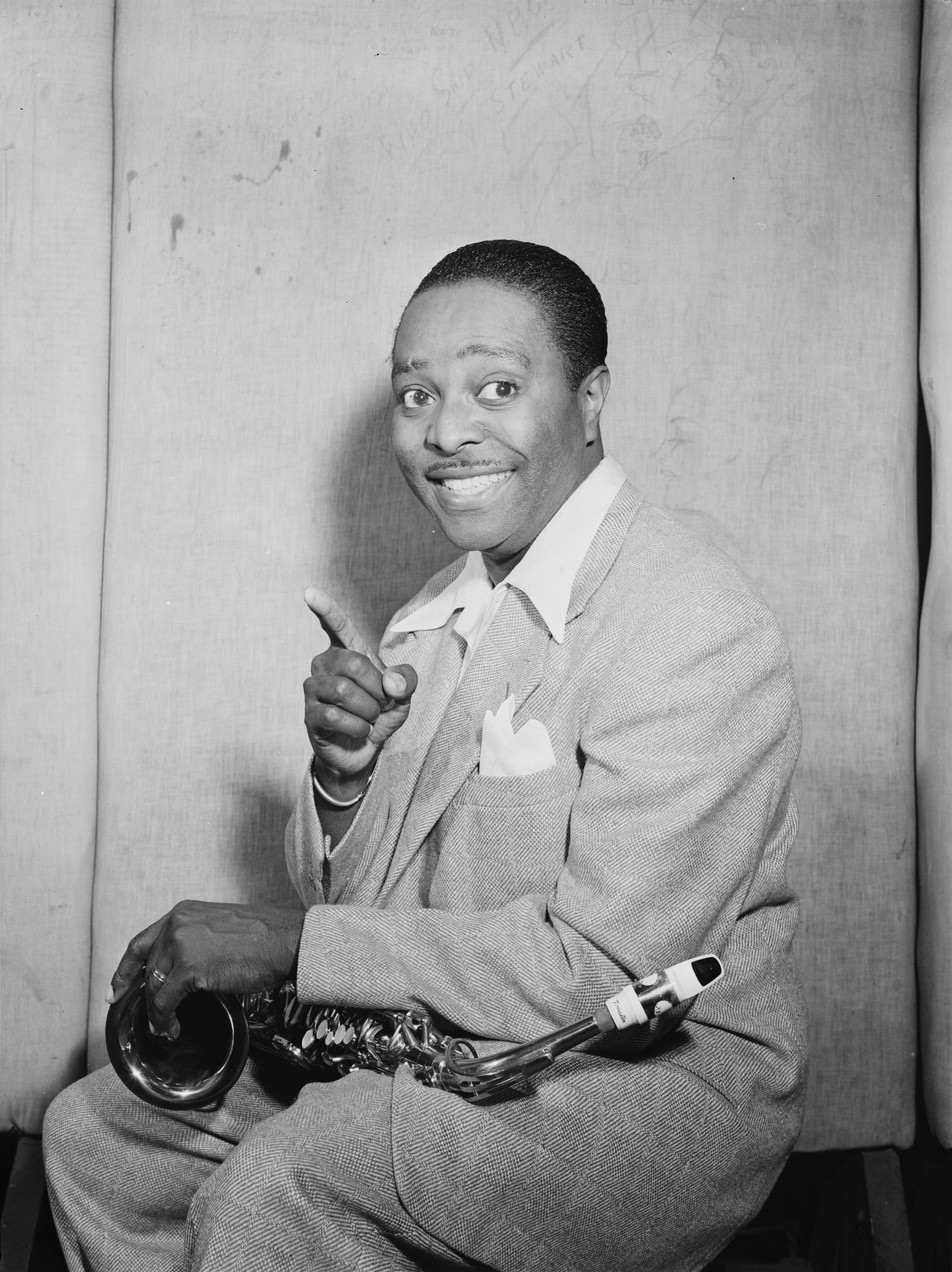
Asked years later whether one of his hits was written for Louis Jordan, Charles corrected the record: "Oh no," he told Performing Songwriter, "what I did in tribute to Louis was 'Let the Good Times Roll.' I was crazy about him. He was very unique. He had his own style." Jordan's Tympany Five had spent the 1940s proving jump blues could fill a jukebox and a dance floor at once — saxophone-driven, wisecracking, built for a crowd. Charles's cover wasn't an imitation; it was a thank-you note, and it won him a Grammy for the gesture.
listen: upstream & heresource: Performing Songwriter — The Genius of Ray Charles, 2002 (Louis Jordan and Nat King Cole quotes) ↗
1946
Let the Good Times RollLouis Jordan
1959
Let the Good Times RollRay Charles
listen forPlay Jordan's 1946 original first: a bounding shuffle led by tenor sax, every line landing on the beat like a punchline. Charles's 1959 version, cut for the album The Genius of Ray Charles, keeps the same swing but thickens it — horns stacked instead of soloing alone, his voice sliding around the melody instead of stating it plainly. The song didn't change; the room around it got bigger, gospel-choir-sized, which is the whole difference between Jordan's era and Charles's.
Nat King Cole1940s–50s · Traditional pop / Jazz / Vocal jazz
Charles never hid the debt: "I loved the man so much," he said of Nat King Cole, whose smooth, jazz-schooled trio sound he leaned on so hard early on that one biography describes his playing as closely resembling Cole's. Cole, when their paths eventually crossed, told him plainly — Charles recalled it to Performing Songwriter — "you're gonna want to find your own way." It took an Atlantic Records contract before Charles fully took the advice, but the trio format Cole had pioneered — piano, guitar, bass, no drummer — stayed the chassis Charles built his first records around.
listen: upstream & heresource: Performing Songwriter — The Genius of Ray Charles, 2002 (Louis Jordan and Nat King Cole quotes) ↗
1944
Straighten Up and Fly RightNat King Cole
1949
Confession BluesRay Charles
listen forCole's 1944 hit "Straighten Up and Fly Right" is the blueprint: piano out front, a single guitar and bass keeping time, no drummer at all, his voice riding just behind the beat like he's got nowhere to be. Charles's first single, "Confession Blues," cut in Seattle five years later, uses the same three instruments in the same arrangement and the same unhurried phrasing — before the gospel shout of his later records, this is Charles still speaking Cole's dialect, word for word.
Pilgrim Travelers1940s–50s · Gospel / Jubilee quartet
The music magazine Cross Rhythms credits Jesse Whitaker, the hard-gospel-shouting baritone of the quartet the Pilgrim Travelers, as one of the models Charles drew on directly when he began carrying church intensity into secular songs. Charles's own account of that debt was plainer: "I was raised in the church," he told Rolling Stone, "singin' in the church and hearin' this good singin' in the church and also hearin' the blues, I guess this was the only way I could sing." Whitaker's shouted, traded-lead vocal style — gospel's oldest trick for building intensity — became, in Charles's hands, the blueprint for turning a blues verse into a testimony.
listen: upstream & heresource: Cross Rhythms — The Pilgrim Travelers ↗
1949
Jesus Hits Like the Atom BombPilgrim Travelers
1959
What'd I SayRay Charles
listen forCue up the Pilgrim Travelers' 1949 "Jesus Hits Like the Atom Bomb": Jesse Whitaker's baritone drives the verse, and the group answers him in tight, shouted unison — call thrown, call caught. A decade later, Charles's "What'd I Say" runs the identical machine on secular fuel: he calls out a line, his backing singers the Raelettes throw it back moaned instead of sung, and the exchange builds past words into pure sound. Same architecture, gospel's oldest trick — just aimed at a nightclub instead of a pulpit.