walking upstream…
Prince



sourcesMinnesota Monthly — Portrait of the Artist as a Native Son (late-night KQ radio; daytime stations passing on early singles as "too black") · Billboard — Prince Paid Off 'Funky Drummer' Clyde Stubblefield's Medical Bills ($80,000 tribute, "drumming idols") · The Current — Pride and Pain · PBS NewsHour — Sly Stone, leader of funk revolutionaries, dies at 82 (Prince among the artists Sly influenced) · The Current — A Guide to Prince's Musical Inspiration (Prince's quote on building an integrated, mixed-gender band like Sly's) · Ultimate Classic Rock — How the Beatles, Stones, Hendrix and Others Influenced Prince (Sly's drum machine on "Family Affair"; Prince covering "Everyday People") · Cheat Sheet — Joni Mitchell Once Thought Fan Letters From Prince Were From 'the Lunatic Fringe' (Mitchell's "From you" chord-recognition anecdote)
Prince Rogers Nelson was born in Minneapolis in 1958 to a pianist father and a jazz-singing mother, and got his real education after midnight on a station he called "the bomb station" — daytime Minneapolis radio, Minnesota Monthly later reported, had passed on his early singles for sounding "too black." "That's where I discovered Carlos Santana, Maria Muldaur, and Joni Mitchell," he said of those late shows. "I always tried to play like Carlos, or Boz Scaggs." At ten, his stepfather put him onstage during a James Brown concert; a bodyguard hauled him off within minutes, but the lesson about commanding a room stuck. He taught himself every instrument he'd need and played them all on his 1978 debut, For You, then spent the next decade fusing funk, gospel, rock, and pop into a sound Minneapolis had never produced before him.
the sound in question
1984
When Doves CryPrince
walk the tributaries ↓
Joni Mitchell1970s · Folk / Folk rock / Jazz
"Another big influence was Joni Mitchell," Prince told MTV in 1985. "She taught me a lot about color and sound, and to her, I'm very grateful." Mitchell felt the debt too, though she couldn't always place it: "From time to time, I would comment and say, 'Oh, I love that chord,' or 'I love that progression — where did you get that from?' And he would say, 'From you.' But I wouldn't recognize it."
listen: upstream & heresource: Joni Mitchell Library — Rule Breakers (Mitchell ↗
1971
A Case of YouJoni Mitchell
1984
Purple RainPrince
listen for"A Case of You" opens on Mitchell's dulcimer picking through an open tuning, chords left just unresolved enough to sound like a question rather than a statement. "Purple Rain" opens the same way — a suspended chord, voiced by guitarist Wendy Melvoin, that hangs before the song commits to a key. Mitchell heard the connection immediately: "I can hear my influence in 'Purple Rain' in the harmony," she said — the same trick of holding a chord open before letting it resolve.
James Brown1960s–70s · Funk / Soul / Rhythm and blues
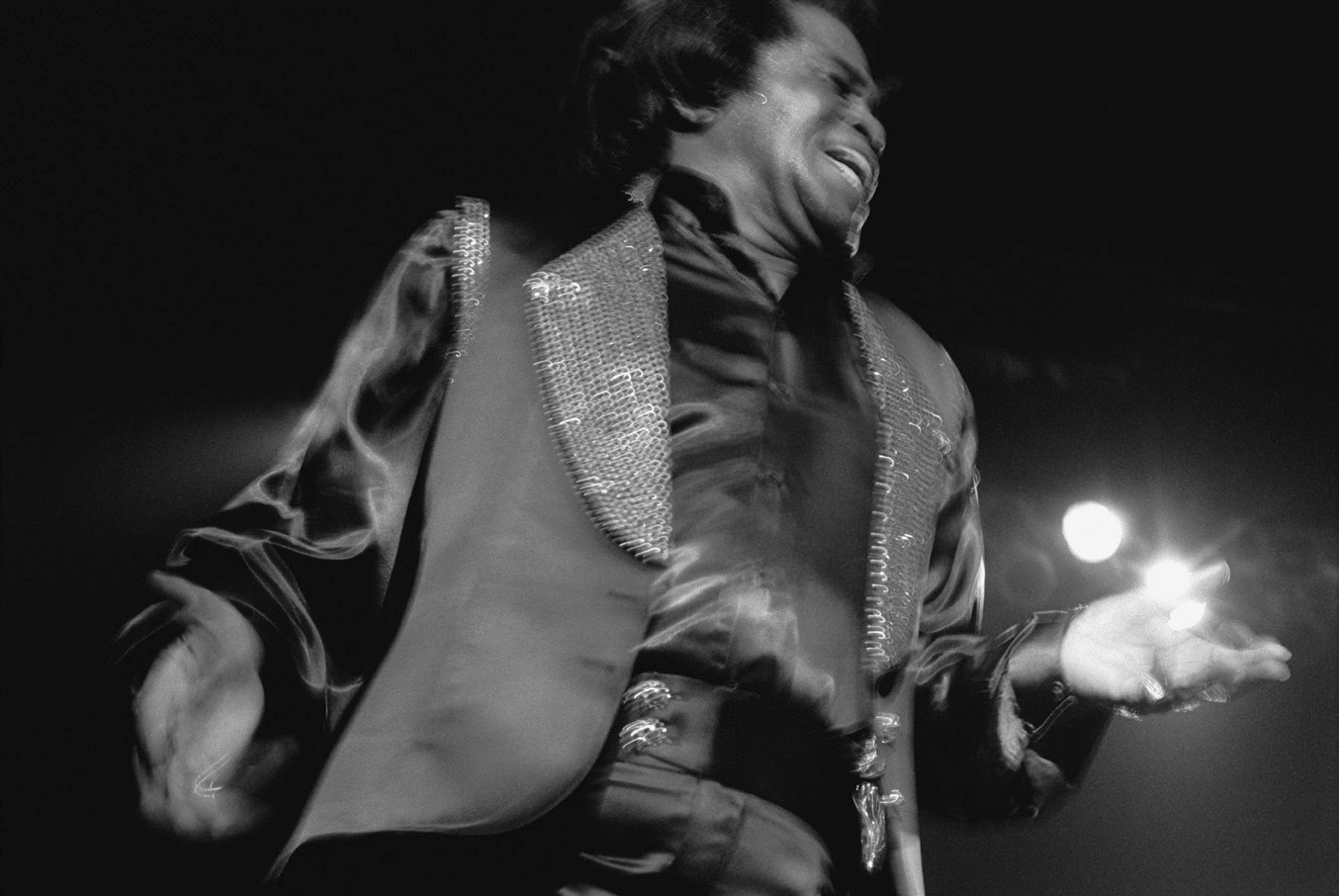
At ten, Prince's stepfather lifted him onto a stage where James Brown was performing — a bodyguard hauled him back off within minutes, but not before he noticed something. "I think, in that respect, he influenced me by his control over his group," Prince told MTV in 1985, more struck by Brown's command of his musicians than by the show itself. He repaid the debt decades later: when Funky Drummer session player Clyde Stubblefield needed cancer treatment he couldn't afford, Prince's camp quietly covered roughly $80,000 of it, telling Stubblefield's wife only that Clyde was "one of his drumming idols."
listen: upstream & heresource: The Boombox — Deconstructing Prince, Part 1 ↗
1970
Funky DrummerJames Brown
1991
Gett OffPrince
listen for"Funky Drummer" is barely a song — mostly Clyde Stubblefield's drum break, a loose pocket that never locks into a rigid grid and is left to run for measures at a stretch. Prince lifted that exact break onto "Gett Off" rather than reprogramming a tighter machine groove to match it, dropping his own vocal and synth stabs on top. The slight human give in the beat is Stubblefield's, not Prince's — it's what keeps a track built in a drum machine's era from ever sounding like one.
Sly and the Family Stone1960s-70s · Funk / Soul / Psychedelic rock / R&B
Assembling the band that would become the Revolution, Prince kept coming back to one model. "He understood the segregation of the industry," he said, describing why he built an integrated, mixed-gender lineup. "I have to have white people in the band and girls in the band. Sly had the right idea." The admiration ran deeper than one interview: Sly's bassist Larry Graham, inventor of the slap-bass technique, later toured with Prince and drew him further into the catalog — far enough that Prince covered Sly's "Everyday People" onstage roughly a hundred times across two decades.
listen: upstream & here
1971
Family AffairSly and the Family Stone
1982
1999Prince
listen for"Family Affair" was the first number-one single built on a drum machine, its rhythm section a flat, mechanical pulse under Sly's slurred, overlapping vocals — a texture nobody had put at the top of the charts before. Prince ran the same kind of machine, a Linn LM-1, at the foundation of "1999," but pushed it forward instead of leaving it slouched in the pocket: the same dry, boxy thump now snaps hard on the beat, turning Sly's woozy home scene into an urgent countdown.