walking upstream…
Kraftwerk



sourcesWikipedia — Kraftwerk (formation, style overview) · Red Bull Music Academy Daily — Ralf Hütter interviewed by Jon Savage, 1991 (Cologne radio, Stockhausen, postwar Germany) · The New York Times — Mike Rubin, the heritage of Kraftwerk on funk and techno (Carl Craig and Mad Mike Banks on Computer World)
"When we started it was like, shock, silence. Where do we stand? Nothing," Ralf Hütter said of coming of age in a West Germany with no pop tradition of its own — no father figures, nothing between the 19th century and the war. In 1970 he and Florian Schneider answered from a converted Düsseldorf storage room they called Kling Klang, treating tape splices and homemade circuits the way earlier bands treated guitars. What began as krautrock's noisiest fringe hardened, over the decade, into something disciplined and strange: four men standing behind synthesizers, singing about autobahns and radio waves in a voice that sounded like it belonged to the machines. By 1981's Computer World the rhythms had gotten so exact that Detroit and the Bronx heard a new kind of groove in them. Kraftwerk didn't just predict electronic music's future; they wrote its owner's manual.
the sound in question
1977
Trans-Europe ExpressKraftwerk
walk the tributaries ↓
The Beach Boys1960s · Surf rock / Pop / Psychedelic pop
In a 1976 interview, asked why a German electronic band would name-check a California surf group, Hütter didn't hesitate: "In their songs they managed to concentrate a maximum of fundamental ideas," he said. "In 100 years from now, when people will want to know what California was like in the 60s, they only had to listen a single by the Beach Boys." He'd seen them play a stadium during Kraftwerk's first American tour and come away shaken — "it was gorgeous, like a rebirth," he said, admitting he wanted to one day say, in song, what Brian Wilson says in "Once in My Life."
listen: upstream & heresource: Rock + Folk — Interview 11/76, P. Alessandrini (Hütter and Schneider on the Beach Boys and European electronics) ↗
1966
Good VibrationsThe Beach Boys
1977
Europe EndlessKraftwerk
listen forGood Vibrations is Brian Wilson treating the studio itself as an instrument — theremin swoops, stacked vocal harmonies, sections spliced together from dozens of takes into something no band could play live in one pass. Europe Endless works the same trick with different tools: a synthesizer sequence built up in careful overdubbed layers, gliding for eight minutes without ever resolving into a rock chorus, meticulous the way only a song assembled piece by piece in a studio can be.
Karlheinz Stockhausen1950s–60s · Electronic / Avant-garde / Musique concrète
Hütter has never hidden the debt. Asked in 1991 what it was like coming of age in a Germany with no pop tradition of its own, he pointed straight at the avant-garde composer broadcasting an hour down the Rhine: "You had these performances from Cologne radio, Stockhausen," he told the writer Jon Savage, "and something new was in the air, with electronic sounds, tape machines." Before Kraftwerk was a pop group, it was two art students chasing that same feeling — treating tape splices and oscillators as instruments, years before a synthesizer entered a hit single.
listen: upstream & here
1956
Gesang der JünglingeKarlheinz Stockhausen
1974
AutobahnKraftwerk
listen forGesang der Jünglinge folds a boy's voice into sine tones and tape-spliced fragments until the human and the electronic are the same material — no beat, no chord progression, just texture assembled like a collage. Cue up Autobahn next and notice how Kraftwerk kept that same patience with pure tone: the synthesizer drone that opens the track sits and breathes for nearly a minute before any rhythm arrives, the same unhurried sound-as-subject Stockhausen practiced two decades earlier, aimed for the first time at something you could drive to.
James Brown1960s–70s · Funk / Soul / Rhythm and blues
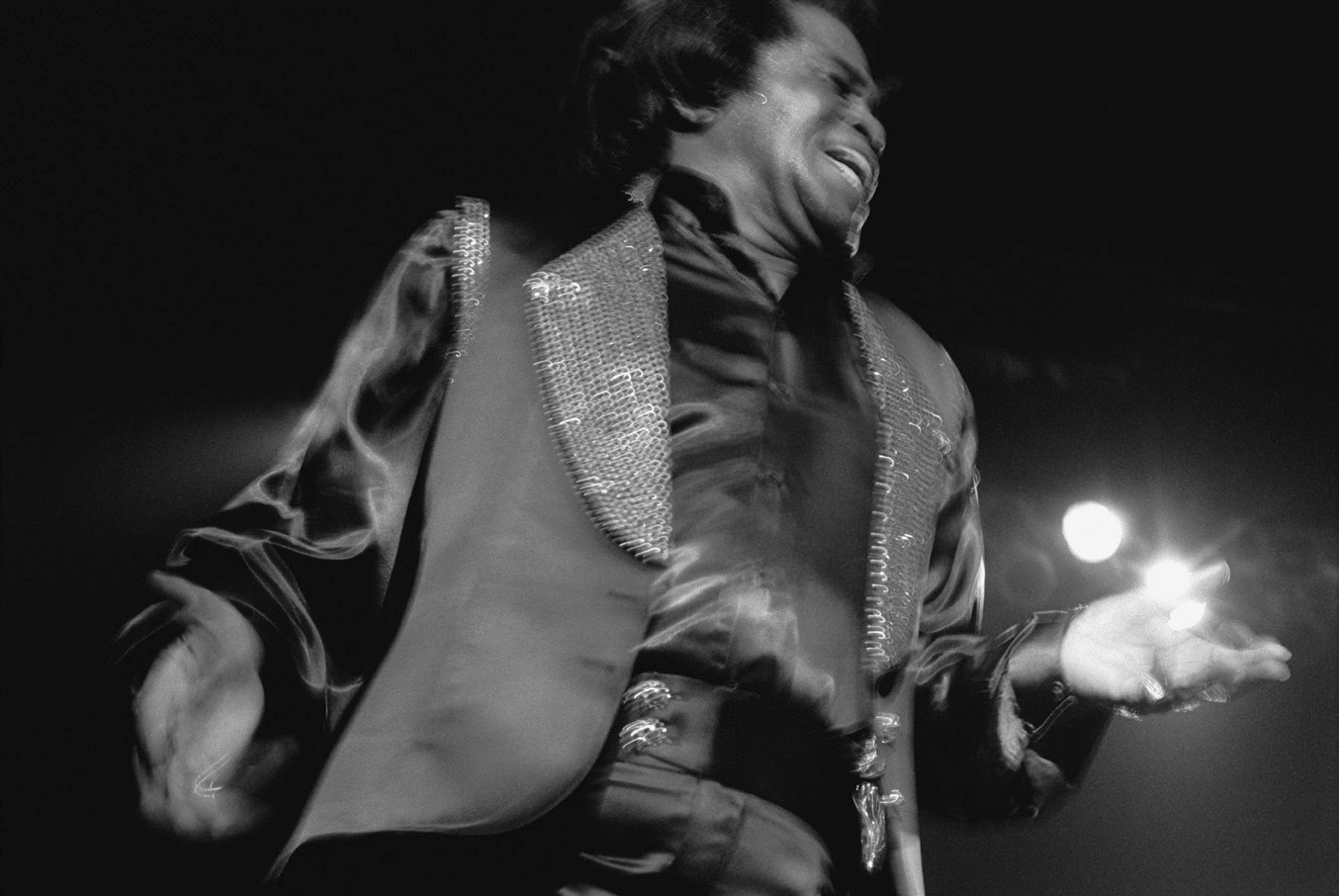
No interview catches Hütter naming James Brown outright, but critics tracing Kraftwerk's evolution keep landing on him anyway. Writing in the Observer, Jude Rogers noted that as the band's sound tightened late in the 1970s, "they got inspired by James Brown's funk, and even punk." By 1981's Computer World, the debt sounded audible in Detroit: producer Carl Craig told the New York Times the album could still pass for James Brown — "it was just this kind of relentless groove." Underground Resistance co-founder Mad Mike Banks called the track "Numbers" the "secret code of electronic funk."
listen: upstream & heresource: The Observer — Jude Rogers, why Kraftwerk are still the world's most influential band (James Brown's funk as an influence) ↗
1970
Sex MachineJames Brown
1981
NumbersKraftwerk
listen forSex Machine barely bothers with melody — James Brown's rhythm section locks into one clipped, endlessly repeating groove and dares the beat itself to carry the whole song for eight minutes. Numbers strips that idea down to its bones: a flat, spoken countdown over a beat so tight and repetitive it barely qualifies as a song, the same relentless groove Craig and Banks both heard, rebuilt entirely out of machines instead of a rhythm section.