walking upstream…
King Sunny Ade
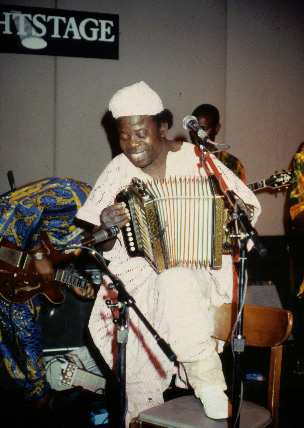

 photo: master_xpo · cc by 2.0 ↗
King Sunny Ade
sourcesPerfect Sound Forever — "King Sunny Ade Interview" by Jason Gross, 1998 (Dairo as model; the pedal steel/Jim Reeves origin story) · uDiscover Music — "'Juju Music' · Encyclopedia.com — King Sunny Adé biography (pedal steel guitar tied explicitly to admiration for Jim Reeves) · Afropop Worldwide — "From Hawaii to Nashville to Lagos · Discogs — Tunde Nightingale, "Omo Abi Lowo / Ya Bonsa" (1967 release listing confirming the recording)
At five years old in Yoruba royal Ondo State, Sunday Adeniyi Adegeye ran after the megaphone jingles of traveling salesmen, dancing until his family caught him at it — royalty, in his father's house, were not supposed to play music at all. "I loved the music so madly that I decided one day I would like to play music," he said. "I just want to be a musician." He got there in stages: teenage percussionist under a borrowed age, then bandleader of his own band, the Green Spots, by 1967, renamed Sunny Adé and His African Beats. He rebuilt juju — Yoruba talking drums and call-and-response guitar — around a full touring band and, later, pedal steel guitar, carrying it worldwide on 1982's Juju Music and the Grammy-nominated Synchro System. He copied no one for long; that refusal became his whole career.
the sound in question
1982
Ja FunmiKing Sunny Ade
walk the tributaries ↓
I.K. Dairo1960s · Juju
When I.K. Dairo, the Blue Spots bandleader who modernized juju with the accordion, died, Adé said he stood by the grave still not quite believing it: "I didn't believe he was a human being. I was thinking he was a saint." Dairo had been the teenage Adé's model twice over — first as the bandleader he and his crew flatly copied ("we were copy cats until we were trying to find our own way"), then as proof a juju band could be run as a real business, with managers and booking offices, the template Adé and fellow juju bandleader Ebenezer Obey both later followed.
listen: upstream & heresource: Afropop Worldwide — "Talking to the King ↗
1967
SalomeI.K. Dairo
1982
365 Is My NumberKing Sunny Ade
listen forAdé named the one piece of Dairo's sound he kept: "the maracas in my music, it's there... it's the first thing I appreciated in his music. And it's still in my music." Hear them shimmer, dry and insistent, under the call-and-response vocals and talking drum on Dairo's 1967 "Salome." On Adé's "365 Is My Number," that same shaken pulse survives underneath a much bigger band and a pedal steel guitar Dairo never had — Dairo's rhythm section, in effect, built out.
Tunde Nightingale1950s · Juju
No one played juju straighter than the guitarist and bandleader Tunde Nightingale, whose open-tuned guitar and party-music style made Adé say, watching him, "nobody copies this guy." That was the point. Having spent years playing a style modeled on the older bandleader I.K. Dairo, Adé wanted his own name: "I decided to copy Tunde Nightingale... If he's playing open-chord, I have to find my own way... So this is how my identity came." Copying the one juju musician nobody else copied became, paradoxically, how Adé stopped sounding like anyone else.
listen: upstream & heresource: Afropop Worldwide — "Talking to the King ↗
1967
Omo AbilowoTunde Nightingale
1982
Ma Jaiye OniKing Sunny Ade
listen forWhere I.K. Dairo, juju's other reigning bandleader, capoed his guitar, Nightingale played his wide open, treating it "like as if I'm playing percussion" rather than a lead instrument, Adé recalled. Listen for that on Nightingale's 1967 single "Omo Abilowo": guitar strummed as rhythm, not melody, under a high, keening vocal. Adé's "Ma Jaiye Oni" keeps that same open-tuned guitar doing percussive, rhythmic work under his own voice — the specific technique he says he adopted to sound like no one else.
Jim Reeves1950s · Country / Nashville sound
Among the American records Adé says shaped him — Brook Benton, Grover Washington, BB King — only one changed an instrument in his band. Searching for an electrified substitute for the goje, a traditional Yoruba fiddle, he found his answer in country music: "By the time I heard Jim Reeves and other country music, then I said, 'it sounds alike, so why don't we just have the sound electrified instead of patching the whole thing together?'" The pedal steel guitar he introduced from that thought became the most recognized sound of his international records.
listen: upstream & heresource: Afropop Worldwide — "Talking to the King ↗
1959
He'll Have to GoJim Reeves
1983
Synchro SystemKing Sunny Ade
listen forReeves' steel guitar glides behind his baritone on "He'll Have to Go," half instrument, half sigh, filling the space between his vocal lines. On "Synchro System," Adé's own pedal steel player, Demola Adepoju, does the equivalent work over the talking drums and guitars — not backing a lonesome crooner but standing in for the fiddle-like Yoruba goje, the "African violin," in Adé's own description, that he'd wanted all along.