walking upstream…
Jacques Brel


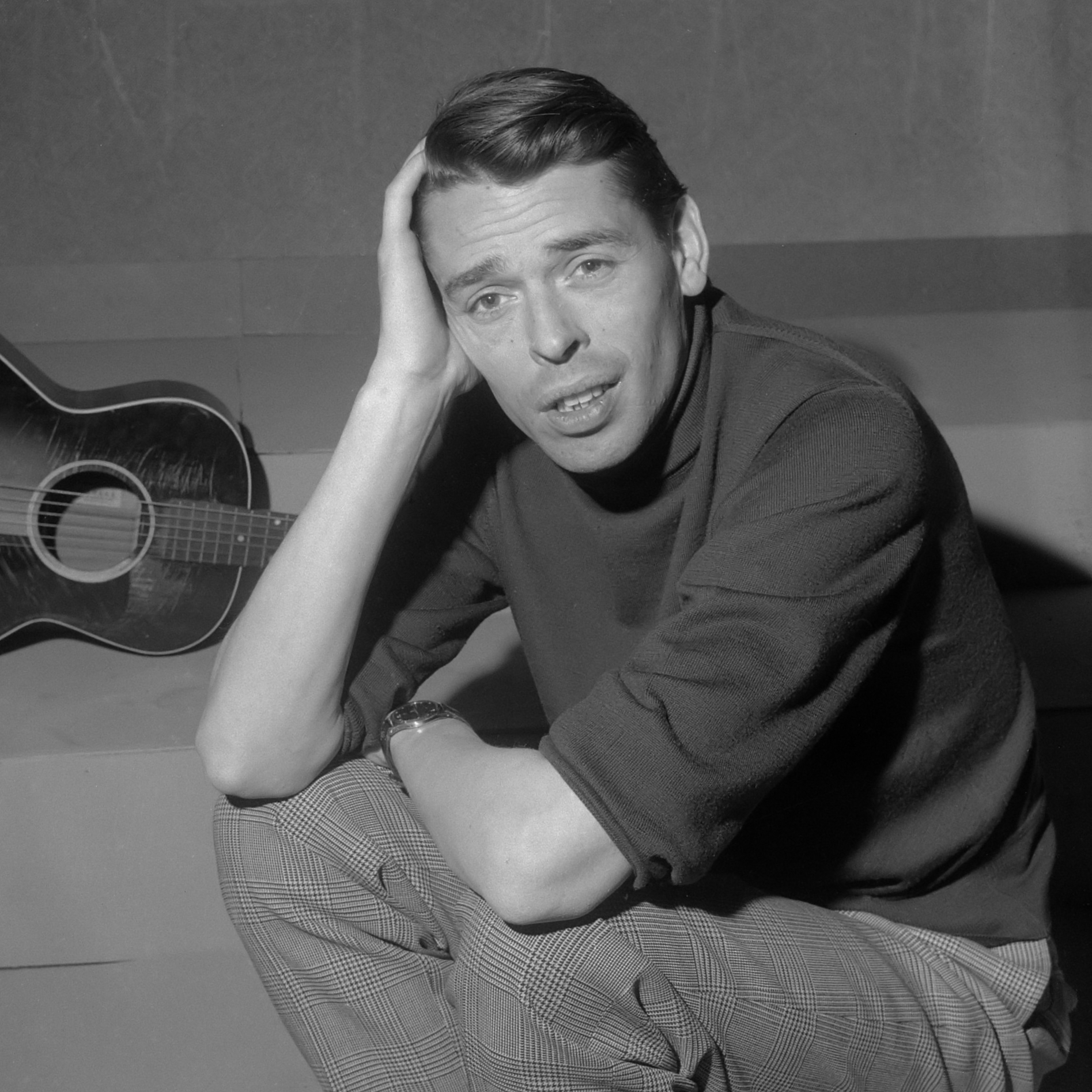 photo: jack de nijs for anefo · cc by-sa 3.0 ↗
Jacques Brel
sourcesAdeline Cordier — "The mediating of chanson" PhD thesis, University of Stirling, 2008 (backs both Trenet and Piaf as acknowledged influences) · Toppermost — critical profile of Jacques Brel, by Andrew Shields (backs Piaf's 1961 Olympia programme note and Rauber's role) · Lokko — Trenet retrospective, independently corroborating the same Brel quote · WSWS — "30 years since the death of Jacques Brel" (backs childhood/bio quotes) · Wikipedia2
Jacques Brel grew up bored inside a comfortable Brussels cardboard-manufacturing family — "I had a childhood where almost nothing happened," he said, "I was bored" — and spent his twenties writing songs against his father's wishes before a 1953 demo tape reached the talent scout Jacques Canetti, who called Brussels that same night. Paris was unimpressed at first: his earnest, scout-troop-inflected material earned him the mocking nickname "l'abbé Brel." Arranger François Rauber and pianist Gérard Jouannest rebuilt his sound from 1956 on, pulling him off guitar and into the physically wrenching stagecraft that became his signature; by his October 1961 Olympia concert, the choirboy reputation was gone for good. He walked off stage for the last time in 1966, turned to film and sailing, and died in 1978 at forty-nine, having remade what a popular song was allowed to confess.
the sound in question
1959
Ne me quitte pasJacques Brel
walk the tributaries ↓
Charles Trenet1940s · Chanson
A University of Stirling doctoral thesis on postwar French chanson found something no surviving interview quite proves firsthand: that Brel, Brassens, and Ferré "unanimously acknowledged the influence of Edith Piaf and above all Charles Trenet" on their work. Brel's own verdict is still repeated in Belgian and French press decades later, worded slightly differently by each outlet but consistent in substance — that without Trenet, his generation would have wound up filing tax returns instead of writing songs: "sans Trenet, nous serions tous des experts-comptables." It's folklore more than transcript, but it names what critics credit Trenet with too — making the singer, not the song, chanson's center of gravity.
listen: upstream & heresource: RTBF — on Charles Trenet's influence, corroborating the "experts-comptables" quote attributed to Brel ↗
1937
Y'a d'la joieCharles Trenet
1959
Les FlamandesJacques Brel
listen forTrenet's 1937 hit opens jaunty and never lets up, piling short clause on short clause until the tune seems to be racing just to keep pace with its own good cheer. Brel borrows the device wholesale on "Les Flamandes" (1959) and inverts its mood: the same breathless accumulation of short lines, the same accelerating tempo, but turned satirical and airless, its Flemish burghers dancing themselves into a stupor rather than joy. Listen for how both singers let tempo, not melody, carry the song's emotional argument.
Édith Piaf1940s-50s · Chanson / Cabaret
When Brel finally shed the "l'abbé Brel" reputation trailing his early scout-troop songs, it was Édith Piaf — the reigning voice of Paris, and like Brel a Jacques Canetti discovery — who wrote the programme notes for his October 1961 Olympia concert, praising a performer who brought "all he had inside him" to the stage "because chanson is how he tells of his reason for living." The same academic source names her, with Trenet, as an influence Brel's generation acknowledged; Piaf had made the performer's raw presence matter as much as the song — "she sang as she lived and loved: passionately." Brel took that further than anyone.
listen: upstream & here
1949
Hymne à l'amourÉdith Piaf
1959
Ne me quitte pasJacques Brel
listen forPiaf's 1949 recording is built to sound like devotion overwhelming technique — the voice cracks at the top of phrases, the vibrato widening as though she can't hold steady. "Ne me quitte pas" (1959) pushes the same collapse further: Brel's voice thins to a rasp on the repeated pleas, phrasing that abandons melodic prettiness for something closer to begging. Both recordings ask you to hear strain, not control, as the point.