walking upstream…
Django Reinhardt


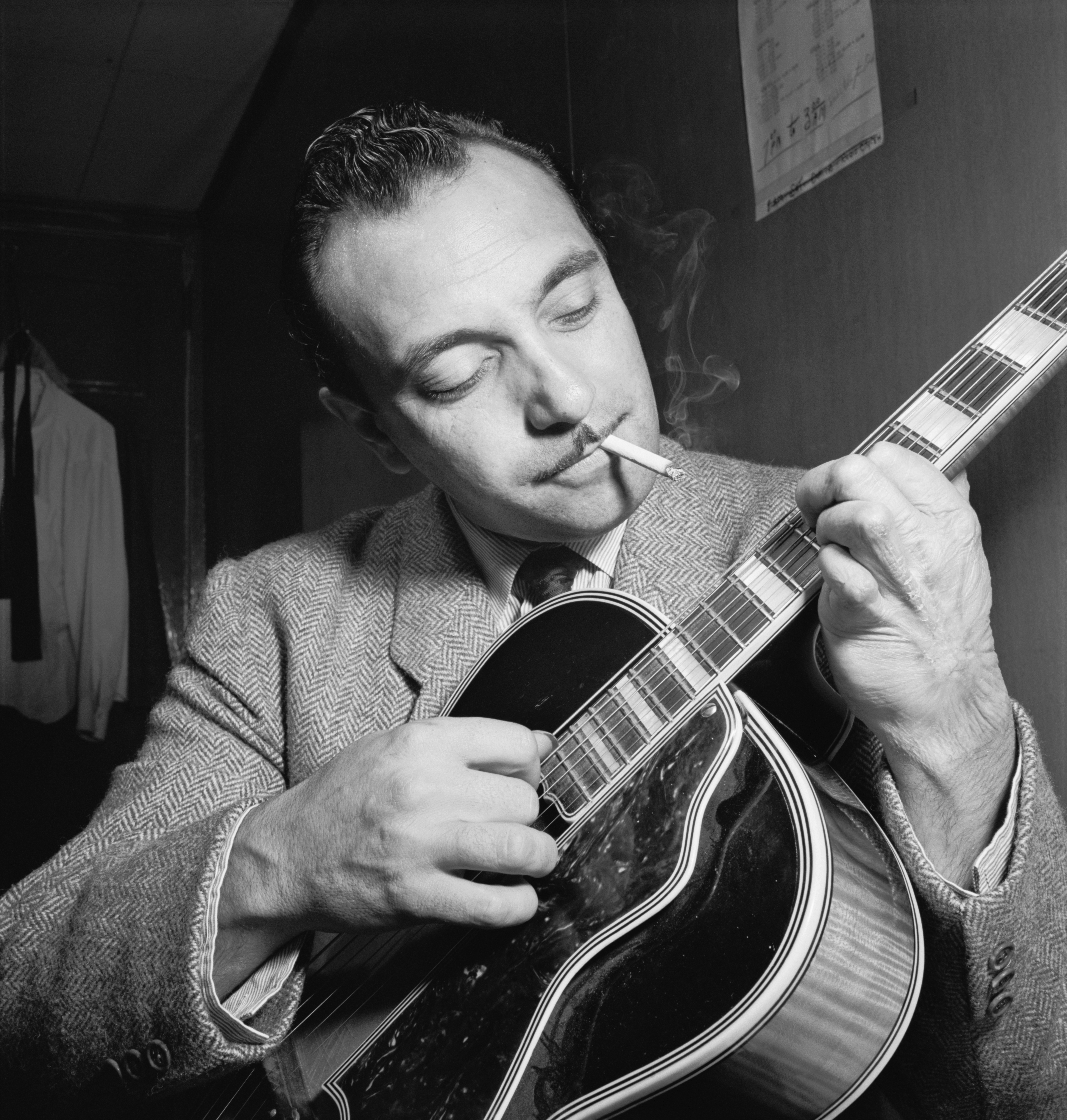 photo: william p. gottlieb / adam cuerden · public domain ↗
Django Reinhardt
sourcesCommentary Magazine — Terry Teachout, "The Incomparable Django" (Armstrong influence, quotes) · Jerry Jazz Musician — Interview with Michael Dregni (Reinhardt's discovery of jazz, biographical detail) · Fretboard Journal — Django Reinhardt's Life on Record (1928 caravan fire and recovery) · Encyclopedia.com — Django Reinhardt biography (early life, family) · Encyclopedia.com — Stéphane Grappelli biography (Grappelli's early career, meeting Reinhardt) · Wikipedia — Quintette du Hot Club de France (formation, all-strings instrumentation) · Wikipedia — Django Reinhardt (bal musette apprenticeship; Savitry/Lang-Venuti record collection)
Jean Reinhardt was born January 23, 1910, in a Romani caravan outside Liberchies, Belgium, the son of a traveling musician his biographers call 'a comic and violinist.' He got a banjo-guitar at ten and was earning a living by thirteen the way most Manouche players did — trailing accordionists through the bal musette dance halls of Paris, an apprenticeship that came years before he started playing jazz. Then, in October 1928, a caravan fire burned his left hand so badly two fingers never recovered full use. He spent eighteen months relearning the instrument around the injury and came back, as the guitar magazine Fretboard Journal later put it, having 'emerged from his sickbed an even more brilliant player,' building an entire two-fingered technique from what should have ended his career. Three years later he met a violinist named Stéphane Grappelli, and gypsy jazz existed within the decade.
the sound in question
1940
NuagesDjango Reinhardt
walk the tributaries ↓
Louis Armstrong1920s–30s · Jazz
In 1931 a friend played Reinhardt a copy of Louis Armstrong's 1927 Hot Five recording of 'Savoy Blues.' The reaction, the critic Terry Teachout recounted, was instant: staggered by 'his first encounter with the greatest of all jazzmen,' Django cried out, 'My brother! My brother!' Armstrong's example, Teachout wrote, is what 'emboldened Reinhardt to treat the guitar not as a mere time-keeping device but as a vehicle for solo playing' — the moment a banjo-guitar sideman started hearing himself as a lead voice.
listen: upstream & here
1927
Savoy BluesLouis Armstrong
1934
DinahDjango Reinhardt
listen forArmstrong's 'Savoy Blues' solo floats free of the beat, the cornet bending and holding notes no ensemble part would allow. Listen for that same freedom on 'Dinah,' the first side the Quintette du Hot Club de France cut together in December 1934: Reinhardt's guitar breaks loose from the chugging rhythm guitars behind him and runs long, syncopated lines that answer no one, phrasing built for a horn player's lungs rather than a strummed chord. It's the sound of an accompanist deciding, mid-record, to become a soloist.
Stéphane Grappelli1930s–70s · Jazz / Swing / Gypsy jazz
They met by chance in 1931, then landed in the same house band at Paris's Hôtel Claridge in 1934, where they started improvising together backstage. Decades later Grappelli described the fit plainly: 'Django was exactly like me.' What struck him most was watching Reinhardt reinvent the instrument itself — he 'tried and he succeeded,' Grappelli said, 'in reproducing on a guitar the effect of a large orchestra.' Their all-strings quintet, guitar and violin trading the lead with no drummer at all, became the format the two spent the next two decades refining together.
listen: upstream & heresource: National Jazz Archive — Stéphane Grappelli interview (Grappelli's own testimony on the partnership) ↗
1935
DjangologyStéphane Grappelli
1937
Minor SwingDjango Reinhardt
listen forOn 'Djangology,' cut at their first session together, Grappelli's violin and Reinhardt's guitar pass the melody back and forth like two singers finishing each other's lines — an interplay neither had on record before meeting the other. Follow that same call-and-response two years later into 'Minor Swing,' the tune they composed together: violin states a phrase, guitar answers and stretches it, then the two lock into unison runs that neither instrument could manage alone. It's the sound of a partnership, not a solo act.
Eddie Lang1920s · Jazz / Early jazz / Dixieland
Before Reinhardt, the writer Scott Nygaard called Eddie Lang 'indisputably the first jazz guitar star' — the Philadelphia-born guitarist who, paired with violinist Joe Venuti, proved on 1920s duets like 'Stringing the Blues' that a guitar could cut through a record as a lead instrument, not just strum behind one. Reinhardt heard those sessions through a friend's record collection years before he ever formed his own guitar-and-violin group, and his biographers describe the Lang-Venuti sound as the direct forerunner of what he'd build with Grappelli.
listen: upstream & heresource: Scott Nygaard — Eddie Lang and Joe Venuti (Lang's "first jazz guitar star" status) ↗
1926
Stringin' the BluesEddie Lang
1935
DjangologyDjango Reinhardt
listen forLang's 'Stringing the Blues' pairs guitar and violin as equals, trading fast unison runs with Venuti's fiddle over a bright, snapping beat — nothing behind them but rhythm. 'Djangology,' the tune Reinhardt and Grappelli cut in their first Quintette session, borrows that exact architecture: guitar and violin out front, weaving around each other in call and response, no horns, no piano, just strings carrying the whole record. The format is Lang's; the vocabulary layered onto it is entirely Reinhardt's own.