walking upstream…
Can



sourcesClassic Rock/Louder — The making of Can's Tago Mago (Sly Stone, Bootsy Collins, and Stockhausen quotes; band formation) · FACT — Holger Czukay on Stockhausen, shortwave radio and being 'too intriguing' (Stockhausen mentorship and shortwave-radio technique) · KQED — A Good Way to Master the Future · Louder/Prog — Irmin Schmidt interview (Stockhausen mentorship, band's self-conception)
Can formed in Cologne in 1968 when Holger Czukay, a bass player fresh out of Karlheinz Stockhausen's composition seminars, moved in with his teenage guitar pupil Michael Karoli and recruited keyboardist Irmin Schmidt, another Stockhausen student, and drummer Jaki Liebezeit, a veteran of Chet Baker's touring band. None of them, by Czukay's own account, had any practical rock experience. They called their method Instant Composition: hours of unrehearsed studio jamming, spliced afterward into finished tracks by Czukay's tape editing. The lineup found its voice when Damo Suzuki, a Japanese traveler spotted singing to himself on a Munich street, was hired and on stage within hours. What followed — Tago Mago, Ege Bamyasi, Future Days — turned academic training and open-eared listening into a sound with no single ancestor, only tributaries.
the sound in question
1971
HalleluhwahCan
walk the tributaries ↓
Karlheinz Stockhausen1950s–60s · Electronic / Avant-garde / Musique concrète
Holger Czukay and Irmin Schmidt studied composition under Karlheinz Stockhausen in Cologne in the early 1960s, before they'd even met each other — the one teacher both of Can's founding instrumentalists credit with opening the door to non-narrative, collage-built music. Michael Karoli arrived by a second route, as Czukay's own guitar pupil. Czukay later traced a direct technique back to the source: playing shortwave radio live on stage, he explained, "the idea came from Stockhausen again. He made a piece called 'Short Wave' ... I would mix stuff in with what the rest of the band were playing."
listen: upstream & here
1956
Gesang der JünglingeKarlheinz Stockhausen
1971
AumgnCan
listen forGesang der Jünglinge folds a boy's voice into sine tones and spliced tape fragments until neither the human nor the electronic source stays legible — a collage built from texture, not melody. On "Aumgn," Schmidt set his keyboard aside for sine-wave generators and oscillators entirely, while Czukay spliced in a smashed chair, a shouting child and a howling dog, all caught on tape during the session. It's the same move Stockhausen taught: treat the studio itself, and whatever wanders into it, as an instrument.
Sly and the Family Stone1960s-70s · Funk / Soul / Psychedelic rock / R&B
In the mid-1960s Irmin Schmidt spent time among New York's avant-garde circle — composers like John Cale and La Monte Young, filmmaker Andy Warhol — soaking up ideas that fed Can's most abstract passages. But when asked what the band actually listened to, he named someone else entirely: "I loved The Doors and liked the Velvets," he said. "But we listened to more Sly Stone than anything." It's the one influence Schmidt singles out by name over every art-world contemporary he was discovering at the same time.
listen: upstream & here
1968
Sing a Simple SongSly and the Family Stone
1972
Vitamin CCan
listen for"Sing a Simple Song" rides a single circling bass-and-horn vamp under call-and-response vocals, content to let one groove breathe for minutes rather than build toward a chorus. "Vitamin C" strips that idea to its bones: Czukay's bass and Jaki Liebezeit's drums lock into one repeating figure for the length of the track, Damo Suzuki's voice dropping in and out like a horn punctuation rather than a lead. It's the most nakedly funk move on any Can record — a groove treated as the whole song, not its backdrop.
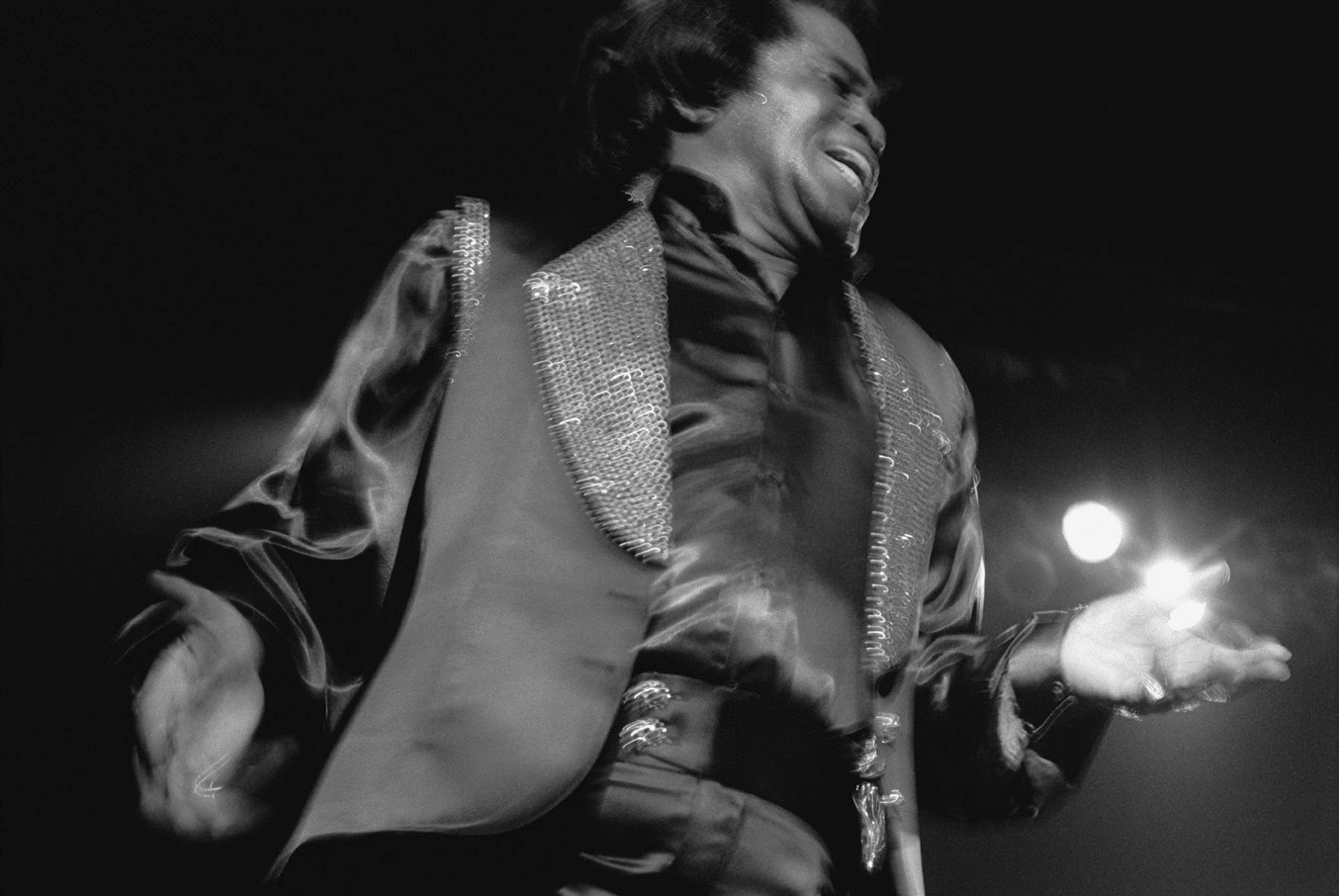
James Brown1960s–70s · Funk / Soul / Rhythm and blues
Czukay, Can's bassist, pointed to a very specific debt when asked about his own playing: "My bass playing was influenced by [James Brown sideman] Bootsy Collins, but I couldn't play that way," he said, naming the young funk innovator who anchored Brown's early-1970s backing band, the JB's. Guitarist Michael Karoli carried the same record collection into the group, drawn to Otis Redding and James Brown before Can existed at all, and drummer Jaki Liebezeit named Brown's own drummer, Clyde Stubblefield, among his touchstones. Funk arrived at Can through three separate turntables, not one.
listen: upstream & here
1970
Super Bad (Parts 1 & 2)James Brown
1970
Mother SkyCan
listen for"Super Bad" rides on Bootsy Collins's elastic, syncopated bassline — a part that pulls against the beat rather than anchoring it, leaving space for the horns to stab around it. "Mother Sky" borrows that same principle without horns: Czukay's bass locks into an eighteen-minute, endlessly repeating pattern that never resolves, daring Liebezeit's drums and Michael Karoli's guitar to build tension against it instead of riding on top. Neither track needs a chord change — the bass alone is the architecture.