walking upstream…
Thomas A. Dorsey


Thomas A. Dorsey
Thomas Andrew Dorsey was born in 1899 in rural Georgia to a Baptist minister and a pianist, moved to Chicago at fifteen, and spent his twenties playing rent parties and backing blues singers, eventually directing Ma Rainey's touring band and co-writing the million-selling hokum hit "It's Tight Like That." Converted in 1928, he kept one foot in church and one in the nightclub until August 1932, when his wife Nettie died in childbirth and their infant son died two days later. At a piano some nights after, he said, "my hands began to browse over the keys," and out came "Take My Hand, Precious Lord." He spent the rest of his life building gospel's institutions — a publishing house, a national association of choirs — on the blues craft he'd already mastered. Every gospel-trained soul singer since has worked in a language he built out of grief and rhythm both.
the sound in question
1932
Take My Hand, Precious LordThomas A. Dorsey
walk the tributaries ↓
Ma Rainey1920s · Blues / Classic female blues / Vaudeville
In 1924, Dorsey took the job that made him a professional musician: director of Ma Rainey's Wild Cats Jazz Band, assembling players who could read an arrangement and still sound like the street. He never forgot the sight of her working a room — "when she started singing, the gold in her teeth would sparkle," he wrote in his memoir. "She was in the spotlight." Blues singer Victoria Spivey put a finer point on it: "ain't nobody in the world been able to holler 'Hey Boweevil' like her." Two years behind that holler taught Dorsey what a voice could do to a room before he ever wrote a hymn.
listen: upstream & heresource: Biography.com — Ma Rainey (Dorsey's Wild Cats Jazz Band directorship; his 'gold in her teeth' quote; Victoria Spivey on Rainey's holler) ↗
1923
Bo-Weevil BluesMa Rainey
1926
If You See My SaviorThomas A. Dorsey
listen forOn "Bo-Weevil Blues," Rainey's voice does the bending — she leans into a line, lets a note sag and catch before landing on the beat, the piano keeping time underneath while she does the expressive work. "If You See My Savior," the gospel-blues song Dorsey wrote during these same touring years, carries the same vocal shape into church language: a lead voice worrying a phrase, sliding around the pitch center rather than hitting it square, over a rhythm section built from the same blues logic Rainey's band ran on. The moan survives the move from heartbreak to salvation intact.
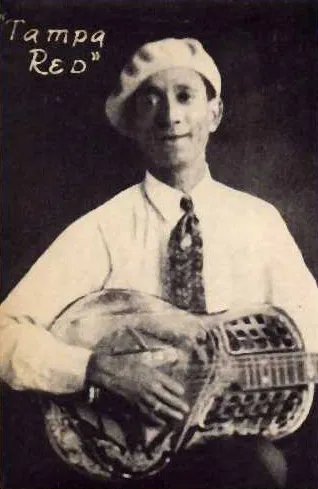
Tampa Red1930s · Chicago blues / Hokum / Blues
Tampa Red and Dorsey had already crossed paths in Ma Rainey's backing band when, in 1928, they cut a song overnight for a label boss impatient for a hit. "It's Tight Like That" — Tampa Red's guitar and Dorsey's piano trading a tight, joke-timed groove — became "a national hit" that the two turned into a running franchise, "eventually collaborating on 60 songs between 1928 and 1932." The duo coined a name for what they'd built, hokum, and Dorsey learned exactly how to make a simple, danceable arrangement land with a room — a skill he'd apply five years later to a different kind of song.
listen: upstream & heresource: New Georgia Encyclopedia — Tampa Red (Whittaker) ('It's Tight Like That' partnership; hokum style; guitar technique) ↗
1928
It's Tight Like ThatTampa Red
1937
(There'll Be) Peace in the ValleyThomas A. Dorsey
listen for"It's Tight Like That" runs on the push and pull between Tampa Red's clipped, single-string guitar answers and Dorsey's rolling piano, the two trading short phrases back and forth like a conversation that never stops moving. "(There'll Be) Peace in the Valley" keeps that same call-and-response architecture — a lead line stated, then answered — but swaps the guitar's wisecracks for a congregation's response and the racy punchline for a promise of rest. The tightness Dorsey and Tampa Red built for laughs became, in gospel's hands, a structure built for comfort.
Charles Albert Tindley1900s–20s · Gospel / Hymnody
Before Dorsey, there was Charles Tindley, a self-taught Philadelphia pastor with an 8,000-volume library who wrote hymns for a congregation living through real hardship. Scholars trace a direct line from him to the gospel generation that followed: Tindley, "often called the 'father of gospel music,' influenced the next generation of composers including... Thomas A. Dorsey." The debt is specific, not general — one hymn history notes that Dorsey's own signature composition "built upon the earlier gospel song tradition of Charles Tindley." Dorsey took Tindley's model of a hymn built for a struggling congregation and ran blues phrasing through it.
listen: upstream & here
1916
Leave It ThereCharles Albert Tindley
1932
Take My Hand, Precious LordThomas A. Dorsey
listen forTindley's refrain in "Leave It There" states its comfort plainly — "leave it there, leave it there, take your burden to the Lord and leave it there" — a melody built for a room of voices to answer together, no ornamentation required. "Take My Hand, Precious Lord" keeps that same congregational refrain structure — a repeated line simple enough for anyone to join — but stretches the melody with blues-inflected slides and pauses that Tindley's hymn doesn't use, the same instinct for a communal, singable comfort now carrying Dorsey's own grief inside it.