walking upstream…
James Cleveland

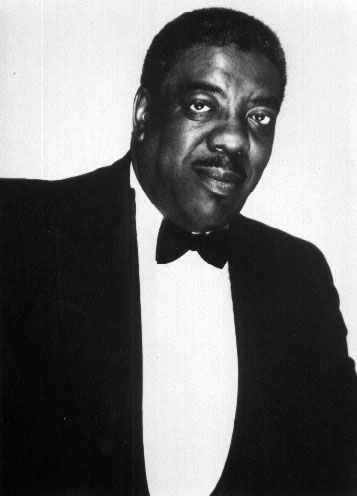
Chicago, the early 1930s — sources disagree on the exact year: a boy soprano makes his solo debut at Pilgrim Baptist Church, where the minister of music is teaching the congregation a startling new hybrid of blues and hymn he calls "gospel." James Cleveland had no piano at home, so he learned by ear on a windowsill, practicing until a strained teenage voice left him with the gravel that would define his sound. He turned that limit into a career: composing, arranging, and eventually directing mass choirs rather than carrying a lead himself. He wrote his first published song at seventeen, played piano behind the Caravans, coached a young Aretha Franklin through her first chords, and by 1963 his own "Peace Be Still" had sold a million copies. In 1968 he founded the Gospel Music Workshop of America to formalize what Chicago's gospel pioneers had only modeled for him.
the sound in question
1960
The Love of GodJames Cleveland
walk the tributaries ↓
Thomas A. Dorsey1930s · Gospel / Blues
Cleveland was eight when he made his solo debut in the Pilgrim Baptist Church choir, where Thomas A. Dorsey — the "father of gospel music" — was minister of music, fusing blues and jazz phrasing into hymns for the first time. Cleveland grew up inside that fusion and, by 1960, had pushed it further into what gospel historian Anthony Heilbut called "sheer funkiness." Decades later, launching his own Gospel Music Workshop of America, Cleveland measured himself against his mentor: "There is no basic difference between the Gospel Music Workshop and Reverend Dorsey's group," he said — though Dorsey's, he added, "did not have the workshop aspect of teaching."
listen: upstream & here
1932
Take My Hand, Precious LordThomas A. Dorsey
1973
Lord, Help Me to Hold OutJames Cleveland
listen forDorsey's "Take My Hand, Precious Lord" is barely more than a prayer set to a slow blues walk — no ornament, just a voice asking to be led. Cleveland's "Lord, Help Me to Hold Out," four decades later, keeps that plainspoken shape even with a full choir answering behind him: scholar Horace Boyer noted that, like Dorsey, Cleveland "wrote and sang in the everyday language of his audiences, dealing with such common subjects as paying rent and buying food." Listen for that same unadorned, first-person plea holding the center of both records.
Roberta Martin1950s-60s · Gospel
Cleveland's family couldn't afford a piano, so he taught himself on a windowsill, treating its "wedges and crevices" as black and white keys — copying, note for note, the woman he watched play every Sunday from the pews of Pilgrim Baptist Church. "And, baby, I played just like Roberta," he told his biographer Anthony Heilbut. "By the time I was in high school, I was some jazz pianist." Martin didn't just teach him touch: in 1948 she began buying his songs outright for her publishing house, a flat forty dollars a title, starting with the teenage Cleveland's first hit, "Grace Is Sufficient."
listen: upstream & heresource: The Village Voice — Black Music ↗
1949
Only a LookRoberta Martin
1963
Peace Be StillJames Cleveland
listen forOn "Only a Look," Martin's piano carries the whole architecture — a spare, hymn-steady left hand building underneath the voices until the group's harmony blooms open on the refrain. Cleveland absorbed that architecture at her elbow and scaled it to a full choir: on "Peace Be Still," scholar Horace Boyer wrote, Cleveland "half croons, half preaches the verse, shifting to a musical sermon at the refrain," while the Angelic Choir repeats a single phrase behind him. Listen for the same piano-anchored climb from restraint to release in both records.
Mahalia Jackson1950s · Gospel / Spiritual
Jackson's house sat on Cleveland's paper route, and as a boy he lingered at her beauty shop to hear her hum hymns while she worked — a scene his biographers return to again and again. The debt became literal work: when Mildred Falls, Jackson's regular accompanist, fell ill, the young pianist filled in on tour, playing behind the voice Chicago already called the Queen of Gospel. "Influenced by gospel songstresses Mahalia Jackson," one encyclopedia entry on Cleveland records, "... Cleveland began performing and composing regularly while still in his teens."
listen: upstream & heresource: Perfect Sound Forever — Reverend James Cleveland ↗
1947
Amazing GraceMahalia Jackson
1972
Precious MemoriesJames Cleveland
listen forJackson's 1947 "Amazing Grace" is essentially solo — voice and organ, the hymn stretched and worried until it becomes something closer to sermon than song. Twenty-five years later, as musical director of Aretha Franklin's Amazing Grace album, Cleveland built "Precious Memories" on the same principle at scale: a hushed verse that opens, without warning, into the full voice of a live congregation and choir. Listen for that same unaccompanied-into-full-voice release Jackson pioneered on record, now multiplied by an entire church behind the lead.