walking upstream…
Tampa Red
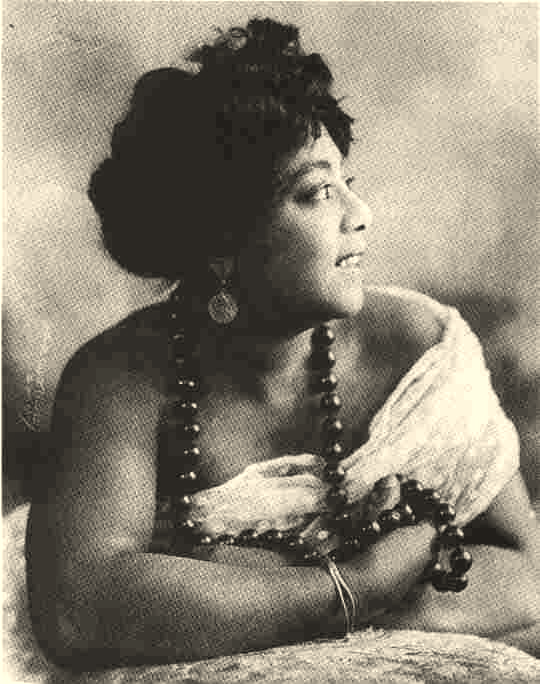
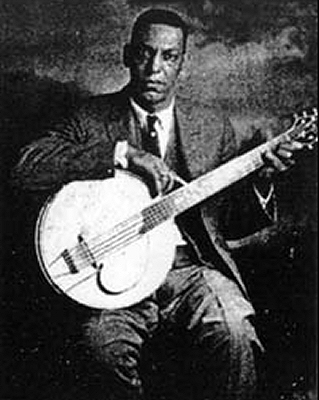

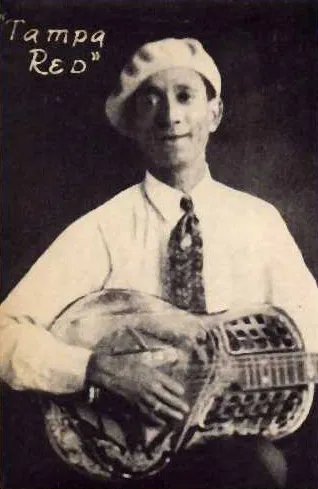
Hudson Whittaker took the stage name Tampa Red from a city he passed through as a boy; Chicago blues fans nicknamed him "the Guitar Wizard" for his clean, single-string bottleneck sound. His brother Eddie kept a guitar at home and a street player named Piccolo Pete showed him licks, but blues historian Jim O'Neal's 1974-75 liner notes say Tampa Red "learned and developed his own style by himself" — fretting with a bottleneck the way Hawaiian steel players fretted with a bar. His 1928 hokum hit "It's Tight Like That," cut with pianist Georgia Tom Dorsey, sold in huge numbers, and over three decades he cut hundreds of sides that helped define Chicago's smooth, ensemble-driven blues. His songs and slide phrasing passed to Elmore James, Robert Nighthawk, and B.B. King — influence built less on who taught him than on what he decided, alone, to do with a bottle.
the sound in question
1928
It's Tight Like ThatTampa Red
walk the tributaries ↓
Mamie Smith1920s · Blues / Vaudeville / Jazz
In 1920, years before his own first session, Tampa Red heard Mamie Smith's "Crazy Blues," one of the earliest blues records ever pressed, and treated it as permission rather than a lesson. "I said to myself, 'I don't know any music, but I can play that,'" he told jazz critic Martin Williams decades later, the words reprinted in the liner notes to his Bluebird reissue. Eight years passed before Paramount put him in a studio, but the decision traces straight back to that record.
listen: upstream & heresource: Encyclopedia.com — Tampa Red, Contemporary Musicians (Mamie Smith quote, Ma Rainey recording sessions) ↗
1920
Crazy BluesMamie Smith
1928
Through Train BluesTampa Red
listen forSmith's "Crazy Blues" is a full band record — cornet, clarinet, and her own big, assertive voice riding atop her backing group, the Jazz Hounds. "Through Train Blues," the first thing Tampa Red ever put on wax, strips all of that away to just his voice and one guitar. That gap is the literal shape of "I can play that": not a band, just a man answering a record alone.
Papa Charlie Jackson1920s · Hokum blues / Country blues
When "It's Tight Like That" became 1928's runaway hit, the debt behind its music isn't Tampa Red's own testimony — no interview names a model. It's scholarship: musicologist Roberta Freund Schwartz traced the song back to Papa Charlie Jackson's 1925 "Shake That Thing," which helped launch the hokum sound Tampa Red and pianist Georgia Tom Dorsey later cashed in on. An older, competing account instead credits a "Papa Charley Jordan" song — likely a mangling of two different musicians' names — and the claims were never reconciled. Credited jointly to Dorsey's music and Tampa Red's lyrics, the song's debt may sit as much with Dorsey as with Tampa Red's guitar.
listen: upstream & heresource: KU News — Blues scholar debunks notion hokum was inauthentic (Papa Charlie Jackson / "Shake That Thing" claim) ↗
1925
Shake That ThingPapa Charlie Jackson
1928
It's Tight Like ThatTampa Red
listen forBoth records grin the same way: a bouncy, ragtime-tinged shuffle under a wink-nudge title daring you to guess what it means. Jackson strums his banjo-guitar in that rolling, dance-hall pulse on "Shake That Thing"; three years later "It's Tight Like That" answers with the same bright bounce and the same comic innuendo, Tampa Red's guitar and Dorsey's piano trading the load where Jackson worked alone.
Ma Rainey1920s · Blues / Classic female blues / Vaudeville
Before he was "Tampa Red," he was a day laborer playing guitar on street corners, hoping to be noticed — and Ma Rainey noticed him. Hiring him as her accompanist was the break that got him off the corner, and it was through that job that he met pianist Georgia Tom Dorsey, his future partner on "It's Tight Like That." The relationship is on record, literally: a discography credit from the reissue label Document Records lists Tampa Red on guitar behind Rainey's own vocal on "Sweet Rough Man," cut in 1928, the same year his own career took off.
listen: upstream & heresource: New Georgia Encyclopedia — Tampa Red (Whittaker) (Ma Rainey career break, meeting Georgia Tom Dorsey, downstream covers) ↗
1928
Sweet Rough ManMa Rainey
listen forListen for the guitar working behind Rainey's own big, unhurried voice: spare, syncopated fills that leave room around her phrasing instead of crowding it — the same instinct for space he'd carry once records had his own name on the label instead of hers. There's no separate answer record to play against it; the influence here is the sound of Tampa Red's own hands, still learning the job, on someone else's session.