walking upstream…
Elmore James
Elmore James
sourcesRock & Roll Hall of Fame — Elmore James inductee page (career summary, 1992 induction) · Mojohand — Elmore James biography (corroborates the Robert Johnson touring connection) · Wikipedia — Elmore James (lead; citation trail to Robert Palmer's Deep Blues for the Johnson/Arnold/Tampa Red influence list)
Elmore James built his first instrument as a boy in Richland, Mississippi — a wire stretched over a lard can — and by the time he cut "Dust My Broom" in Jackson in August 1951, he'd turned that homemade buzz into the loudest slide guitar in the blues. The record, an electrified rework of a Robert Johnson song James had learned playing alongside Johnson himself a decade earlier, became a surprise national R&B hit and gave him his band, the Broomdusters, and his nickname, "King of the Slide Guitar." He spent the next decade cutting for Chess, Meteor, and Bobby Robinson's Fire label, piling up "The Sky Is Crying" and "It Hurts Me Too" before a bad heart killed him in Chicago in 1963, days before a scheduled European tour. The riff outlived him: a generation of rock guitarists spent the next decade chasing that same raw, amplified slide.
the sound in question
1951
Dust My BroomElmore James
walk the tributaries ↓
Robert Johnson1930s · Delta blues / Blues
James was still a teenager when he fell in with Robert Johnson on the juke-joint and radio circuit around Belzoni, Mississippi, in the late 1930s, the two of them documented playing together alongside harmonica player Sonny Boy Williamson II. The debt showed up in everything James recorded afterward: his breakthrough single was an electrified reworking of Johnson's own "Dust My Broom," and the Mississippi Blues Trail's historical marker for James states it outright — "Johnson's boogie bass runs and slide guitar style were integral to James' approach to the guitar."
listen: upstream & heresource: Mississippi Blues Trail — Elmore James historical marker (biography, Robert Johnson/Belzoni connection) ↗
1936
Cross Road BluesRobert Johnson
1954
Standing at the CrossroadsElmore James
listen forJohnson's 1936 "Cross Road Blues" is one guitar and one voice, the slide answering each vocal line in a tight, unhurried conversation, nothing between the two but silence. James's own "Standing at the Crossroads" borrows Johnson's crossroads image directly and drops it over the amplified, droning riff he built his whole career on — the same call-and-response shape, blown up to full band and full volume, the guitar now shouting back instead of murmuring.
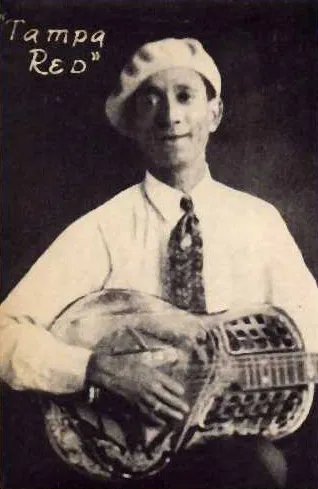
Tampa Red1930s · Chicago blues / Hokum / Blues
By the time James reached Chicago, Tampa Red had already spent two decades defining the city's prewar slide sound — sharp single-string runs where older Delta players used block chords — and James absorbed the debt directly: two of Tampa Red's own musicians, pianist "Little" Johnny Jones and drummer Odie Payne, joined his band, the Broomdusters. James also took one of Tampa Red's own songs outright. The Blues Foundation, inducting the 1940 original, praised how it showed "the blues can be an expression of empathy and tenderness" on the line "when things go wrong, go wrong with you, it hurts me too."
listen: upstream & heresource: The Blues Foundation — 2012 Hall of Fame Inductees ↗
1940
It Hurts Me TooTampa Red
1957
It Hurts Me TooElmore James
listen forTampa Red's 1940 "It Hurts Me Too" is spare and almost polite — his slide answers his own vocal in short, melodic phrases, with a kazoo solo standing in for a horn. James's 1957 version keeps Tampa Red's tune and structure intact but pushes everything louder: the same slide line comes back distorted and stretched thin, his vocal rougher, the whole arrangement scaled up from parlor blues to bar-band blues.
Kokomo Arnold1930s · Blues / Chicago blues
No recorded meeting or interview ties Elmore James to Kokomo Arnold directly, and the clearest evidence is a phrase, not a lesson. Arnold's 1934 "Sagefield Woman Blues" is where the words "dust my broom" first appear on record — a blues-history site notes plainly that "the line 'Dust my Broom' is from his 'Sagefield Woman Blues.'" Robert Johnson borrowed the phrase for his own 1936 song title, and James's electrified version of that title, cut in 1951, became the record he's remembered for. Wikipedia's citation trail, via Robert Palmer's "Deep Blues," lists Arnold directly among James's influences, though the book's own wording remains unverified.
listen: upstream & heresource: All About Blues Music — Kokomo Arnold biography (backs the "dust my broom" phrase origin) ↗
1934
Sagefield Woman BluesKokomo Arnold
1951
Dust My BroomElmore James
listen forArnold's 1934 "Sagefield Woman Blues" is loose, ragtime-inflected picking behind a plainspoken vocal — nothing like a rock riff yet. What carries forward isn't the sound but the words: "dust my broom" passed from Arnold's lyric into Johnson's song title, then into James's own 1951 "Dust My Broom," the tumbling slide riff that became his signature. The three records share almost nothing sonically except that one phrase and the title it grew into.