walking upstream…
Albert King


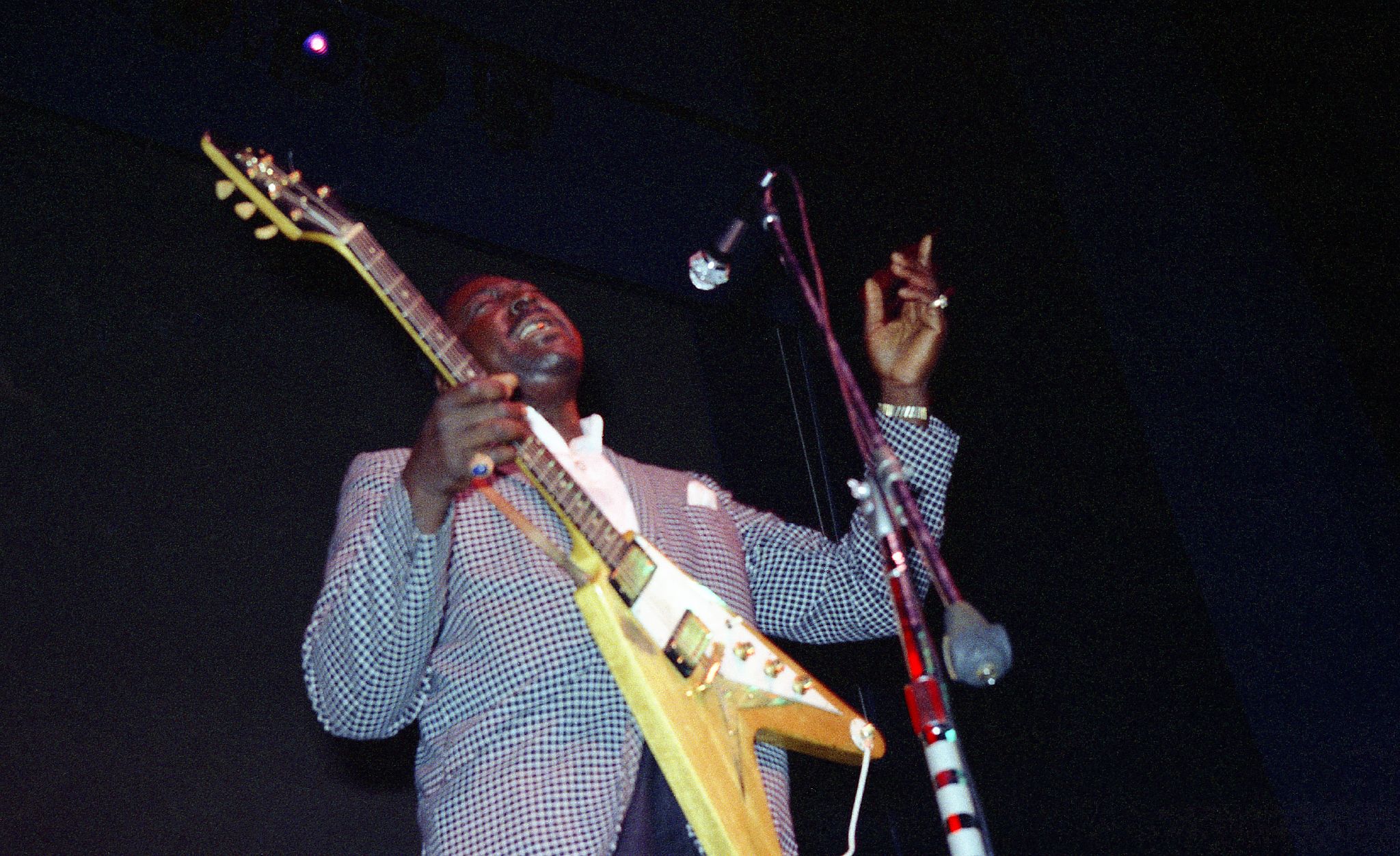 photo: grant gouldon · cc by-sa 2.0 ↗
Albert King
sourcesuDiscover Music
Born in Mississippi and raised in Arkansas, Albert King was a self-taught, left-handed guitarist who played a standard right-handed Gibson Flying V upside down, producing the wide, vocal-like string bends that became his signature. Signed to Stax Records in 1966, he paired his stinging lead lines with the label's house band on Born Under a Bad Sign (1967), an album whose title track and "Crosscut Saw" would go on to shape a generation of blues-rock guitarists. One of the so-called "Three Kings" of electric blues alongside B.B. King and Freddie King (no relation to either), he remained a commanding live presence into the early 1990s.
the sound in question
1967
Born Under a Bad SignAlbert King
walk the tributaries ↓
T-Bone Walker1940s · Jump blues / Electric blues / West Coast blues
King said it himself: after slide guitar and "a couple more people," Walker was the one who "did it" — the decisive jolt that pointed King toward electric, single-note lead lines played with a horn-like, vocal phrasing rather than chordal rhythm playing.
listen: upstream & heresource: King on Elmore James' slide guitar and "then along came T-Bone Walker, and that did it" (Guitar World) ↗
1947
Call It Stormy Monday (But Tuesday Is Just as Bad)T-Bone Walker
1966
Crosscut SawAlbert King
listen forSmooth, confident single-string lead lines that bend and slide the way a horn section would, rather than strummed chords.
Elmore James1950s · Chicago blues / Electric blues / Delta blues
King named Elmore James' slide playing directly as something he studied early on in Osceola, Arkansas; though King himself never played slide, the raw intensity and forward drive of James' guitar carried over into King's own aggressive, hard-bent attack.
listen: upstream & heresource: King on Elmore James' slide guitar and "then along came T-Bone Walker, and that did it" (Guitar World) ↗
1951
Dust My BroomElmore James
1967
As the Years Go Passing ByAlbert King
listen forA hard-driving, insistent guitar pulse under the vocal, with an overdriven, biting tone even on a note that isn't slid.
Blind Lemon Jefferson1920s · Texas blues / Country blues
Multiple accounts of King's early years describe him being pointed toward the blues after hearing Blind Lemon Jefferson (alongside Lonnie Johnson); Jefferson's loose, conversational back-and-forth between voice and guitar shows up in how King's guitar answers his own vocal lines like a second voice.
listen: upstream & heresource: Encyclopedia of Arkansas ↗
1927
Matchbox BluesBlind Lemon Jefferson
1967
Oh, Pretty WomanAlbert King
listen forThe guitar answering the vocal line phrase by phrase, almost like a conversation, rather than just backing it.