walking upstream…
The Shangri-Las


In the fall of 1963, at Andrew Jackson High School in the Cambria Heights section of Queens, two sets of sisters -- Mary and Betty Weiss, and twins Marge and Mary Ann Ganser -- started singing together on the playground and settled on a name lifted from a restaurant sign passed on a Long Island drive. Within a year they'd met producer George "Shadow" Morton, who arrived at a demo session in a cape and dark glasses chasing Phil Spector's orchestral scale, and signed to the Brill Building label Red Bird. Mary Weiss, fifteen and already road-hardened, turned Morton's radio-play melodramas into something closer to acting than singing. Before any of that, there was the sound she'd absorbed as a child -- doo-wop's spoken bridges and rock and roll's close harmony -- reassembled into pop's most convincing teenage tragedies.
the sound in question
1964
Leader of the PackThe Shangri-Las
walk the tributaries ↓
The Ink Spots1930s–40s · Vocal harmony / Traditional pop
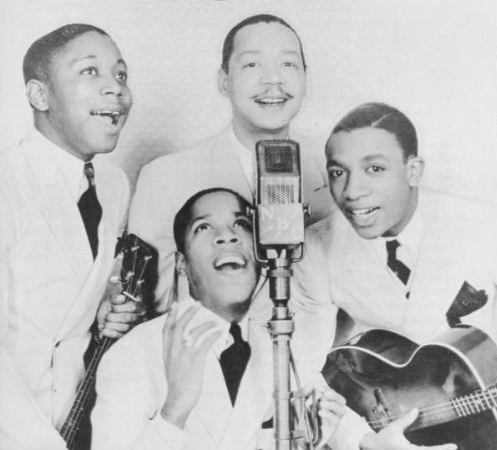
Asked what first drew her to music, Weiss didn't reach for a rock and roll name. "When I was a kid, I loved the Ink Spots," she told interviewer Miriam Linna in 2006, ahead of the Everly Brothers or Neil Sedaka. She'd have grown up on the group's "top and bottom" format -- tenor Bill Kenny's soaring lead handed to bass singer Hoppy Jones, who spoke the same lyric underneath. By 1966 Weiss pushed that handoff to its limit: "Past, Present and Future" isn't a song with a spoken bridge, it's nothing but the bridge, a girl reciting her own heartbreak while the band never lets her sing a note.
listen: upstream & heresource: Norton Records — Remembering Mary Weiss (Mary Weiss's own testimony on the Ink Spots, the Everly Brothers, and Shadow Morton) ↗
1939
If I Didn't CareThe Ink Spots
1966
Past, Present and FutureThe Shangri-Las
listen forOn "If I Didn't Care," listen for the moment Hoppy Jones's bass voice drops beneath Bill Kenny's fading tenor and simply speaks the closing verse -- the song stops singing to make its point. "Past, Present and Future" takes that same move and never lets the singing start back up: Mary Weiss recites the entire track in a flat, wounded deadpan against a lone piano and strings, no chorus, no hook, just a girl talking herself through what happened to her. The device is identical; the Shangri-Las simply removed the melody it once interrupted.
The Everly Brothers1950s · Rock and roll / Country / Pop
The only rock and roll show Mary Weiss attended as a schoolgirl was a class trip to Freedomland, a Bronx amusement park, where the bill included the Everly Brothers. "They did so much for everybody regarding harmony," she told the reissue label Norton Records decades later -- the one specific, technical compliment she pays any artist in that interview. The Shangri-Las never sang note-for-note close harmony the way the Everlys did, but the four girls built their records around blended, overlapping vocal lines, and Weiss named the brothers, alongside the Ink Spots, as a formative influence from her pre-teen years.
listen: upstream & heresource: Norton Records — Remembering Mary Weiss (Mary Weiss's own testimony on the Ink Spots, the Everly Brothers, and Shadow Morton) ↗
1958
All I Have to Do Is DreamThe Everly Brothers
1964
Remember (Walkin' in the Sand)The Shangri-Las
listen forDon and Phil Everly stack their voices so evenly on "All I Have to Do Is Dream" that the harmony reads as a single instrument, not two brothers trading lines -- the blend Weiss praised as their gift to "everybody." "Remember (Walkin' in the Sand)" works the same trick in a wilder setting: under producer Shadow Morton's seagull effects and shifting tempos, the Shangri-Las still lock their voices into a tight, wordless "oh, no, no, no" behind Weiss's lead, that four-part blend holding the record together while everything around it swings and crashes.
The Chantels1950s · Doo-wop / Girl group / R&B
When the Shangri-Las assembled their 1965 debut LP Leader of the Pack, they didn't write a song to fill out side two -- they covered one: the Chantels' 1957 single "Maybe," with Betty Weiss taking the lead her sister usually held. Chantels lead singer Arlene Smith wrote and sang the original at sixteen, a record Rolling Stone later called "a template for a generation of girl groups," and the Vocal Group Hall of Fame credits the Chantels' "choir-like sound and close-knit harmony" with bringing "a new dimension to rock and roll and R&B." This wasn't homage by suggestion -- it was Betty Weiss singing the Chantels' own words.
listen: upstream & heresource: Rolling Stone — 500 Greatest Songs of All Time ↗
1957
MaybeThe Chantels
1965
MaybeThe Shangri-Las
listen forArlene Smith's original "Maybe" opens cold, her voice cracking on the title word before the group's close harmony rises behind her like a held breath -- a fragile, churchy blend built from years of choir practice at their Bronx Catholic school. Betty Weiss's cover keeps that same vulnerable, held-back opening, letting the tension sit before the harmony fills in behind her. It's the clearest evidence anywhere in the Shangri-Las' catalog of which older girl group they were listening to, note for note.