walking upstream…
Slick Rick


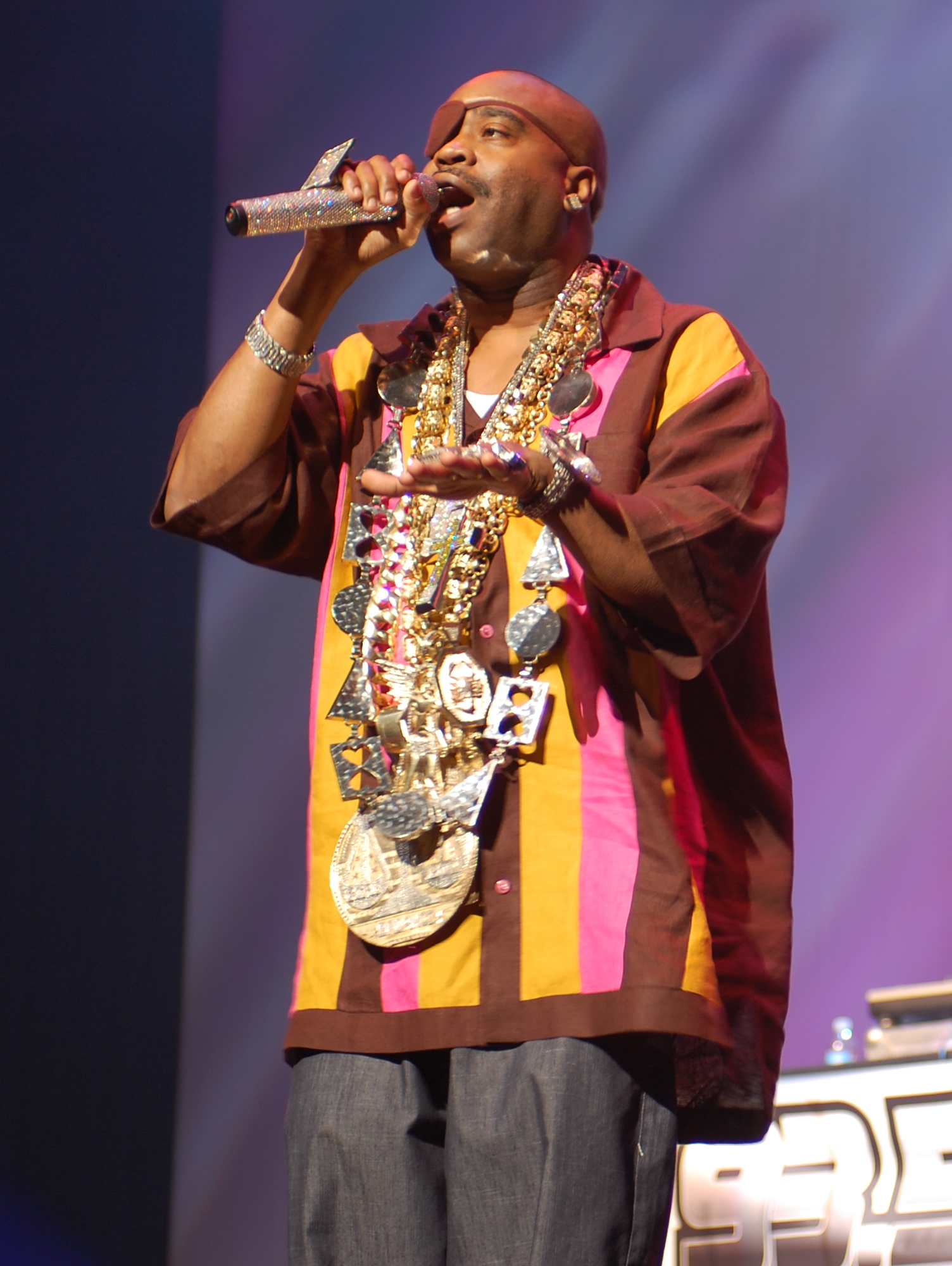 photo: brett hammond · cc by 2.0 ↗
Slick Rick
Ricky Walters lost sight in his right eye to a shard of glass before he was two, growing up in Mitcham, near London, then landing in the Bronx at eleven, in 1976, just as hip-hop was becoming a block-party religion. He and a schoolmate, Dana Dane, built a crew out of nothing but a desk to bang on and a story to tell — the Kangol Crew. Doug E. Fresh, the beatboxing kid he'd once bothered at a skating rink, made him MC Ricky D; their 1985 beatbox-and-rap b-side, "La Di Da Di," became one of hip-hop's most sampled records. As Slick Rick, "The Ruler," he wrote every word of 1988's The Great Adventures of Slick Rick himself, spinning cinematic, multi-character fables — Mona Lisa, "Children's Story" — in an unhurried, half-sung cadence that made storytelling itself hip-hop's signature move.
the sound in question
1988
Children's StorySlick Rick
walk the tributaries ↓
Cold Crush Brothers1980s · Hip-hop / Old-school hip-hop
Ask Rick who shaped him and the answer comes without hesitation: "The Cold Crush Brothers inspired me the most, cuz they had good routines, and they picked good records to rhyme on," he told Red Bull Music Academy — a Bronx crew whose choreographed group routines and ear for a dope beat he named, unprompted, across three separate interviews spanning a decade. He credits them for schooling him in staged, crowd-drilled performance before he'd written a bar of his own.
listen: upstream & heresource: Red Bull Music Academy Daily — "5x5 ↗
1983
Punk Rock RapCold Crush Brothers
1991
The Ruler's BackSlick Rick
listen forCold Crush Brothers' "Punk Rock Rap" is pure crew choreography — call-and-response bars, timed pauses, a group working a crowd like a drill team. None of that ensemble structure survives intact in Rick's solo work, but the confidence does: on "The Ruler's Back," his unhurried, self-assured cadence — the sense that every line has already been rehearsed and won — is that same crowd-drilled showmanship, filtered down to one voice.
Melle Mel1980s · Hip hop / Old-school hip hop
Rick says his storytelling method came from high school English class — introduction, body, conclusion — and when he needs a real-world example, he reaches for one song by name: "even 'The Message,' Melle Mel's 'Don't push me cuz I'm close to the edge,' or whatever — you know which one I'm talking about," he told Red Bull Music Academy. It's Melle Mel's own line, cited by Rick as his model for the clean, cautionary arc he built his own narratives around.
listen: upstream & heresource: Red Bull Music Academy Daily — "5x5 ↗
1982
The MessageMelle Mel
1988
Hey Young WorldSlick Rick
listen for"The Message" moves in exactly the three acts Rick describes: a bleak scene-setting verse, an escalating middle, then Melle Mel's blunt, oft-quoted warning landing like a punchline. "Hey Young World" borrows that shape wholesale — Rick opens on the block, builds his case verse by verse, then closes not with a story twist but a direct, spoken-to-the-listener lesson: the essay's conclusion, delivered as a chorus.
Busy Bee1980s · Hip-hop / Old-school hip-hop
Rick names Busy Bee in the same breath as Cold Crush Brothers as a formative Bronx influence, and what he remembers isn't a lyric but a sound: "I'd have to say Busy Bee was one, you know, with his 'Bah-diddy-bah-do-bang-do-bang,'" he told Red Bull Music Academy — a nonsense chant-hook he can still recite from memory decades later, proof of how deep a showman's catchphrase can lodge in a kid's ear.
listen: upstream & heresource: Red Bull Music Academy Daily — "5x5 ↗
1982
Making Cash MoneyBusy Bee
1988
Mona LisaSlick Rick
listen forBusy Bee's "Making Cash Money" is built almost entirely on that chant — a hook with no real lyrical content, just rhythm and personality, aimed at working a room. "Mona Lisa" takes the same crowd-pleasing instinct for a vocal hook and gives it an actual character: Rick doesn't just chant at his listener, he performs a whole flirtatious voice for the record's title woman, turning Busy Bee's wordless showmanship into scripted personality.