walking upstream…
Roger Troutman

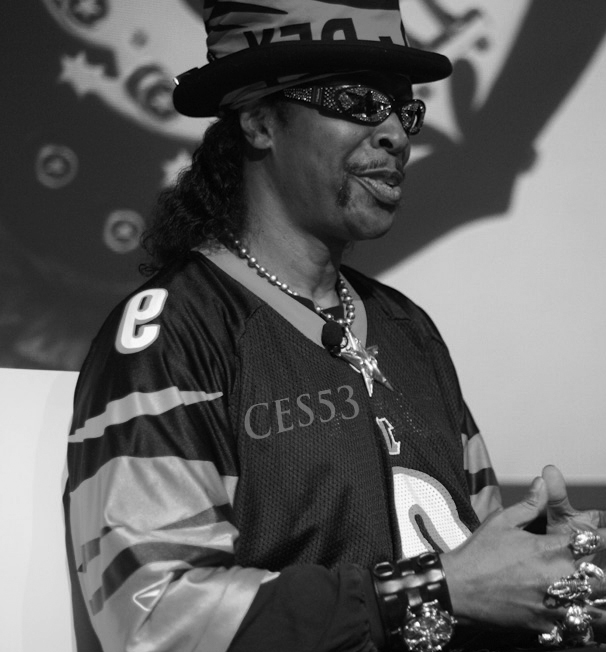

Roger Troutman
Roger Troutman grew up one of ten children in a two-bedroom house in Hamilton, Ohio, learning guitar, bass, and keys in a garage studio his father built so the family band wouldn't shake the walls. Bootsy Collins caught him at a Cincinnati club in the 1970s, and George Clinton later renamed the group Zapp and pushed "More Bounce to the Ounce" to Warner Bros. — the start of a Parliament-Funkadelic-adjacent run built on Roger's talk box, which turned his voice into a synthesizer years before Auto-Tune existed. Zapp and Roger's catalog became one of hip-hop's most sampled foundations, carrying his processed vocal into a generation of West Coast records. In 1999 Roger was shot and killed by his brother Larry in a murder-suicide behind the family's studio, cutting short a career built on turning gear into a voice.
the sound in question
1985
Computer LoveRoger Troutman
walk the tributaries ↓
George Clinton1970s · Funk / Psychedelic soul / R&B
In 1979, running two bands at once, George Clinton pulled Roger Troutman aside with a proposal: take "More Bounce to the Ounce" to Warner Bros. under a new name, so it wouldn't compete with his own Parliament and Funkadelic. "He said, 'I've got Parliament, I've got Funkadelic, I've got two groups,'" Troutman recalled in 1996 — and it was his brother Terry's nickname, standing nearby, that became the band's name. Zapp's debut carried Parliament-Funkadelic's synth-bass swagger, and Troutman never buried the debt, naming Funkadelic's "(Not Just) Knee Deep" as a song he still wanted to cover.
listen: upstream & heresource: Funk-U Magazine & P-VIEWS — 1996 interview with Roger Troutman (George Clinton and Bootsy Collins origin stories, talk-box lineage including Peter Frampton, in his own words) ↗
1979
(Not Just) Knee DeepGeorge Clinton
1980
More Bounce to the OunceRoger Troutman
listen forBoth tracks ride a single vamp instead of a chord progression: Funkadelic stretch "Knee Deep" past fifteen minutes on a two-chord loop, and Zapp's "More Bounce" locks onto one popping bassline for its entire run, the exact hypnosis Troutman was chasing when he took the song to Clinton. Neither song builds toward a chorus — listen for how each one just deepens the groove instead, opening space for Roger's talk box to needle through the loop rather than sing over it.
Bootsy Collins1970s · Funk / Psychedelic soul / R&B
Bootsy Collins caught Roger Troutman playing a Cincinnati club as a teenager, sent word through his brother, guitarist Phelps "Catfish" Collins, and pulled him to Detroit to record at Parliament-Funkadelic's home base. Years later Bootsy handed him something stranger than a break: one of the first guitar synthesizers ever built, a machine he'd bought and couldn't get a sound out of. "He gave it to me as a gift," Troutman said in 1996, "so I took it, I worked it & I wrote this song about it." The song was "Maxx Axe" — the gift turned into an instrument, not a souvenir.
listen: upstream & heresource: Funk-U Magazine & P-VIEWS — 1996 interview with Roger Troutman (George Clinton and Bootsy Collins origin stories, talk-box lineage including Peter Frampton, in his own words) ↗
1978
BootzillaBootsy Collins
1981
Maxx AxeRoger Troutman
listen for"Bootzilla" opens with Bootsy's own voice pitched down into a cartoon-robot growl before the bass drops in, gear standing in for a second vocalist. "Maxx Axe" answers with the actual gifted machine: Troutman's guitar synthesizer bends and sustains through the whole track, doing for six strings what Bootsy's studio voice tricks did for singing. Listen for how both records treat borrowed or broken equipment as a character worth building a song around, not a novelty buried in the mix.
Peter Frampton1970s · Rock / Pop rock
Before Zapp had a hit record, Roger Troutman was already running a talk box through nightclub cover sets, chasing an effect he'd first clocked from other players. "I had heard it with Peter Frampton and a couple of other artists," he told Donnie Simpson on the BET program Video Soul in 1987, as later reported by the outlet The Root, "and I would use it before we had hit records playing in nightclubs doing cover songs." In a 1996 interview he named the device's whole lineage — "made famous by Joe Walsh... and by Peter Frampton" — before landing on his own name for it: "an African robot."
listen: upstream & heresource: Funk-U Magazine & P-VIEWS — 1996 interview with Roger Troutman (George Clinton and Bootsy Collins origin stories, talk-box lineage including Peter Frampton, in his own words) ↗
1976
Show Me the WayPeter Frampton
1987
I Want to Be Your ManRoger Troutman
listen forFrampton sings a plain, spoken-sounding line straight through the tube partway into the live "Show Me the Way," the talk box working as a second voice inside a ballad rather than a showcase gimmick. Troutman takes that same slow-tempo use further: "I Want to Be Your Man" is a full love song sung entirely through the talk box, stretching the one moment Frampton borrowed it for into an entire lead vocal. Listen for the same thin, vowel-heavy croon shaping both.